Opinion - (2025) Volume 16, Issue 5
Received: 01-Oct-2025, Manuscript No. jfr-26-184123;
Editor assigned: 03-Oct-2025, Pre QC No. P-184123;
Reviewed: 17-Oct-2025, QC No. Q-184123;
Revised: 22-Oct-2025, Manuscript No. R-184123;
Published:
29-Oct-2025
, DOI: 10.37421/2157-7145.2025.16.684
Citation: Turner, Michael. ”Forensic Imaging: Revolutionizing
Evidence Visualization and Analysis.” J Forensic Res 16 (2025):684.
Copyright: © 2025 Turner M. This is an open-access article distributed under the terms of the Creative Commons Attribution License, which permits unrestricted use, distribution
and reproduction in any medium, provided the original author and source are credited.
The field of forensic science is undergoing a significant transformation driven by advancements in imaging technologies, offering unprecedented capabilities for detailed visualization and analysis of evidence. These sophisticated techniques are revolutionizing forensic investigations by providing non-destructive and highly detailed insights into various aspects of forensic casework. From reconstructing events to identifying remains and supporting legal proceedings, modern imaging modalities are proving indispensable in the pursuit of accurate and comprehensive forensic understanding.
Computed tomography (CT), magnetic resonance imaging (MRI), and advanced radiographic methods are at the forefront of this revolution, providing critical insights into skeletal trauma, decomposition processes, and the identification of foreign objects. These technologies surpass traditional methods in their ability to reveal minute details, thereby enhancing the investigative process. Their application is crucial for reconstructing the dynamics of incidents and ensuring accurate identification of deceased individuals, especially in challenging circumstances. Digital radiography and CT scans are increasingly being employed in postmortem examinations, particularly in cases involving suspected child abuse or severe violent trauma. These imaging modalities enable the precise localization and characterization of fractures, significantly aiding in the reconstruction of assault dynamics without the need for extensive tissue disruption. The generation of 3D reconstructions from CT data further refines the understanding of complex injuries, offering a clearer picture of the physical forces involved. The application of MRI in forensic investigations is expanding due to its exceptional soft tissue contrast capabilities. It is particularly valuable for detecting subtle internal injuries, identifying early signs of strangulation, and examining the intricate patterns of decomposition. Postmortem MRI can also reveal medical implants or ante-mortem conditions that might be overlooked during a conventional autopsy, contributing to a more complete understanding of the deceased's biological history. Radiomics, which involves the quantitative extraction of numerous features from medical images, is emerging as a potent tool in forensic science. By analyzing patterns and textures that are imperceptible to the human eye, radiomics can assist in identifying specific tissue characteristics, estimating the time since death, and even potentially differentiating between various types of trauma based on distinctive imaging signatures. This opens new avenues for objective forensic analysis. The utility of portable X-ray devices and handheld ultrasound in forensic field investigations is rapidly growing. These tools facilitate rapid, on-site assessments of skeletal abnormalities or injuries, which is especially beneficial in mass disaster scenarios or in remote locations where access to conventional imaging facilities is limited. This capability allows for preliminary triage and documentation prior to more extensive analyses. Three-dimensional printing technology, frequently integrated with CT data, is profoundly impacting forensic reconstructions. Detailed anatomical models can be generated directly from imaging scans, which is invaluable for visualizing complex fractures, planning surgical interventions for trauma victims, and creating compelling courtroom exhibits that clearly illustrate injury patterns to legal professionals and juries. Advanced imaging techniques are critical for the identification of microscopic evidence that may be linked to trauma or pathology. Modalities such as micro-CT provide high-resolution images of bone microstructure, aiding in the differentiation between ante-mortem and post-mortem fractures and enabling the analysis of fine skeletal damage details essential for determining the cause and manner of death. Virtual autopsy, leveraging CT and MRI, is becoming an indispensable tool in forensic medicine, particularly when a full conventional autopsy is not feasible or desirable. This non-invasive approach allows for comprehensive documentation of injuries, identification of disease, and evidence collection without disturbing the body, while also yielding valuable data for subsequent molecular or histological analyses. The integration of artificial intelligence (AI) and machine learning (ML) into forensic imaging analysis represents a rapidly evolving frontier. AI algorithms can automate the detection and classification of abnormalities, enhancing the speed and accuracy of analysis for large datasets and potentially identifying subtle patterns that might escape human observers, especially in cases involving degraded remains or complex evidence.The advent of advanced imaging techniques, including computed tomography (CT), magnetic resonance imaging (MRI), and sophisticated radiographic methods, is fundamentally reshaping forensic anthropology by enabling non-destructive and highly detailed visualization of evidence. These technologies are critical for providing crucial insights into skeletal trauma, decomposition patterns, and the identification of foreign objects within remains. Their application is vital for reconstructing events, identifying individuals, and bolstering the rigor of legal investigations, offering a significant advancement over traditional forensic approaches.
In postmortem examinations, digital radiography and CT imaging are increasingly relied upon for documenting skeletal injuries, particularly in sensitive cases like suspected child abuse or severe violent trauma. These modalities permit the precise localization and detailed characterization of fractures, which greatly assists in reconstructing the dynamics of assaults without causing further damage to the remains. Furthermore, the capability to generate three-dimensional reconstructions from CT data enhances the comprehension of intricate injury patterns, providing a more holistic understanding of the forces involved. The utilization of MRI in forensic investigations is expanding, primarily due to its exceptional ability to visualize soft tissues with high contrast. This makes it particularly useful for identifying internal injuries, detecting subtle indicators of strangulation, and examining the stages of decomposition. Postmortem MRI can also help identify pre-existing medical implants or conditions, offering a more comprehensive picture of the deceased's biological state than might be achievable through conventional autopsy alone. Radiomics, a burgeoning field within forensic science, involves the quantitative extraction of a vast number of features from medical images. By analyzing subtle patterns and textures within these images that are not visible to the naked eye, radiomics holds promise for characterizing tissue properties, estimating the post-mortem interval, and potentially distinguishing between different types of trauma based on unique imaging signatures. This quantitative approach introduces a new layer of analytical depth. The deployment of portable X-ray devices and handheld ultrasound in forensic field investigations is becoming more prevalent. These portable tools allow for rapid, on-site assessments of skeletal abnormalities or injuries, which is particularly advantageous in mass disaster scenarios or in geographically remote locations where access to fixed imaging facilities is impractical. This enables preliminary assessments and documentation before more in-depth analysis can be performed. Three-dimensional printing, often working in conjunction with CT scan data, is making a significant impact on forensic reconstructions. The ability to generate detailed anatomical models from imaging scans is invaluable for visualizing complex fractures, aiding in the planning of surgical interventions for trauma victims, and creating clear, illustrative courtroom exhibits for legal proceedings. Advanced imaging techniques play a crucial role in identifying microscopic evidence that might be related to trauma or pathological conditions. Methods such as micro-computed tomography (micro-CT) can produce high-resolution images of bone microstructure. This allows for the differentiation between fractures sustained before and after death, and detailed analysis of skeletal damage, which is essential for accurately determining the cause and manner of death. Virtual autopsy, a procedure that employs CT and MRI, is becoming an indispensable component of forensic medicine, especially in situations where a full conventional autopsy is either not possible or not desired. This non-invasive approach facilitates comprehensive documentation of injuries, identification of diseases, and collection of evidence without necessitating physical disturbance of the body, while also generating valuable data for further analyses. The application of dual-energy CT (DECT) in forensic imaging offers enhanced capabilities for material decomposition and contrast differentiation. This technique allows for a more precise distinction between various tissues, the identification of trace elements, and the characterization of projectiles or bullet fragments. DECT provides a more detailed analysis of both skeletal and soft tissue trauma, thereby improving the accuracy of injury interpretation and reconstruction. The integration of artificial intelligence (AI) and machine learning (ML) into the analysis of forensic imaging data is a rapidly developing and promising area. AI algorithms can automate the detection and classification of abnormalities, thereby increasing the speed and accuracy of analyzing large volumes of imaging data. This technology has the potential to identify subtle patterns that might be missed by human observers, particularly in cases involving degraded remains or complex evidentiary material.Advanced imaging techniques such as CT, MRI, and radiomics are revolutionizing forensic science by providing detailed, non-destructive visualization of evidence. These methods are crucial for analyzing skeletal trauma, decomposition, and identifying foreign objects, aiding in event reconstruction and identification. Digital radiography and CT are vital in postmortem examinations for documenting injuries and reconstructing assault dynamics. MRI offers superior soft tissue contrast for detecting internal injuries and signs of strangulation. Radiomics extracts quantitative image features to characterize tissues and estimate time of death. Portable imaging tools facilitate rapid field assessments, while 3D printing aids in creating anatomical models for reconstruction and court exhibits. Micro-CT and dual-energy CT provide high-resolution microscopic and material decomposition analyses, respectively. Virtual autopsy using CT and MRI offers a non-invasive approach to injury documentation. Artificial intelligence and machine learning are increasingly integrated to automate analysis and detect subtle patterns, enhancing the speed and accuracy of forensic imaging interpretation.
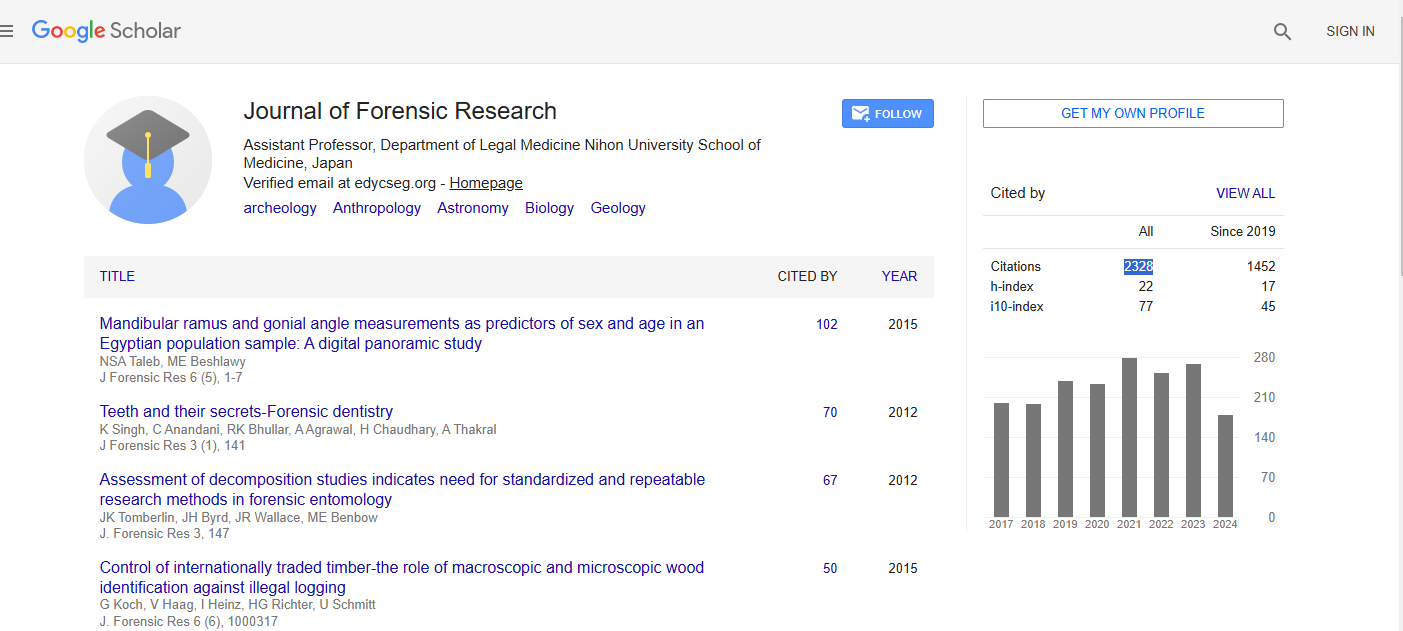
Journal of Forensic Research received 2328 citations as per Google Scholar report