Brief Report - (2025) Volume 16, Issue 6
Received: 01-Dec-2025, Manuscript No. jfr-26-184130;
Editor assigned: 03-Dec-2025, Pre QC No. P-184130;
Reviewed: 17-Dec-2025, QC No. Q-184130;
Revised: 22-Dec-2025, Manuscript No. R-184130;
Published:
29-Dec-2025
, DOI: 10.37421/2157-7145.2025.16.691
Citation: Zhang, Wei. ”Forensic Identification: Advanced Techniques
for Unidentified Remains.” J Forensic Res 16 (2025):691.
Copyright: © 2025 Zhang W. This is an open-access article distributed under the terms of the Creative Commons Attribution License, which permits unrestricted use,
distribution and reproduction in any medium, provided the original author and source are credited.
The identification of unidentified human remains presents a formidable challenge within forensic science, demanding a multifaceted approach to overcome complexities such as advanced decomposition and fragmentation [1].
Traditional methods, while foundational, often prove insufficient on their own [1].
The advent of advanced techniques has revolutionized the field, enabling more definitive identifications than ever before [1].
Among these advanced methodologies, Next-Generation Sequencing (NGS) technologies stand out for their profound impact on DNA-based identification [2].
NGS offers the capability to analyze degraded or limited DNA samples, thereby yielding more comprehensive genetic profiles [2].
This enhanced capability is particularly beneficial in kinship analysis and the identification of missing persons [2].
Complementing genetic analysis, skeletal analysis remains an indispensable component in the initial assessment of unidentified human remains [3].
Through meticulous examination of bones, crucial information regarding age, sex, stature, and ancestry can be reliably determined [3].
Conventional osteological methods continue to be refined with technological advancements [3].
When other identification methods reach their limitations, facial approximation and reconstruction techniques emerge as vital tools [4].
These methods encompass a spectrum from traditional sculpting based on skeletal morphology to sophisticated three-dimensional digital modeling and printing [4].
The accuracy of these reconstructions is inherently linked to the quality of the skeletal data and the skill of the forensic artist [4].
Isotopic analysis of bone and teeth provides a unique avenue for establishing an individual's geographic origin and migration history [5].
By analyzing stable isotope ratios, forensic investigators can reconstruct aspects of an individual's life journey, offering critical contextual clues for identification [5].
This technique is particularly valuable when integrated with other forensic disciplines [5].
Successfully managing and investigating cases of unidentified human remains hinges significantly on interdisciplinary collaboration [6].
Effective communication and coordinated efforts among law enforcement, forensic anthropologists, geneticists, dentists, and medical examiners are paramount [6].
Establishing clear protocols for evidence handling and documentation is essential for maximizing identification success [6].
The increasing volume of unidentified human remains, especially in the aftermath of mass disasters or conflicts, underscores the need for robust database management and sophisticated search strategies [7].
DNA and genealogical databases serve as critical resources for linking unknown individuals to missing persons records [7].
Postmortem changes, encompassing decomposition and taphonomic processes, profoundly influence the ability to recover and identify human remains [8].
Forensic entomology and botany contribute valuable insights by analyzing insect activity and plant colonization, helping to estimate the time since death and reconstruct circumstances [8].
The ethical and legal dimensions associated with the identification of unidentified human remains are intricate and demand careful navigation [9].
Considerations such as consent for DNA testing, data privacy, and the respectful disposition of remains are crucial aspects of the process [9].
The integration of advanced imaging technologies, including computed tomography (CT) and magnetic resonance imaging (MRI), is increasingly vital in the forensic examination of unidentified human remains [10].
These technologies are particularly beneficial in mass fatality incidents or when remains are fragmented or subjected to intense heat [10].
The identification of unidentified human remains is a complex forensic discipline, often complicated by advanced decomposition or fragmented remains, where traditional methods may prove insufficient [1].
To address these challenges, advanced techniques such as DNA profiling, which includes Short Tandem Repeat (STR) and mitochondrial DNA analysis, alongside facial reconstruction and isotopic analysis, have become indispensable for establishing identity [1].
Furthermore, the process is governed by significant ethical considerations and legal frameworks concerning exhumation, sample collection, and data sharing [1].
Next-generation sequencing (NGS) technologies are ushering in a new era for DNA-based identification of unidentified human remains [2].
The ability of NGS to analyze degraded or low-quantity DNA is critical, as it yields more comprehensive genetic profiles and increases the likelihood of successful identification, especially in kinship analyses or when searching missing persons databases [2].
However, challenges related to data interpretation and the development of standardized protocols persist [2].
Skeletal analysis continues to be a fundamental pillar in the preliminary assessment of unidentified human remains, providing essential data on age, sex, stature, and ancestry [3].
While conventional osteological techniques are robust, advancements in imaging technologies like CT and MRI, along with biomechanical modeling, offer complementary approaches to enhance the accuracy and detail of skeletal examinations, thereby aiding in individual differentiation and generating investigative leads [3].
Facial approximation and reconstruction techniques are critical when other identification methods are inconclusive or unavailable [4].
These methods range from traditional artistic approaches, such as clay sculpting based on skeletal morphology, to highly sophisticated digital techniques involving 3D modeling and printing [4].
The reliability of these reconstructions is contingent upon the quality of the underlying skeletal data and the expertise of the forensic artist, presenting inherent challenges in achieving definitive identification [4].
Isotopic analysis of bone and teeth offers a potent analytical tool for determining an individual's geographic origin and migration patterns, significantly aiding in narrowing the search for missing persons [5].
By examining the ratios of stable isotopes, such as oxygen, strontium, carbon, and nitrogen, forensic investigators can reconstruct an individual's life history [5].
This provides crucial contextual information for identifying unknown remains, especially when used in conjunction with other forensic methodologies [5].
The effective investigation and management of cases involving unidentified human remains necessitate a high degree of collaboration among diverse agencies and disciplines [6].
This includes coordinated efforts between law enforcement, forensic anthropologists, geneticists, dentists, and medical examiners [6].
The establishment of clear protocols for documentation, evidence handling, and interdisciplinary communication is vital for maximizing the chances of successful identification and providing closure to affected families [6].
The increasing incidence of unidentified human remains cases, particularly in the context of mass disasters or armed conflicts, highlights the critical need for efficient database management and effective search strategies [7].
DNA databases, such as CODIS, and genealogical databases are indispensable resources for linking unknown individuals with missing persons records [7].
However, challenges related to data privacy, consent, and the need for international cooperation remain significant [7].
Postmortem changes, including decomposition processes and taphonomic alterations influenced by environmental factors, significantly impact the ability to recover and subsequently identify human remains [8].
Forensic entomology and botany can provide invaluable insights into the time since death and postmortem interval by analyzing insect activity and plant colonization [8].
This aids in reconstructing the circumstances surrounding death and enhances overall identification efforts [8].
The ethical and legal dimensions inherent in the identification of unidentified human remains are multifaceted and require careful consideration [9].
Issues such as obtaining informed consent for DNA testing, the management of sensitive personal information, the potential for re-traumatization of families, and the appropriate disposition of remains are paramount [9].
Forensic practitioners must navigate these complexities to ensure that identification processes are both respectful and legally sound [9].
The application of advanced imaging techniques, such as computed tomography (CT) and magnetic resonance imaging (MRI), is becoming increasingly crucial in the forensic examination of unidentified human remains [10].
These technologies are particularly valuable in mass fatality incidents or when dealing with fragmented or burned skeletal remains [10].
They allow for the visualization of subtle details not apparent to the naked eye, aiding in feature reconstruction and improving identification accuracy [10].
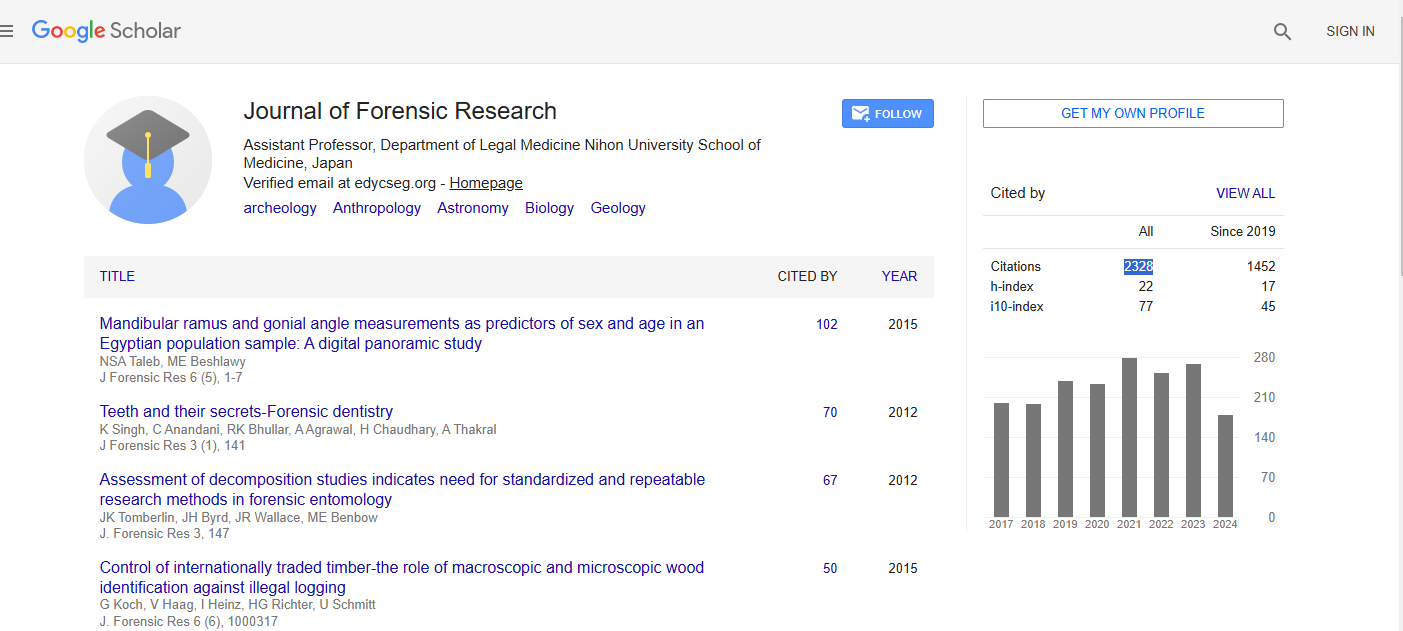
Journal of Forensic Research received 2328 citations as per Google Scholar report