Perspective - (2025) Volume 16, Issue 3
Received: 02-Jun-2025, Manuscript No. jfr-26-184106;
Editor assigned: 04-Jun-2025, Pre QC No. P-184106;
Reviewed: 18-Jun-2025, QC No. Q-184106;
Revised: 23-Jun-2025, Manuscript No. R-184106;
Published:
30-Jun-2025
, DOI: 10.37421/2157-7145.2025.16.667
Citation: Petrovic, Nina. ”Forensic Blood Alcohol Content: Methods,
Implications, and Challenges.” J Forensic Res 16 (2025):667.
Copyright: © 2025 Petrovic N. This is an open-access article distributed under the terms of the Creative Commons Attribution License, which permits unrestricted use,
distribution and reproduction in any medium, provided the original author and source are credited.
The accurate estimation of Blood Alcohol Content (BAC) is of paramount importance within the field of forensic pathology. It serves as a critical tool in the determination of impairment and culpability in cases involving alcohol consumption. This research delves into advanced methodologies and the inherent challenges associated with BAC measurement, carefully considering factors such as post-mortem changes, individual variability, and the complex interpretation of results within a legal framework. The implications of precise BAC determination are far-reaching, impacting traffic safety, the criminal justice system, and public health initiatives significantly [1].
Furthermore, this study undertakes an investigation into the reliability of various biological matrices for post-mortem BAC determination. A key focus is placed on highlighting potential discrepancies that may arise between different sample types, including blood, vitreous humor, and urine. The research emphasizes the critical importance of standardized sample collection protocols and the application of precise analytical techniques. These measures are essential for minimizing post-mortem redistribution artifacts and ensuring the ultimate accuracy of BAC estimations within forensic investigations [2].
The forensic implications stemming from BAC analysis are notably multifaceted. They extend to the very legal definitions of intoxication, influence the prosecution of impaired driving offenses, and are instrumental in the assessment of criminal responsibility. This article undertakes a thorough examination of the legal standards and the requisite scientific evidence necessary to successfully establish BAC-related offenses. It also discusses the considerable challenges encountered when presenting complex toxicological data to judicial bodies [3].
A distinct area of research evaluates the influence of various physiological factors on BAC readings. These include, but are not limited to, an individual's hydration status, their recent food intake, and their unique metabolic processes. A comprehensive understanding of these variables is deemed crucial for the accurate interpretation of BAC levels. Moreover, this knowledge is vital for effectively challenging or supporting evidence presented in legal proceedings [4].
The accuracy of breathalyzer devices, widely used for estimating BAC, remains a continuous subject of research and legal scrutiny. This article provides an in-depth examination of the calibration processes, routine maintenance schedules, and potential sources of error that can be associated with breath testing. It also assesses the scientific validity of these devices within various forensic contexts [5].
Another critical aspect explored is the interpretation of BAC in complex cases involving chronic alcohol abuse. The study also addresses potential synergistic effects that may arise from the co-ingestion of alcohol with other substances. This highlights the imperative need for comprehensive toxicological screening and the careful consideration of co-intoxicants when assessing impairment and its subsequent forensic consequences [6].
The inherent variability observed in alcohol metabolism among different individuals, frequently influenced by genetic predispositions and specific enzyme activity, represents a key consideration in the practice of forensic toxicology. This article engages in a detailed discussion of the pharmacogenetics of alcohol metabolism and its profound impact on both BAC estimation and the establishment of legal standards [7].
This paper further examines the application of advanced analytical techniques for the precise and accurate determination of BAC and other volatile organic compounds within forensic samples. Methodologies such as gas chromatography-mass spectrometry (GC-MS) and liquid chromatography-tandem mass spectrometry (LC-MS/MS) are discussed in detail, underscoring their role in forensic analysis [8].
The interpretation of BAC in cases pertaining to driving under the influence (DUI) demands a robust understanding of established legal limits, the inherent accuracy of testing methodologies, and the precise physiological effects of alcohol. This article offers valuable insights into the medico-legal aspects of DUI and elucidates the significant role played by forensic pathology in these proceedings [9].
Finally, this study addresses the specific challenges encountered in estimating BAC within particular populations. This includes, but is not limited to, pregnant women and individuals presenting with certain pre-existing medical conditions, where standard interpretation might be complicated. The research underscores the necessity for tailored and individualized approaches in forensic evaluations [10].
Accurate Blood Alcohol Content (BAC) estimation is a cornerstone of forensic pathology, directly informing the assessment of impairment and culpability in alcohol-related incidents. This research comprehensively reviews advanced methodologies and the persistent challenges in BAC measurement, taking into account critical variables such as post-mortem alterations, individual physiological differences, and the nuanced interpretation of findings within legal settings. The broad societal impact on traffic safety, the administration of criminal justice, and overall public health underscores the significance of this scientific endeavor [1].
The reliability of various biological matrices for determining post-mortem BAC is a central theme in this investigation. The study aims to illuminate potential discrepancies observed between different sample types, including blood, vitreous humor, and urine, thus guiding forensic practitioners. It strongly emphasizes the indispensable role of meticulously followed sample collection protocols and the utilization of sophisticated analytical techniques. These practices are vital for mitigating artifacts arising from post-mortem redistribution and ensuring the integrity and accuracy of BAC estimations in forensic investigations [2].
The forensic implications of BAC analysis are profoundly complex and extend into numerous legal domains. These include the establishment of legal intoxication thresholds, the successful prosecution of driving under the influence (DUI) charges, and the critical assessment of criminal responsibility. This article meticulously dissects the legal benchmarks and the scientific evidence required to substantiate BAC-related offenses, while also addressing the practical difficulties in conveying intricate toxicological information to the courts [3].
A significant component of this research involves an empirical evaluation of how diverse physiological factors impact BAC readings. Aspects such as an individual's hydration levels, dietary intake, and unique metabolic rates are scrutinized. A thorough grasp of these influencing variables is indispensable for the precise interpretation of BAC measurements, thereby strengthening or challenging evidence within legal contexts [4].
The ongoing assessment of breathalyzer devices for their accuracy in estimating BAC continues to be a focal point of scientific inquiry and legal debate. This article provides a detailed analysis of the critical factors governing the precision of these devices, including their calibration, maintenance procedures, and the potential sources of error. It further examines the foundational scientific validity of breath testing in various forensic applications [5].
Particular attention is given to the complexities of interpreting BAC in scenarios involving chronic alcohol abuse. The study also investigates the potential for synergistic interactions between alcohol and other concurrently ingested substances. This investigation highlights the crucial need for comprehensive toxicological assessments and careful consideration of poly-intoxication when evaluating impairment and its forensic ramifications [6].
A key area of focus is the considerable variation in alcohol metabolism observed across different individuals, often influenced by genetic makeup and the activity of specific metabolic enzymes. This article thoroughly discusses the pharmacogenetics of alcohol metabolism and its direct impact on the accuracy of BAC estimations and the formulation of legal standards [7].
The practical application of cutting-edge analytical methodologies for the precise and accurate quantification of BAC and other volatile organic compounds in forensic samples is thoroughly explored. The paper highlights the utility of techniques such as gas chromatography-mass spectrometry (GC-MS) and liquid chromatography-tandem mass spectrometry (LC-MS/MS) in achieving reliable forensic toxicological results [8].
The accurate interpretation of BAC evidence in driving under the influence (DUI) cases necessitates a deep understanding of legal statutes, the reliability of analytical methods, and the physiological effects of alcohol. This article offers critical insights into the medico-legal dimensions of DUI cases and delineates the vital role of forensic pathology in these complex legal proceedings [9].
Finally, this research tackles the unique challenges associated with BAC estimation in specialized populations, such as pregnant individuals and those with specific medical comorbidities. Such conditions can complicate standard interpretations, underscoring the necessity for refined and individualized approaches in forensic evaluations to ensure accurate and equitable outcomes [10].
This collection of research addresses the critical aspects of Blood Alcohol Content (BAC) estimation in forensic science. It covers the importance of accurate BAC measurement for legal determinations of impairment and culpability, exploring advanced methodologies and challenges including post-mortem changes and individual variability. The studies examine the reliability of different biological samples for BAC analysis, the forensic and legal implications of BAC, and the influence of physiological factors on readings. The accuracy and limitations of breathalyzer devices, as well as the complexities of interpreting BAC in cases of chronic alcohol abuse and co-ingestion, are also discussed. Furthermore, the research highlights the role of pharmacogenetics in alcohol metabolism and the application of advanced analytical techniques for precise BAC determination. The medico-legal perspectives of DUI cases and special considerations for specific populations are also detailed, emphasizing the need for tailored approaches in forensic evaluations.
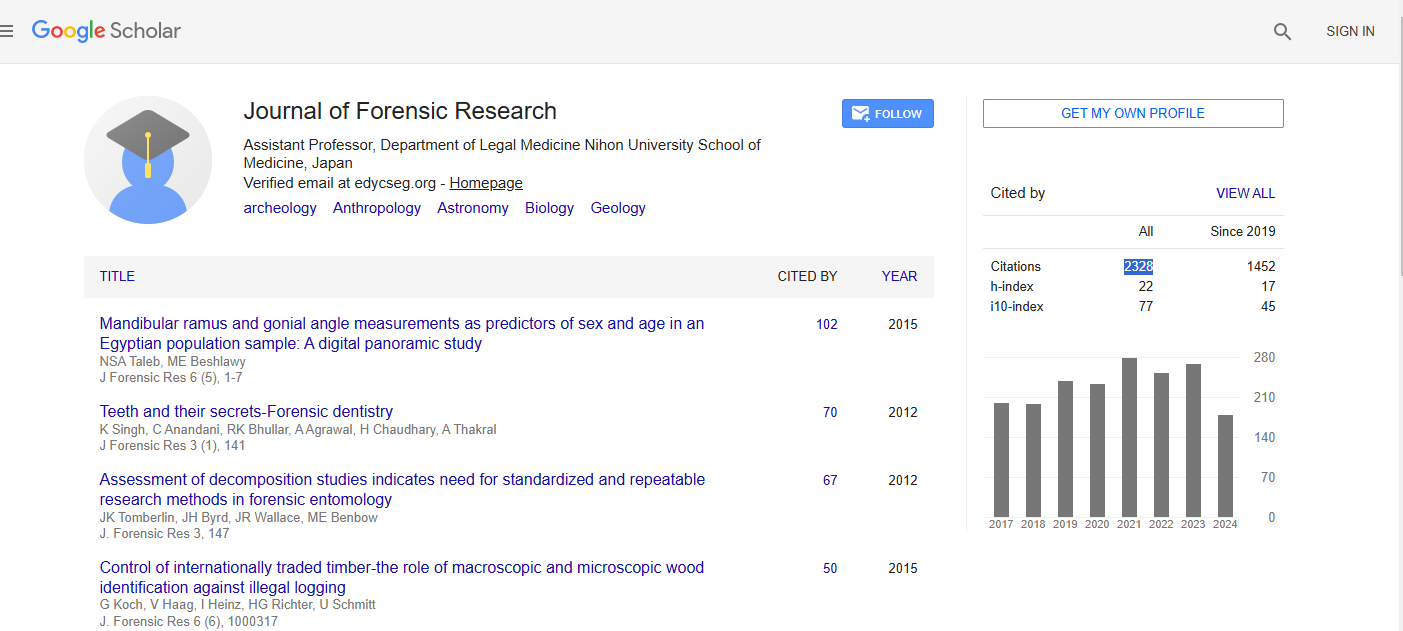
Journal of Forensic Research received 2328 citations as per Google Scholar report