Short Communication - (2025) Volume 9, Issue 5
Received: 02-Sep-2025, Manuscript No. fsb-26-189967;
Editor assigned: 04-Sep-2025, Pre QC No. P-189967;
Reviewed: 18-Sep-2025, QC No. Q-189967;
Revised: 23-Sep-2026, Manuscript No. R-189967;
Published:
30-Sep-2025
, DOI: 10.37421/2577-0543.2025.9.253
Citation: Petrova, Elena. ”Food’s Impact on Drug Bioavailability and Absorption.” J. Formul. Sci. Bioavailability 09 (2025):253.
Copyright: © 2025 Petrova E. This is an open-access article distributed under the terms of the Creative Commons Attribution License, which permits unrestricted use, distribution and reproduction in any medium, provided the original author and source are credited.
The intricate relationship between food consumption and the pharmacokinetics of orally administered drugs is a critical area of study with significant implications for therapeutic outcomes. Food intake can profoundly influence how a drug is absorbed, distributed, metabolized, and excreted, leading to variations in drug exposure and potential clinical consequences. Understanding these food-drug interactions is paramount for optimizing drug therapy and minimizing adverse effects [1].
This phenomenon is driven by a multitude of physiological changes induced by meals, which alter the gastrointestinal environment. Factors such as gastric emptying, intestinal transit time, splanchnic blood flow, and gastric pH are all modulated by food, thereby impacting the rate and extent of drug absorption [2].
A prime example of this interaction is the effect of a high-fat meal, which can significantly alter the pharmacokinetic profile of certain drugs. The presence of fat can delay gastric emptying and increase bile secretion, which are particularly relevant for the absorption of lipophilic compounds [3].
Gastrointestinal motility plays a pivotal role in these interactions. Food can either accelerate or retard the movement of drugs through the digestive tract, directly influencing the time available for dissolution and subsequent absorption into the bloodstream [4].
Beyond general food components, specific food items can also exert unique effects. Grapefruit juice, for instance, is well-known for its ability to inhibit cytochrome P450 enzymes in the intestine, leading to enhanced systemic exposure of certain drugs [5].
For poorly water-soluble drugs, food intake can sometimes be beneficial. Mechanisms such as increased gastric residence time and stimulated bile secretion can improve the absorption of these challenging compounds, although formulation strategies may also be necessary [6].
The timing of food intake relative to drug administration is another crucial aspect. While some drugs benefit from being taken with food for enhanced absorption or reduced gastric irritation, others may experience diminished efficacy or increased toxicity if co-administered with meals [7].
Drug metabolism, particularly by cytochrome P450 enzymes, can also be significantly influenced by food. Specific dietary components can induce or inhibit these enzymes, thereby altering drug clearance and overall exposure [8].
Dietary fiber, a common component of many diets, has also been shown to impact drug absorption. Fiber can bind to drugs in the gastrointestinal tract, potentially reducing their absorption and bioavailability, which is an important consideration for certain patient populations [9].
Given the broad spectrum of oral medications, it is essential to consider food-drug interactions across different drug classes. Antibiotics, for example, exhibit varying degrees of susceptibility to food effects, necessitating specific dosing recommendations to ensure therapeutic success [10].
The significant impact of food consumption on the oral bioavailability and pharmacokinetic profiles of drugs is a multifaceted area of pharmacological research. This influence stems from the complex physiological responses elicited by food intake, which can either facilitate or impede drug absorption, distribution, metabolism, and excretion. Understanding these interactions is crucial for optimizing therapeutic efficacy and minimizing potential adverse events, as highlighted by extensive research in this domain [1].
Meals, by their very nature, trigger a cascade of physiological changes within the gastrointestinal tract that are instrumental in modulating oral drug absorption. These alterations include significant shifts in gastric emptying rates, changes in intestinal transit duration, modifications to splanchnic blood flow, and variations in gastric pH. Each of these factors plays a critical role in determining how a drug dissolves, reaches the absorption sites, and enters the systemic circulation [2].
Specific food components, such as those found in high-fat meals, can have a pronounced effect on drug pharmacokinetics. The presence of dietary fat is known to delay gastric emptying and stimulate bile secretion, processes that are particularly relevant for enhancing the absorption of lipophilic drugs, which are often poorly soluble in aqueous environments [3].
Gastrointestinal motility, encompassing both gastric emptying and intestinal transit, is a dynamic process that is highly responsive to food intake. The rate at which food leaves the stomach and moves through the intestines directly influences the time a drug spends in the absorptive regions of the gastrointestinal tract, thereby affecting the extent and rate of its absorption [4].
Certain food items, such as grapefruit juice, possess unique properties that can lead to significant drug interactions. The furanocoumarins present in grapefruit juice are known inhibitors of intestinal cytochrome P450 3A4 (CYP3A4), an enzyme critical for the metabolism of many drugs. This inhibition can lead to a substantial increase in the systemic exposure of co-administered drugs [5].
For drugs that exhibit poor water solubility, food intake can sometimes offer a beneficial effect by improving their absorption. Mechanisms such as increased gastric residence time and augmented bile secretion, stimulated by food, can help to solubilize and enhance the absorption of these challenging drug molecules. However, formulation strategies remain a key area for overcoming solubility limitations [6].
The temporal relationship between food consumption and drug administration is a critical determinant of drug bioavailability. Some drugs are best taken with food to promote absorption or to mitigate gastrointestinal distress, while others may suffer reduced efficacy or increased toxicity if administered concurrently with a meal, underscoring the importance of precise dosing instructions [7].
Drug metabolism, a key determinant of drug clearance and elimination, can be significantly influenced by dietary factors. Specific components within food can either induce or inhibit the activity of drug-metabolizing enzymes, notably the cytochrome P450 (CYP) family of enzymes, thereby altering the rate of drug metabolism and impacting drug half-life and overall exposure [8].
Dietary fiber, a significant component of many diets, can also exert an influence on the absorption and pharmacokinetics of oral medications. Fiber's ability to bind to drugs within the gastrointestinal tract may reduce their dissolution and subsequent absorption, leading to decreased bioavailability, an effect that requires consideration, especially in patients with high fiber intake [9].
Across the diverse landscape of orally administered medications, the impact of food varies considerably. For instance, in the case of antibiotics, their susceptibility to food-drug interactions differs, with some showing enhanced absorption and others reduced absorption when taken with food. This necessitates the development of evidence-based recommendations for optimal dosing strategies to ensure effective treatment outcomes [10].
Food consumption significantly impacts oral drug bioavailability and pharmacokinetic profiles by altering physiological factors like gastric emptying, intestinal transit, and splanchnic blood flow. Specific food components, such as fats and fiber, can enhance or reduce drug absorption through various mechanisms. The timing of food intake and the presence of certain food items like grapefruit juice can also profoundly influence drug exposure. For poorly water-soluble drugs, food may improve absorption. Drug metabolism by enzymes like CYP450 can be modulated by diet. Understanding these food-drug interactions is crucial for optimizing therapeutic efficacy and minimizing adverse effects, with varying implications for different drug classes like antibiotics.
None
None
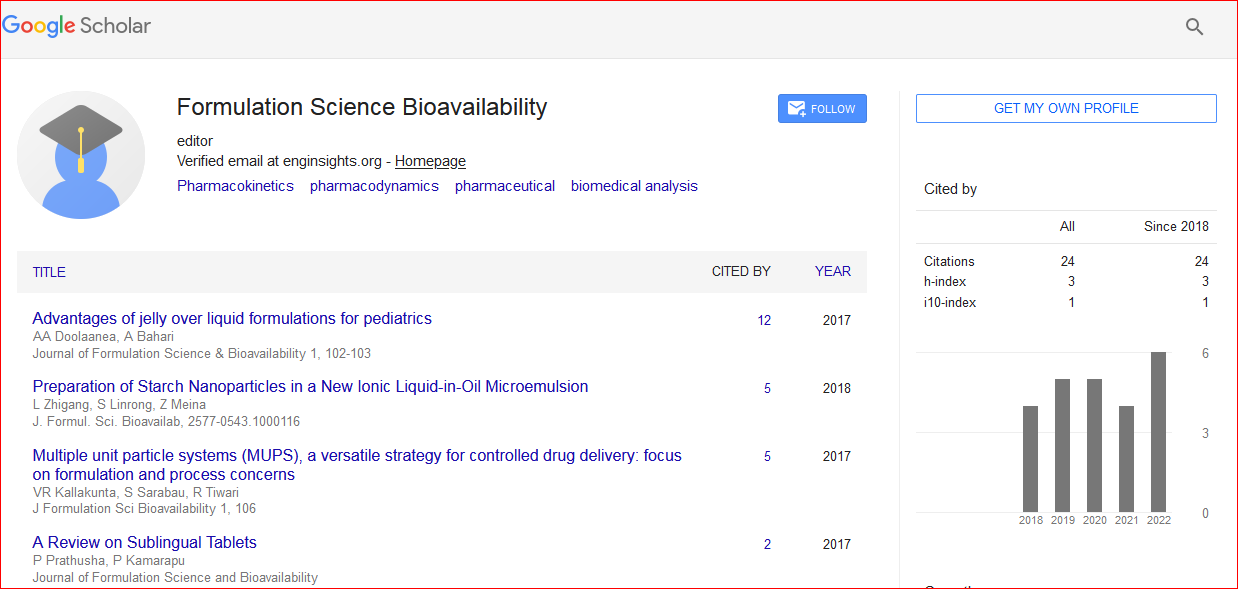
Journal of Formulation Science & Bioavailability received 23 citations as per Google Scholar report