Brief Report - (2025) Volume 16, Issue 4
Received: 01-Jul-2025, Manuscript No. hycr-25-174938;
Editor assigned: 03-Jul-2025, Pre QC No. P-174938;
Reviewed: 17-Jul-2025, QC No. Q-174938;
Revised: 22-Jul-2025, Manuscript No. R-174938;
Published:
29-Jul-2025
, DOI: 10.37421/2157-7587.2025.16.605
Citation: Calderon, Mira. ”Flooding: Global Challenges, Solutions, Resilience.” Hydrol Current Res 16 (2025):605.
Copyright: © 2025 Calderon M. This is an open-access article distributed under the terms of the Creative Commons Attribution License, which permits unrestricted use,
distribution and reproduction in any medium, provided the original author and source are credited.
Flooding represents a critical global challenge with profound and multifaceted impacts across various sectors. The disruption to agriculture and food security is particularly severe, as floods directly affect crop production, livestock, and essential infrastructure, leading to substantial economic losses and exacerbating food insecurity, especially in already vulnerable regions. Integrated flood risk management strategies within agricultural sectors are urgently needed to mitigate these effects [1].
In urban environments, flood risk management faces persistent and evolving challenges. Rapid urbanization, the accelerating impacts of climate change, and aging infrastructure collectively contribute to increased vulnerability. Despite these obstacles, there are significant opportunities for developing sustainable solutions, including the strategic integration of green infrastructure, the deployment of advanced early warning systems, and robust community engagement initiatives, all crucial for enhancing urban flood resilience [2].
Nature-based solutions (NBS) are emerging as a highly effective and sustainable approach to flood risk reduction. A systematic review and meta-analysis of numerous studies conclusively demonstrates that interventions such as wetland restoration, reforestation efforts, and the implementation of permeable surfaces can significantly attenuate flood peaks and substantially enhance natural water retention capabilities. These solutions provide a viable and ecologically sound alternative to conventional grey infrastructure approaches [3].
A complex and increasingly prevalent phenomenon is compound flooding, characterized by the co-occurrence or interaction of multiple flood drivers, such as storm surge and heavy rainfall. This synergy leads to significantly exacerbated impacts compared to single-driver events. Understanding the underlying mechanisms of compound events and assessing their increased risks is crucial for developing effective adaptation strategies, particularly for coastal and low-lying regions that are highly susceptible to these combined threats [4].
To address urban flood susceptibility on a global scale, studies are leveraging remotely sensed data for comprehensive risk assessment. This approach allows for the identification of key urban areas that are highly prone to flooding, correlating this susceptibility with crucial environmental and anthropogenic factors. These factors include impervious surface cover, population density, and specific hydrological characteristics, offering invaluable insights for designing and implementing targeted risk mitigation efforts globally [5].
The inextricable link between climate change and flood risk in the Anthropocene is a subject of intensive study, highlighting both significant challenges and emerging adaptation opportunities. Changing precipitation patterns, relentless sea-level rise, and the increasing frequency and intensity of extreme weather events are all contributing to the intensification of flood hazards worldwide. This necessitates the development and implementation of flexible, robust, and scalable adaptation strategies across all levels of governance and community engagement [6].
Beyond environmental and infrastructural impacts, floods inflict substantial socio-economic consequences, particularly evident across Europe. A synthesis of evidence reveals direct and indirect economic losses, severe disruptions to livelihoods, and significant psychological trauma experienced by affected communities. These findings underscore the imperative for integrated flood risk management policies that holistically consider both the economic ramifications and the profound social dimensions of flooding [7].
Advancements in flood forecasting and early warning systems are critical for improving preparedness and response. Recent reviews cover a broad spectrum of technologies, ranging from sophisticated hydrological models to advanced remote sensing techniques and the application of Artificial Intelligence (AI). These innovations play a vital role in improving prediction accuracy and extending lead times, emphasizing the urgent need for integrated, real-time systems coupled with enhanced communication channels to bolster community readiness [8].
Building community resilience to floods is a complex endeavor, requiring comprehensive frameworks, reliable indicators, and effective assessment methods. Systematic reviews synthesize current approaches to understand how communities can better resist, absorb, and recover from flood events. Key factors identified as essential for building long-term resilience include strong social capital, effective governance structures, and a high adaptive capacity within affected populations [9].
Finally, significant attention is given to the pivotal role of land use and land cover (LULC) changes in exacerbating urban flood susceptibility. Practices such as deforestation, rapid urbanization, and agricultural expansion critically alter natural hydrological processes. These changes increase surface runoff and reduce vital infiltration rates, thereby rendering urban areas far more prone to flooding. The article underscores the urgent necessity for implementing sustainable land management practices as a cornerstone for effective flood risk mitigation [10].
Flooding represents a pervasive and escalating global threat, manifesting in diverse forms and impacting numerous facets of human society and natural environments. A significant area of concern is the profound impact on agriculture and food security, where flood events disrupt crop cycles, threaten livestock, and damage critical infrastructure, leading to substantial economic losses and intensifying food insecurity, particularly in regions with limited resources [1]. These challenges highlight the urgent need for comprehensive, integrated flood risk management tailored specifically for agricultural sectors to ensure resilience and sustained food production.
Urban areas are at the forefront of this global challenge, contending with complex flood risks driven by an interplay of factors. Rapid urbanization, often characterized by extensive impervious surface development, combined with the increasing intensity of rainfall due to climate change, places immense pressure on existing, often aging, infrastructure [2]. Assessments of urban flood risk, particularly those leveraging remotely sensed data, reveal a clear correlation between susceptibility and factors such as impervious cover and population density [5]. Addressing these vulnerabilities requires a multi-pronged approach, encompassing the adoption of green infrastructure, the enhancement of early warning systems, and robust community engagement to foster urban resilience [2]. Furthermore, sustainable land management practices are critical in mitigating urban flood susceptibility, as changes in land use/land cover (LULC), such as deforestation and agricultural expansion, can significantly alter hydrological processes, increasing runoff and reducing infiltration, thereby making urban centers more prone to inundation [10].
The broader context of climate change undeniably exacerbates flood risks globally. The Anthropocene era is witnessing intensified flood hazards due to shifting precipitation patterns, relentless sea-level rise, and more frequent and extreme weather events [6]. This necessitates flexible and robust adaptation strategies across all scales, from local communities to national policy frameworks. A related, yet distinct, phenomenon is compound flooding, where multiple driversâ??like storm surge and heavy rainfallâ??co-occur, leading to amplified impacts, particularly in vulnerable coastal and low-lying regions. Understanding the intricate mechanisms of these compound events is vital for developing effective adaptation measures [4].
Effective flood risk management also encompasses innovative solutions and proactive measures. Nature-based solutions (NBS) offer a sustainable alternative to traditional grey infrastructure, with interventions such as wetlands, reforestation, and permeable surfaces demonstrating significant capacity to attenuate flood peaks and enhance water retention [3]. These solutions are not only environmentally beneficial but also often more cost-effective in the long term. Concurrently, advancements in flood forecasting and early warning systems are pivotal. Modern systems integrate hydrological models, remote sensing, and Artificial Intelligence (AI) to improve prediction accuracy and extend lead times, which are crucial for enhancing community preparedness and response capabilities [8].
Beyond the physical and technological aspects, the socio-economic dimensions of flooding are profound. Across Europe, for instance, floods result in not only direct and indirect economic losses but also significant disruptions to livelihoods and considerable psychological trauma within affected communities [7]. These impacts underscore the importance of policy decisions that consider both economic and social dimensions in integrated flood risk management. Moreover, building community flood resilience is central to long-term sustainability. This involves understanding and bolstering elements such as social capital, effective governance, and adaptive capacity, utilizing various frameworks, indicators, and assessment methods to gauge and improve a community's ability to resist, absorb, and recover from flood events [9]. Collectively, these studies highlight the interconnected nature of flood challenges and the diverse, multidisciplinary approaches required for effective mitigation and adaptation in a changing world.
This collection of reviews and studies provides a comprehensive overview of global flood challenges, impacts, and management strategies. The significant global impacts of flooding on agriculture and food security are highlighted, detailing disruptions to crop production and economic losses, particularly in vulnerable regions. Urban areas face increasing flood risks due to rapid urbanization, climate change, and aging infrastructure, emphasizing the need for sustainable solutions like green infrastructure and community engagement. Nature-based solutions (NBS) are presented as effective interventions for reducing flood risk, with examples like wetlands and reforestation enhancing water retention and attenuating flood peaks. The complex phenomenon of compound flooding, involving multiple interacting drivers like storm surge and heavy rainfall, is explored, underscoring the exacerbated risks it poses. Remotely sensed data is leveraged for global urban flood risk assessment, identifying susceptibility factors such as impervious surfaces and population density. The crucial link between climate change and intensified flood hazards in the Anthropocene is examined, advocating for flexible adaptation strategies. Socio-economic impacts of floods, including economic losses and psychological trauma, are discussed, particularly in the European context, stressing the importance of integrated policies. Advancements in flood forecasting and early warning systems, utilizing hydrological models, remote sensing, and Artificial Intelligence (AI), are reviewed for their role in improving preparedness. Finally, the importance of community flood resilience is addressed through various frameworks and indicators, recognizing social capital and governance as key factors. The role of land use/land cover (LULC) changes in urban flood susceptibility is also investigated, linking deforestation and urbanization to increased runoff and reduced infiltration. Together, these studies emphasize the multidisciplinary nature of flood challenges and the necessity for integrated, sustainable, and community-focused management approaches.
None
None
Indexed at, Google Scholar, Crossref
Indexed at, Google Scholar, Crossref
Indexed at, Google Scholar, Crossref
Indexed at, Google Scholar, Crossref
Indexed at, Google Scholar, Crossref
Indexed at, Google Scholar, Crossref
Indexed at, Google Scholar, Crossref
Indexed at, Google Scholar, Crossref
Indexed at, Google Scholar, Crossref
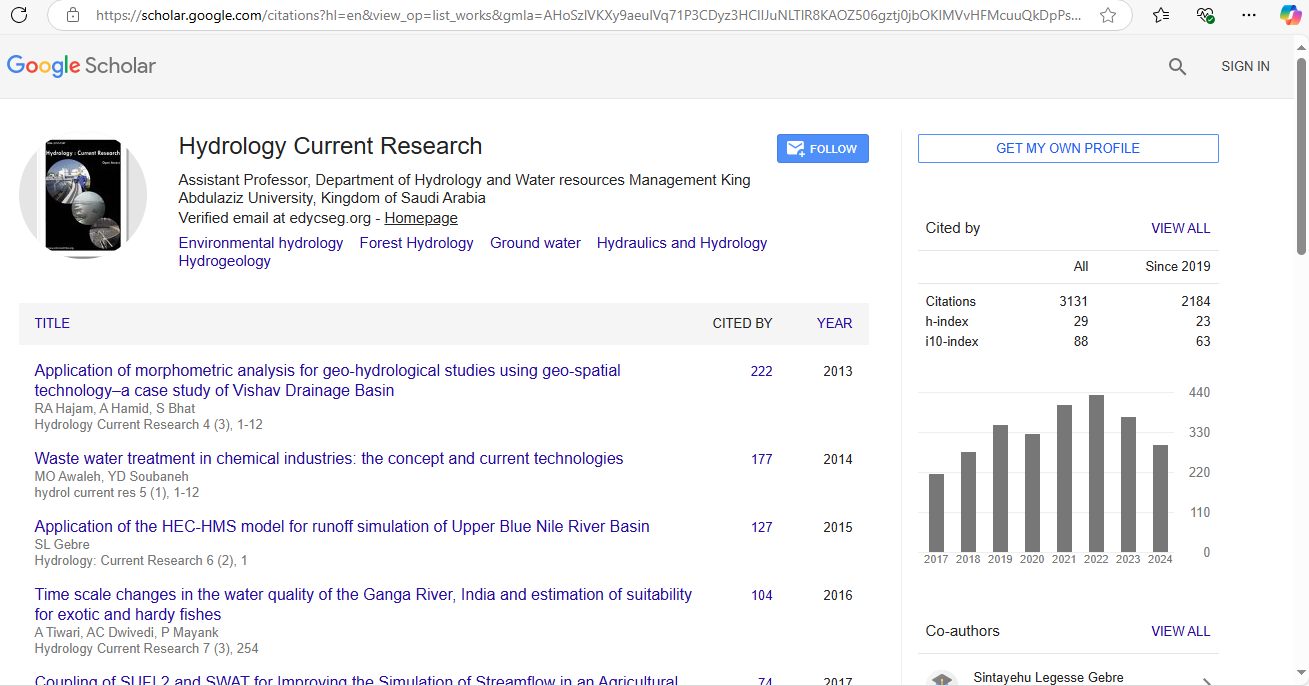
Hydrology: Current Research received 2843 citations as per Google Scholar report