Brief Report - (2025) Volume 16, Issue 3
Received: 02-Jun-2025, Manuscript No. jbsbe-26-183296;
Editor assigned: 04-Jun-2025, Pre QC No. P-183296;
Reviewed: 18-Jun-2025, QC No. Q-183296;
Revised: 23-Jun-2025, Manuscript No. R-183296;
Published:
30-Jun-2025
, DOI: 10.37421/2165-6210.2025.16.502
Citation: Whitmore, Jacob. ”Flexible Bioelectronics: Revolutionizing Wearable Health Monitoring.” J Biosens Bioelectron 16 (2025):502.
Copyright: © 2025 Whitmore J. This is an open-access article distributed under the terms of the Creative Commons Attribution License, which permits unrestricted use, distribution and reproduction in any medium, provided the original author and source are credited.
The integration of flexible and stretchable bioelectronics represents a significant paradigm shift in the development of wearable devices, enabling conformable interfaces with the skin for enhanced physiological monitoring and targeted therapeutic interventions. Novel conductive polymers, elastomers, and advanced microfabrication techniques are being employed to achieve a crucial balance between mechanical adaptability and electrical performance, promising new avenues in personalized healthcare and human-computer interaction [1].
The development of bioelectronic systems that seamlessly integrate with biological tissues, particularly the skin, necessitates materials capable of mimicking human physiology through exceptional stretchability and biocompatibility. Recent advancements have focused on innovative porous electrode designs and hydrogel-based conductors to optimize signal acquisition and minimize interfacial impedance, aiming for unobtrusive sensors that maintain comfort and data integrity over extended periods [2].
A fundamental challenge in wearable bioelectronics lies in material science, specifically in engineering conductors that maintain electrical conductivity and mechanical robustness under dynamic strain. Nanomaterials such as carbon nanotubes and graphene, when incorporated into elastomeric matrices, offer promising solutions by preserving electrical pathways during significant stretching, which is essential for reliable biosignal detection [3].
For effective integration, bioelectronic devices must not only exhibit mechanical flexibility but also endure the body's physiological environment, including sweat and motion. The development of sweat-processable electrodes using conductive inks and hydrogels, easily patterned onto flexible substrates, simplifies manufacturing and yields devices that are highly conformal and resistant to environmental degradation [4].
The application of stretchable electrodes extends beyond basic sensing to encompass active functions like drug delivery. The integration of microfluidic channels within flexible substrates enables controlled therapeutic agent release in response to physiological cues, fostering intelligent wearable systems capable of autonomous monitoring and treatment [5].
The advent of transient and biodegradable bioelectronics marks a substantial advancement toward sustainable and less invasive medical devices. These materials are engineered to naturally degrade post-function, circumventing the need for surgical removal and proving particularly valuable for implantable sensors and drug delivery systems where prolonged presence can be a concern [6].
Achieving high-resolution sensing with flexible and stretchable electronics is paramount for capturing subtle physiological signals. Microfabrication techniques such as inkjet printing and photolithography are being adapted to create intricate electrode patterns on elastic substrates, enabling precise detection of localized biological events and mapping of complex physiological processes across the skin's surface [7].
The power source for wearable bioelectronic devices remains a critical challenge. The development of flexible and stretchable batteries, utilizing ion gels or solid-state electrolytes, aims to match the mechanical properties of the sensors. Concurrently, energy harvesting technologies like triboelectric and piezoelectric generators are being integrated to provide continuous, wireless power, reducing reliance on conventional batteries [8].
The interface between bioelectronics and the human body is crucial for accurate signal transduction. Biocompatible coatings and surface modifications are employed to mitigate immune responses and promote integration. Hydrophilic polymer coatings, for instance, can enhance ion transport and reduce protein adsorption, leading to more stable and reliable biosignal measurements over time [9].
The reliability and longevity of flexible and stretchable bioelectronic devices are significantly influenced by their capacity to withstand repeated mechanical deformation. Advanced computational modeling and experimental validation are employed to predict material fatigue and device failure. Strategies like incorporating strain-limiting layers and optimizing electrode geometries are vital for extending the operational lifespan of these wearable technologies [10].
Flexible and stretchable bioelectronics are fundamental to the evolution of wearable devices, offering conformable interfaces with the skin that facilitate continuous physiological monitoring and precise therapeutic delivery. This field is propelled by innovations in conductive polymers, elastomers, and microfabrication techniques, which are essential for balancing mechanical flexibility with robust electrical performance, thereby unlocking new possibilities in personalized medicine and human-computer interaction [1].
To achieve seamless integration with biological tissues, particularly the skin, bioelectronic systems require materials that exhibit excellent stretchability and biocompatibility, effectively mimicking human physiology. Current research highlights progress in porous electrode designs and hydrogel-based conductors, which are instrumental in enhancing signal acquisition quality and reducing interfacial impedance, leading to the creation of unobtrusive sensors for prolonged wear without compromising data accuracy or user comfort [2].
A central obstacle in the field of wearable bioelectronics is the material science aspect, specifically the challenge of developing conductors that maintain high electrical conductivity and mechanical integrity under significant strain. The incorporation of nanomaterials, such as carbon nanotubes and graphene, into elastomeric matrices presents a promising approach, as their inherent properties ensure the preservation of electrical pathways even during substantial stretching, a critical requirement for dependable biosignal detection [3].
Effective integration of bioelectronic devices demands not only mechanical flexibility but also resilience to the body's inherent environmental factors, including sweat and physical motion. The advancement of sweat-processable electrodes, utilizing materials like conductive inks and hydrogels that can be readily patterned onto flexible substrates, simplifies the manufacturing process and leads to the development of devices that are both highly conformal and resistant to degradation [4].
The functional scope of stretchable electrodes is expanding beyond simple sensing capabilities to include sophisticated applications such as targeted drug delivery. The strategic integration of microfluidic channels within flexible substrates allows for the controlled release of therapeutic agents, often triggered by physiological signals, thus enabling the creation of intelligent wearable systems capable of autonomous monitoring and intervention [5].
Recent breakthroughs in transient and biodegradable bioelectronics are paving the way for more sustainable and minimally invasive medical devices. These innovative materials are designed to naturally degrade within the body after their intended function, thereby eliminating the need for surgical removal, which is particularly advantageous for implantable sensors and drug delivery systems where long-term presence can pose challenges [6].
Attaining high-resolution sensing capabilities with flexible and stretchable electronics is crucial for the accurate detection of subtle physiological signals. Advanced microfabrication techniques, including inkjet printing and photolithography, are being adapted for the precise creation of intricate electrode patterns on elastic substrates. This level of precision is vital for capturing localized biological events and mapping complex physiological processes occurring on the skin's surface [7].
The persistent challenge of powering wearable bioelectronic devices is being addressed through the development of flexible and stretchable energy storage solutions, such as batteries employing ion gels or solid-state electrolytes, designed to complement the mechanical characteristics of the sensors. Furthermore, the integration of energy harvesting technologies, including triboelectric and piezoelectric generators, offers a path towards continuous, wireless power supply, reducing dependence on conventional bulky batteries [8].
The effectiveness of the bioelectronic interface with the human body is paramount for reliable signal transduction. The implementation of biocompatible coatings and advanced surface modifications serves to minimize adverse immune responses and promote better integration. For example, the use of hydrophilic polymer coatings can enhance ionic transport and reduce protein adsorption, ultimately contributing to more stable and accurate biosignal measurements over extended operational periods [9].
The operational longevity and reliability of flexible and stretchable bioelectronic devices are critically dependent on their ability to endure repeated mechanical stresses. Sophisticated computational modeling techniques, coupled with rigorous experimental validation, are employed to anticipate material fatigue and identify potential failure mechanisms. Consequently, the incorporation of strain-limiting layers and optimization of electrode designs are essential strategies for extending the functional lifetime of these advanced wearable technologies [10].
Flexible and stretchable bioelectronics are revolutionizing wearable devices by enabling seamless skin integration for advanced physiological monitoring and targeted therapies. Innovations in materials like conductive polymers and nanomaterials, along with techniques such as microfabrication and sweat-processable electrodes, are addressing challenges in conductivity, mechanical robustness, and environmental resistance. These advancements support applications ranging from high-resolution sensing to drug delivery and are driving the development of unobtrusive, long-lasting devices. Efforts are also focused on sustainable materials, efficient power sources, and optimized biointerfaces to enhance device performance and user experience. The reliability and longevity of these devices are being improved through advanced modeling and design strategies.
None
None
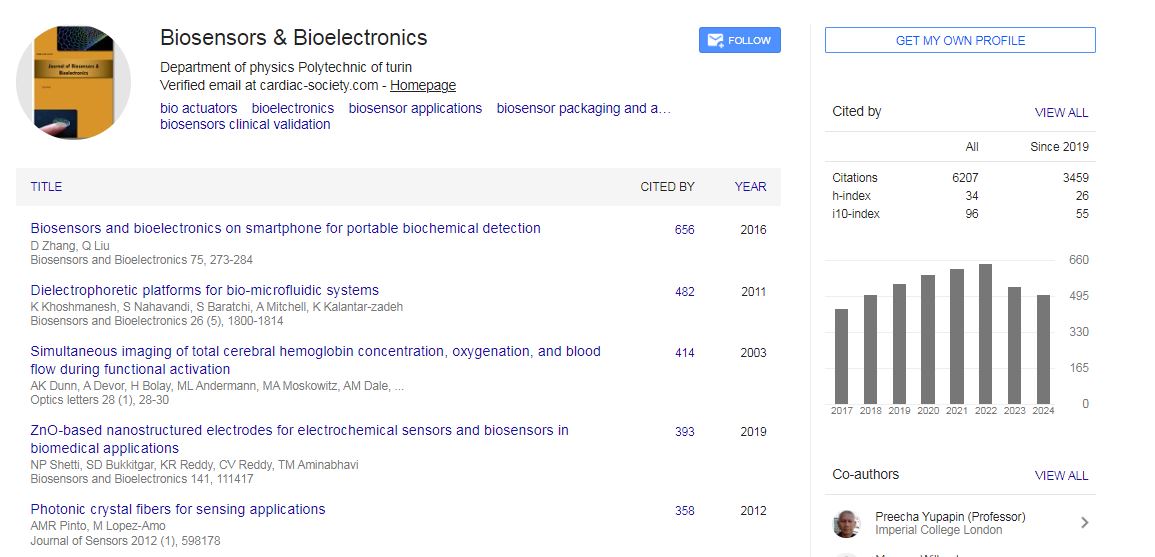
Biosensors & Bioelectronics received 6207 citations as per Google Scholar report