Perspective - (2025) Volume 14, Issue 2
Received: 01-Apr-2025, Manuscript No. jbfa-25-174136;
Editor assigned: 03-Apr-2025, Pre QC No. P-174136;
Reviewed: 17-Apr-2025, QC No. Q-174136;
Revised: 22-Apr-2025, Manuscript No. R-174136;
Published:
29-Apr-2025
, DOI: 10.37421/2167-0234.2025.14.526
Citation: Oliveira, Maria. ”Financial Literacy: Health, Well-being, and Resilience.” J Bus Fin Aff 14 (2025):526.
Copyright: © 2025 Oliveira M. This is an open-access article distributed under the terms of the Creative Commons Attribution License, which permits unrestricted use, distribution and reproduction in any medium, provided the original author and source are credited.
This study investigates how financial literacy influences health behaviors among adults in China, utilizing data from a national survey. It finds that higher financial literacy correlates with better health behaviors, such as healthier eating habits, increased physical activity, and reduced risky health actions. The findings emphasize the broader societal benefits of improving financial education beyond just economic outcomes, suggesting that financial knowledge can empower individuals to make more informed decisions about their health and well-being[1].
This quasi-experimental study evaluated the impact of a financial literacy education program on college students, revealing significant improvements in participants' financial knowledge, attitudes, and behaviors. The intervention helped students develop better financial planning skills, manage debt more effectively, and increase their savings habits. These findings highlight the importance of structured financial education programs in equipping young adults with essential skills for future financial stability[2].
This scoping review explores the relationship between financial literacy and psychological well-being specifically among older adults. It identifies a strong connection, showing that higher financial literacy is associated with reduced financial stress, increased confidence in managing finances, and better overall mental health outcomes. The review underscores the need for targeted financial education interventions to support the well-being of the aging population[3].
Examining data from older Americans, this study reveals that greater financial literacy is linked to a higher utilization of preventive health services. Individuals with better financial understanding are more likely to engage in health-preserving behaviors, suggesting an intricate connection between financial capability and proactive healthcare engagement. The findings imply that promoting financial literacy could have positive spillover effects on public health outcomes[4].
This systematic review explores the landscape of financial literacy for adolescents in the digital age, highlighting the unique challenges and opportunities presented by evolving digital financial tools. It points out the critical need for financial education programs to adapt to online platforms and address topics like cybersecurity, digital payments, and online investing to prepare young people for modern financial realities. The insights suggest that effective programs must be innovative and relevant to current digital trends[5].
This cross-country study investigates the role of financial literacy in building economic resilience, particularly during disruptive events like the COVID-19 pandemic. The findings indicate that individuals with higher financial literacy were better equipped to cope with economic shocks, demonstrating greater financial adaptability and stability. This highlights financial literacy as a crucial factor in mitigating the adverse effects of crises on household finances[6].
This systematic review focuses on the connection between financial literacy and well-being among vulnerable populations. It uncovers that financial education can significantly improve the financial decision-making and overall quality of life for groups facing economic disadvantages or social barriers. The review emphasizes that tailored and accessible financial literacy programs are essential to empower vulnerable individuals and reduce financial disparities[7].
This systematic review provides a comprehensive overview of digital financial literacy, defining its scope and proposing a future research agenda. It highlights the growing importance of understanding digital financial products, services, and associated risks in an increasingly digitized economy. The review suggests that enhancing digital financial literacy is crucial for consumers to navigate modern financial landscapes effectively and safely[8].
This scoping review examines the interplay between financial literacy, cognitive function, and financial decision-making among older adults. It emphasizes that cognitive abilities are critical in how financial literacy translates into sound financial choices, especially as individuals age. The review suggests that interventions should not only enhance financial knowledge but also consider cognitive support mechanisms to improve financial outcomes for older populations[9].
This systematic review highlights the profound importance of financial literacy for both individual public health and broader policy considerations. It synthesizes evidence showing that financial understanding impacts health behaviors, access to care, and overall well-being. The findings advocate for integrating financial literacy into public health initiatives and policy frameworks to foster a healthier and more economically secure populace[10].
Financial literacy emerges as a critical determinant of various aspects of individual and societal well-being. Studies have shown that higher financial literacy correlates with better health behaviors, such as healthier eating, increased physical activity, and reduced risky health actions among adults in China [1]. This demonstrates the broader societal benefits of improving financial education, extending beyond mere economic outcomes to empower individuals in making informed health decisions [1]. Similarly, the importance of financial literacy for public health and policy is profound, with evidence indicating that financial understanding impacts health behaviors, access to care, and overall well-being. This suggests the necessity of integrating financial literacy into public health initiatives and policy frameworks to foster a healthier and more economically secure populace [10].
Structured financial education programs play a vital role in equipping younger generations with essential skills. A quasi-experimental study on college students revealed significant improvements in financial knowledge, attitudes, and behaviors, including better financial planning, debt management, and increased savings habits [2]. For adolescents, particularly in the digital age, financial literacy needs to adapt to evolving digital financial tools. This highlights the critical need for programs to cover topics like cybersecurity, digital payments, and online investing, preparing young people for modern financial realities with innovative and relevant approaches [5].
The connection between financial literacy and the well-being of older adults is particularly strong. Higher financial literacy is associated with reduced financial stress, increased confidence in managing finances, and better overall mental health outcomes [3]. Furthermore, greater financial literacy among older Americans is linked to a higher utilization of preventive health services, indicating an intricate connection between financial capability and proactive healthcare engagement. Promoting financial literacy in this demographic could lead to positive spillover effects on public health outcomes [4]. It's also recognized that cognitive abilities are crucial in how financial literacy translates into sound financial choices as individuals age. Therefore, interventions for older populations should consider not just enhancing financial knowledge but also providing cognitive support mechanisms to improve financial outcomes [9].
Financial literacy also acts as a crucial factor in building economic resilience, especially during disruptive events. During the COVID-19 pandemic, a cross-country study showed that individuals with higher financial literacy were better equipped to cope with economic shocks, demonstrating greater adaptability and stability in their finances [6]. For vulnerable populations, financial education significantly improves financial decision-making and overall quality of life for groups facing economic disadvantages or social barriers. This underscores the need for tailored and accessible financial literacy programs to empower these individuals and reduce financial disparities [7]. In the broader economic context, digital financial literacy is becoming increasingly important, requiring an understanding of digital financial products, services, and associated risks. Enhancing digital financial literacy is crucial for consumers to navigate modern financial landscapes effectively and safely [8].
Financial literacy plays a crucial role in influencing diverse aspects of individual well-being and societal resilience. Studies show a direct correlation between higher financial literacy and better health behaviors, including healthier eating, increased physical activity, and reduced risky actions among adults. This suggests that financial education can empower individuals to make informed decisions about their health, extending its benefits beyond economic outcomes. Targeted financial education programs have demonstrated significant improvements in college students' financial knowledge, attitudes, and behaviors, equipping them with essential skills for future financial stability, such as better debt management and savings habits. For older adults, financial literacy is strongly linked to psychological well-being, reducing financial stress and increasing confidence in managing finances, leading to better overall mental health. Greater financial understanding also correlates with higher utilization of preventive health services among older Americans, implying positive spillover effects on public health. Cognitive function also significantly impacts how older adults translate financial literacy into sound financial choices, emphasizing the need for interventions that consider cognitive support. In a rapidly digitizing world, financial literacy for adolescents must adapt to online platforms, covering topics like cybersecurity and digital payments. Digital financial literacy is increasingly vital for navigating modern financial landscapes effectively and safely. Financial literacy is also a key factor in building economic resilience, particularly during crises like the COVID-19 pandemic, where financially literate individuals demonstrated greater adaptability. For vulnerable populations, tailored and accessible financial education can improve financial decision-making and quality of life, reducing disparities. Overall, integrating financial literacy into public health initiatives and policy frameworks is essential for fostering a healthier and more economically secure populace.
None
None
Indexed at, Google Scholar, Crossref
Indexed at, Google Scholar, Crossref
Indexed at, Google Scholar, Crossref
Indexed at, Google Scholar, Crossref
Indexed at, Google Scholar, Crossref
Indexed at, Google Scholar, Crossref
Indexed at, Google Scholar, Crossref
Indexed at, Google Scholar, Crossref
Indexed at, Google Scholar, Crossref
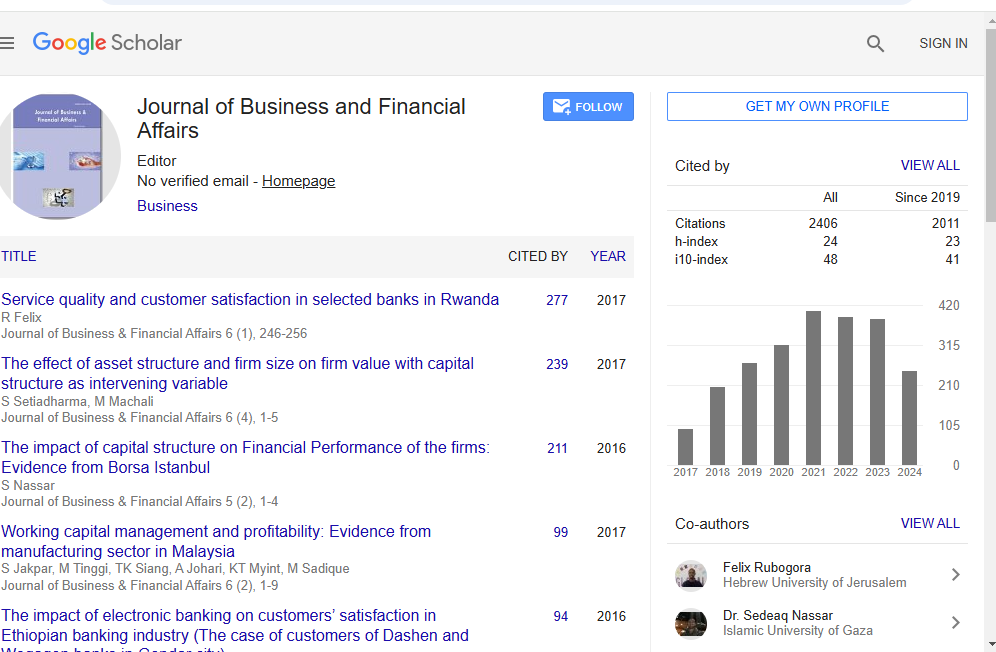
Journal of Business & Financial Affairs received 1726 citations as per Google Scholar report