Short Communication - (2025) Volume 15, Issue 5
Received: 30-Sep-2025, Manuscript No. jmcj-25-176924;
Editor assigned: 02-Oct-2025, Pre QC No. P-176924;
Reviewed: 14-Oct-2025, QC No. Q-176924;
Revised: 21-Oct-2025, Manuscript No. R-176924;
Published:
28-Oct-2025
, DOI: 10.37421/2165-7912.2025.15.646
Citation: Johansson, Clara S.. ”Fake News: Challenges, Detection, Impacts, Solutions.” J Mass Communicat Journalism 15(2025):646.
Copyright: © 2025 Johansson S. Clara This is an open-access article distributed under the terms of the Creative Commons Attribution License, which permits unrestricted use, distribution and reproduction in any medium, provided the original author and source are credited.
This systematic review provides an overview of deep learning techniques applied to fake news detection, identifying prominent models, datasets, and performance metrics. It highlights the challenges and future research directions in this critical area, pushing for more robust and generalizable solutions to effectively combat misinformation [1].
Here's the thing about misinformation: this paper explores the cognitive and motivational psychological factors that make individuals susceptible to misinformation and fake news, alongside strategies for effective correction. It highlights the interplay of memory, reasoning, and social influence in shaping our beliefs [2].
Let's break down the spread of fake news on social media. This survey reviews the mechanisms behind its rapid dissemination, exploring factors like network structure, user behavior, and algorithmic amplification. It also discusses existing detection and mitigation strategies, pointing towards a multifaceted solution [3].
What this really means is that fake news has serious real-world consequences. This article examines the detrimental effects of fake news on public health, using the COVID-19 pandemic as a case study. It highlights how misinformation can undermine public trust, influence health behaviors negatively, and complicate crisis communication efforts [4].
This review explores the role and effectiveness of fact-checking initiatives as a primary tool for combating the spread of fake news. It discusses various fact-checking methodologies, their reach, and the persistent challenges in altering audience beliefs and improving information literacy [5].
This review synthesizes current trends and future directions for Artificial Intelligence (AI) and Machine Learning, particularly Natural Language Processing, in the detection of fake news. It explores various computational approaches and models designed to identify misinformation, showing us how technology is stepping up to the challenge [6].
This systematic review examines the effectiveness of various media literacy interventions designed to equip individuals with the skills to identify and resist fake news. It emphasizes the importance of critical thinking and digital fluency in the current information landscape, showing a clear path forward for education [7].
This systematic review delves into the phenomenon of political fake news, outlining its characteristics, mechanisms of spread, and its significant impact on democratic processes and public opinion. It also proposes a future research agenda, highlighting areas where more understanding is crucial [8].
This article explores the ethical dimensions surrounding misinformation and disinformation, including fake news, discussing the responsibilities of platforms, content creators, and users. It highlights the challenges in balancing freedom of expression with the need to prevent harm, a fundamental tension in the digital age [9].
This comparative study investigates how perceptions and interpretations of fake news vary across different cultural contexts. It highlights the role of cultural values, media systems, and political environments in shaping public understanding and responses to misinformation, showing that a one-size-fits-all approach won't work [10].
The fight against fake news involves significant technological advancements, particularly in automated detection methods. Systematic reviews provide a detailed overview of deep learning techniques applied to fake news detection, identifying prominent models, key datasets, and relevant performance metrics. These analyses highlight the architectural nuances and data-centric challenges inherent in building effective detection systems, pushing for more robust and generalizable solutions to effectively combat misinformation [1]. Furthermore, a comprehensive review synthesizes current trends and future directions for Artificial Intelligence (AI) and Machine Learning, with a specific focus on Natural Language Processing, in the context of fake news detection. It explores various computational approaches and models designed to identify misinformation, including those leveraging textual cues, metadata, and propagation patterns, showing us how technology is stepping up to the challenge [6].
Beyond technological tools, understanding the human and social dynamics of misinformation is absolutely critical. Research explores the cognitive and motivational psychological factors that make individuals susceptible to misinformation and fake news, alongside effective strategies for correction. This work delves into underlying human biases, emotional responses, and the role of cognitive shortcuts in belief formation, emphasizing the interplay of memory, reasoning, and social influence in shaping our beliefs [2]. Let's break down the spread of fake news on social media: a detailed survey reviews the mechanisms behind its rapid dissemination. It explores factors like network structure, user behavior, and algorithmic amplification, highlighting how platform designs and user engagement patterns facilitate viral sharing, often preceding critical evaluation. The survey also discusses existing detection and mitigation strategies within social platforms, pointing towards a multifaceted solution that combines human and algorithmic approaches [3].
What this really means is that fake news has serious real-world consequences, extending into vital societal domains. An article examines the detrimental effects of fake news on public health, using the COVID-19 pandemic as a powerful case study. It vividly illustrates how health-related misinformation can undermine public trust, influence health behaviors negatively—leading to issues like vaccine hesitancy or the adoption of unproven remedies—and significantly complicate crisis communication efforts [4]. The phenomenon of political fake news, a substantial area of concern, outlines its characteristics, mechanisms of spread, and its significant impact on democratic processes and public opinion. This systematic review considers how politically motivated misinformation can influence election outcomes, polarize societies, and erode faith in democratic institutions, also proposing a future research agenda to deepen understanding in these crucial areas [8].
Combating fake news relies on a combination of active countermeasures and a clear understanding of ethical considerations. Reviews explore the role and effectiveness of fact-checking initiatives as a primary tool. They discuss various fact-checking methodologies, their reach, and the persistent challenges encountered in altering audience beliefs and improving information literacy, often struggling to keep pace with the sheer volume and speed of misinformation [5]. Media literacy interventions also prove effective, designed to equip individuals with the skills to identify and resist fake news. This emphasizes the importance of fostering critical thinking and digital fluency in the current information landscape, showing a clear path forward for education and empowering individuals to make informed judgments [7]. Furthermore, articles explore the ethical dimensions surrounding misinformation and disinformation, including fake news, discussing the responsibilities of platforms, content creators, and users. This highlights the challenges in balancing freedom of expression with the pressing need to prevent harm, a fundamental tension in the digital age that requires ongoing deliberation and policy adjustments [9].
Finally, it's important to recognize that perceptions and interpretations of fake news vary significantly across different cultural contexts. A comparative study investigates how cultural values, media systems, and political environments profoundly shape public understanding and responses to misinformation. This reveals that a one-size-fits-all approach won't work, emphasizing the necessity for tailored strategies that are culturally sensitive and locally relevant to effectively address the global challenge of misinformation [10].
Fake news presents multifaceted challenges, from technical detection to its profound societal impacts and the human factors influencing its spread. Research highlights deep learning and Artificial Intelligence (AI) techniques, including Natural Language Processing, as crucial for detection, identifying prominent models and future directions for robust solutions. Psychological factors contribute significantly to susceptibility, exploring cognitive and motivational aspects that shape beliefs. On the social front, surveys detail the rapid dissemination of fake news across social media, influenced by network structure, user behavior, and algorithmic amplification. What this really means is that fake news has serious real-world consequences, notably its detrimental effects on public health, as seen during the COVID-19 pandemic, which can undermine trust and complicate crisis communication. Ethical dimensions also surround misinformation, prompting discussions on the responsibilities of platforms, content creators, and users in balancing freedom of expression with harm prevention. Efforts to combat misinformation include fact-checking initiatives, which review various methodologies and address challenges in altering audience beliefs. Media literacy interventions are designed to equip individuals with critical thinking and digital fluency to identify and resist fake news, showing a clear path forward for education. The phenomenon of political fake news outlines its characteristics and impact on democratic processes, calling for further research. Furthermore, cross-cultural studies reveal that perceptions and interpretations of fake news vary, showing how cultural values and media systems shape understanding, indicating a one-size-fits-all approach won't work.
None
None
Muhammad I, Muhammad UK, Muhammad A. "Fake News Detection Using Deep Learning Techniques: A Systematic Review".Computer Systems Science and Engineering 43 (2022):833–848.
Indexed at, Google Scholar, Crossref
David NR, Lisa KF, Nadia MB. "Psychological drivers of misinformation susceptibility and its correction".Current Opinion in Psychology 36 (2020):105-110.
Indexed at, Google Scholar, Crossref
Md. SH, Mahfuzur R, Md. AM. "Understanding the Spread of Fake News on Social Media: A Survey".IEEE Access 9 (2021):109861-109882.
Indexed at, Google Scholar, Crossref
Ady GR, Sara EM, Erin EM. "The Impact of Fake News on Public Health: Lessons Learned from the COVID-19 Pandemic".J Public Health Manag Pract 28 (2022):112-115.
Indexed at, Google Scholar, Crossref
Silvia C, Paula AdF, Nuno MN. "Fact-checking and its implications for combating fake news: A review".Communication & Society 35 (2022):45-60.
Indexed at, Google Scholar, Crossref
Hamzah AA, M. H, M. AAA. "A review of AI and machine learning in fake news detection: current trends and future directions".Artif Intell Rev 55 (2022):3001–3042.
Indexed at, Google Scholar, Crossref
Elena MF, Jessica MD, Robert LS. "Media Literacy Interventions for Combating Fake News: A Systematic Review".J Media Lit Educ 13 (2021):1-17.
Indexed at, Google Scholar, Crossref
Giovanni PDA, Marco DC, Luca RDC. "Political fake news: a systematic review and research agenda".J Bus Res 107 (2020):395-403.
Indexed at, Google Scholar, Crossref
John MO, Mary TS, David RJ. "Ethical Considerations in the Age of Misinformation and Disinformation".J Med Internet Res 23 (2021):e31792.
Indexed at, Google Scholar, Crossref
Chen L, Juan Z, Wei W. "Cross-Cultural Perceptions of Fake News: A Comparative Study".J Cross Cult Psychol 54 (2023):187-205.
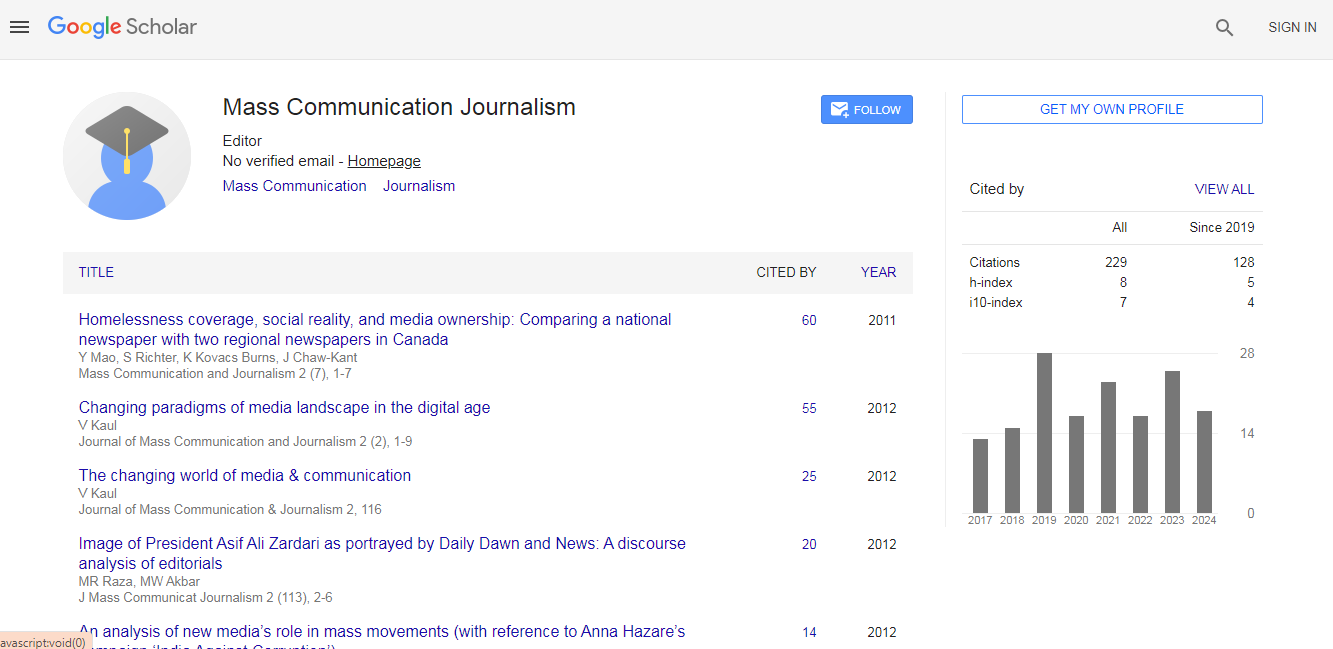
Journal of Mass Communication & Journalism received 205 citations as per Google Scholar report