Perspective - (2025) Volume 11, Issue 3
Received: 01-Aug-2025, Manuscript No. jmt-25-175193;
Editor assigned: 04-Aug-2025, Pre QC No. P-175193;
Reviewed: 18-Aug-2025, QC No. Q-175193;
Revised: 22-Aug-2025, Manuscript No. R-175193;
Published:
29-Aug-2025
, DOI: 10.37421/2471-271X.2025.11.354
Citation: O’Neill, Michael. ”Exposure Therapy: Evolving Strategies, Enhanced Access.” J Ment Disord Treat 11 (2025):354.
Copyright: © 2025 O’Neill M. This is an open-access article distributed under the terms of the Creative Commons Attribution License, which permits unrestricted use, distribution and reproduction in any medium, provided the original author and source are credited.
Exposure therapy has long been recognized as a highly effective intervention for a range of mental health conditions, primarily those characterized by anxiety and fear. Its foundational principle involves confronting feared stimuli in a safe, controlled environment, thereby facilitating a reduction in distressing responses through processes like habituation and inhibitory learning. The efficacy of this therapeutic approach continues to be a central focus of extensive research, exploring ways to enhance its impact, broaden its applicability, and understand its underlying mechanisms. Recent advancements highlight the diverse strategies designed to boost the effectiveness of exposure therapy for anxiety disorders, covering pharmacologic, behavioral, and technological additions that detail their mechanisms and research backing. Refining fear extinction learning and its generalization is vital, and combining different approaches can significantly improve treatment outcomes while lowering the risk of relapse [1].
For those with treatment-resistant anxiety disorders, specific augmentation strategies, encompassing various pharmacologic and behavioral enhancements, are being investigated to overcome common obstacles to success. Such approaches promise to improve outcomes for individuals not responding adequately to standard exposure therapy, emphasizing personalized interventions [10].
A significant area of development involves the integration of technology into therapeutic practice. Virtual Reality Exposure Therapy (VRET) has emerged as an effective treatment for anxiety disorders, performing comparably to traditional in-vivo exposure, particularly for specific phobias and social anxiety. VRET reduces fear through immersive simulated environments, offering a practical alternative to standard therapy approaches [2].
Beyond virtual reality, a broader category of digital applications, including mobile apps, has proven effective in reducing anxiety symptoms across various disorders. These digital tools enhance accessibility and engagement in treatment, positioning technology-assisted exposure therapy as a powerful complement or alternative to traditional methods [6].
Furthermore, internet-delivered prolonged exposure (PE) therapy shows considerable promise for Posttraumatic Stress Disorder (PTSD), leading to substantial reductions in symptoms similar to in-person therapy. This expands access to evidence-based PTSD care, especially for those facing barriers to traditional therapy [3].
Understanding the core mechanisms of change driving exposure therapyâ??s success is paramount. This involves examining processes such as habituation, extinction, inhibitory learning, and cognitive restructuring, recognizing their combined role in mitigating fear responses. Grasping these mechanisms is key to optimizing exposure-based treatments and tailoring them effectively to individual client needs [4].
From a neuroscientific perspective, exploring the brain mechanisms behind fear extinction and its implications for exposure therapy is crucial. Integrating findings from animal models and human neuroimaging studies helps elucidate the neural circuits involved in reducing learned fear responses. A deeper understanding of these mechanisms can lead to more targeted and effective interventions, potentially enhancing the durability of treatment gains and preventing relapse [9].
The application of exposure therapy continues to expand to new populations and conditions. For Obsessive-Compulsive Disorder (OCD), Exposure and Response Prevention (ERP) is a key intervention, and research identifies various patient and treatment characteristics that moderate outcomes. Insights into these moderators are crucial for personalizing ERP interventions, optimizing treatment plans, and improving success rates for individuals with OCD [5].
Emerging evidence also supports the utility of exposure therapy for eating disorders, specifically in addressing fear of food, body image distress, and other anxiety-related symptoms prevalent in these conditions. This highlights the need for further research to refine exposure-based protocols and integrate them more effectively into comprehensive eating disorder treatments [7].
For younger individuals, the involvement of parents plays a significant role in enhancing exposure therapy outcomes for child and adolescent anxiety disorders. Active parental participation, through coaching and modeling, reinforces exposure principles and promotes the generalization of fear reduction, thereby improving the efficacy of therapy for younger populations [8].
This collection of research underscores exposure therapyâ??s dynamic evolution, emphasizing innovation in delivery, augmentation, and a deeper understanding of its cognitive and neural underpinnings to optimize patient care across a broad spectrum of disorders.
Exposure therapy, a foundational cognitive behavioral treatment, primarily focuses on helping individuals confront feared objects, situations, or memories in a controlled environment to reduce anxiety and distress. The underlying principle involves gradually exposing individuals to stimuli they typically avoid, allowing for new learning that challenges existing fear associations. This process relies on several key fear learning mechanisms, including habituation, where anxiety naturally decreases with continued exposure; extinction, which involves learning that the feared stimulus no longer predicts negative outcomes; inhibitory learning, which creates new, non-fearful associations that compete with the original fear memory; and cognitive restructuring, where maladaptive thought patterns are challenged. Grasping these combined roles is crucial for optimizing and personalizing exposure-based treatments [4].
The efficacy of exposure therapy extends across various mental health conditions, with notable success in anxiety disorders. Studies show that comprehensive augmentation strategies, including pharmacologic, behavioral, and technological additions, can significantly boost its effectiveness. These strategies are designed to refine fear extinction learning and its generalization, ultimately improving treatment outcomes and lowering the risk of relapse [1]. For individuals whose anxiety disorders are resistant to standard treatment, systematic reviews suggest that targeted augmentation strategies, incorporating both pharmacologic and behavioral enhancements, hold promise. These personalized approaches are critical for overcoming common obstacles to treatment success [10]. For Obsessive-Compulsive Disorder (OCD), Exposure and Response Prevention (ERP) is a specialized form of exposure therapy. Research into ERP identifies specific patient and treatment characteristics that act as moderators, offering crucial insights for tailoring interventions to improve therapeutic success rates [5].
Technological innovations have significantly transformed the delivery and accessibility of exposure therapy. Virtual Reality Exposure Therapy (VRET), for instance, has been confirmed as an effective treatment for anxiety disorders through meta-analyses. It performs comparably to traditional in-vivo exposure, particularly for specific phobias and social anxiety, by reducing fear through immersive simulated environments and offering a practical alternative to standard approaches [2]. More broadly, a systematic review and meta-analysis on digital applications for exposure therapy, including virtual reality and mobile apps, concludes that these digital tools are effective in reducing anxiety symptoms across various disorders. They enhance accessibility and engagement, suggesting that technology-assisted exposure therapy can powerfully complement or even serve as an alternative to traditional methods [6]. Similarly, internet-delivered Prolonged Exposure (PE) therapy for Posttraumatic Stress Disorder (PTSD) has demonstrated effectiveness, achieving substantial reductions in symptoms akin to in-person therapy. This online delivery model presents a significant opportunity to widen access to evidence-based PTSD care, particularly for those facing logistical or geographical hurdles [3].
Beyond established applications, exposure therapy is also being explored for its utility in emerging areas, such as eating disorders. A scoping review identifies evidence supporting its use, especially in addressing fear of food, body image distress, and other anxiety-related symptoms frequently observed in these conditions. This highlights a need for further research to refine protocols and integrate them more effectively into comprehensive eating disorder treatments [7]. Furthermore, when treating child and adolescent anxiety disorders, parental involvement plays a crucial role. Active participation from parents, through coaching and modeling, can significantly enhance treatment outcomes by reinforcing exposure principles and promoting the generalization of fear reduction, ultimately improving overall efficacy for younger populations [8]. The ongoing exploration into the neuroscience of fear extinction further informs these clinical applications. Integrating findings from animal models and human neuroimaging studies elucidates the neural circuits involved in reducing learned fear responses, suggesting that a deeper understanding can lead to more targeted interventions that enhance treatment durability and prevent relapse [9]. This collective body of research paints a picture of exposure therapy as a continuously evolving and adaptable treatment paradigm.
Exposure therapy stands as a cornerstone in treating anxiety disorders, Posttraumatic Stress Disorder (PTSD), and Obsessive-Compulsive Disorder (OCD), leveraging fear extinction learning to reduce symptoms. Recent research highlights diverse strategies to enhance its effectiveness and accessibility. Augmentation strategies, including pharmacologic, behavioral, and technological additions, are crucial for refining fear extinction and preventing relapse, especially in treatment-resistant cases. The advent of digital applications like Virtual Reality Exposure Therapy (VRET) and mobile apps offers promising alternatives, performing comparably to traditional in-vivo methods and expanding treatment reach, particularly for specific phobias and social anxiety. Internet-delivered Prolonged Exposure (PE) for PTSD mirrors the efficacy of in-person therapy, improving access for many. Understanding the core fear learning mechanismsâ??habituation, extinction, inhibitory learning, and cognitive restructuringâ??is vital for optimizing personalized treatments. Moreover, the application of exposure therapy extends to emerging areas such as eating disorders, addressing fear of food and body image distress. For younger populations, active parental involvement in therapy significantly boosts outcomes by reinforcing principles and promoting generalization. Neuroscience insights into fear extinction further inform targeted interventions, aiming to enhance treatment durability. The collective evidence underscores exposure therapyâ??s adaptability and ongoing evolution to better serve diverse client needs.
None
None
Michelle GC, Kristen LMVD, Rebekka EZ. "Enhancing Exposure Therapy for Anxiety Disorders: A Comprehensive Review of Augmentation Strategies".Clin Psychol Rev 104 (2023):102319.
Indexed at, Google Scholar, Crossref
Stéphane B, Anne-Claire B, �ric LGL. "The Efficacy of Virtual Reality Exposure Therapy for Anxiety Disorders: A Meta-Analysis of Randomized Controlled Trials".J Anxiety Disord 87 (2022):102555.
Indexed at, Google Scholar, Crossref
Kathleen MW, Lindsay PP, Christie HH. "Efficacy of internet-delivered prolonged exposure therapy for posttraumatic stress disorder: a systematic review and meta-analysis".Psychol Med 52 (2022):2616-2630.
Indexed at, Google Scholar, Crossref
David MT, Courtney AC, Jennifer BB. "Mechanisms of change in exposure therapy: A review of fear learning processes".Clin Psychol Rev 87 (2021):102047.
Indexed at, Google Scholar, Crossref
Jesse FT, Emily LWW, Arianna T. "Exposure and Response Prevention for Obsessive-Compulsive Disorder: A Systematic Review and Meta-Analysis of Moderators".J Anxiety Disord 94 (2023):102660.
Indexed at, Google Scholar, Crossref
Simon B, Jens K, Julian N. "Digital applications for exposure therapy: A systematic review and meta-analysis".J Anxiety Disord 82 (2021):102434.
Indexed at, Google Scholar, Crossref
Emily SS, Melinda AK, Ashley MH. "A Scoping Review of Exposure Therapy for Eating Disorders".Curr Psychiatry Rep 25 (2023):55-63.
Indexed at, Google Scholar, Crossref
Lara MP, Christina MAW, Jessica A. "Parental Involvement in Exposure Therapy for Child and Adolescent Anxiety Disorders: A Systematic Review".Clin Psychol Sci Pract 28 (2021):44-59.
Indexed at, Google Scholar, Crossref
Elisabeth BB, Katharina P, Lars M. "Translational Neuroscience of Fear Extinction and Exposure Therapy".Curr Opin Behav Sci 35 (2020):13-20.
Indexed at, Google Scholar, Crossref
Andrea EC, Catherine ML, Caroline H. "Augmenting exposure therapy for treatment-resistant anxiety disorders: A systematic review".Clin Psychol Rev 97 (2022):102206.
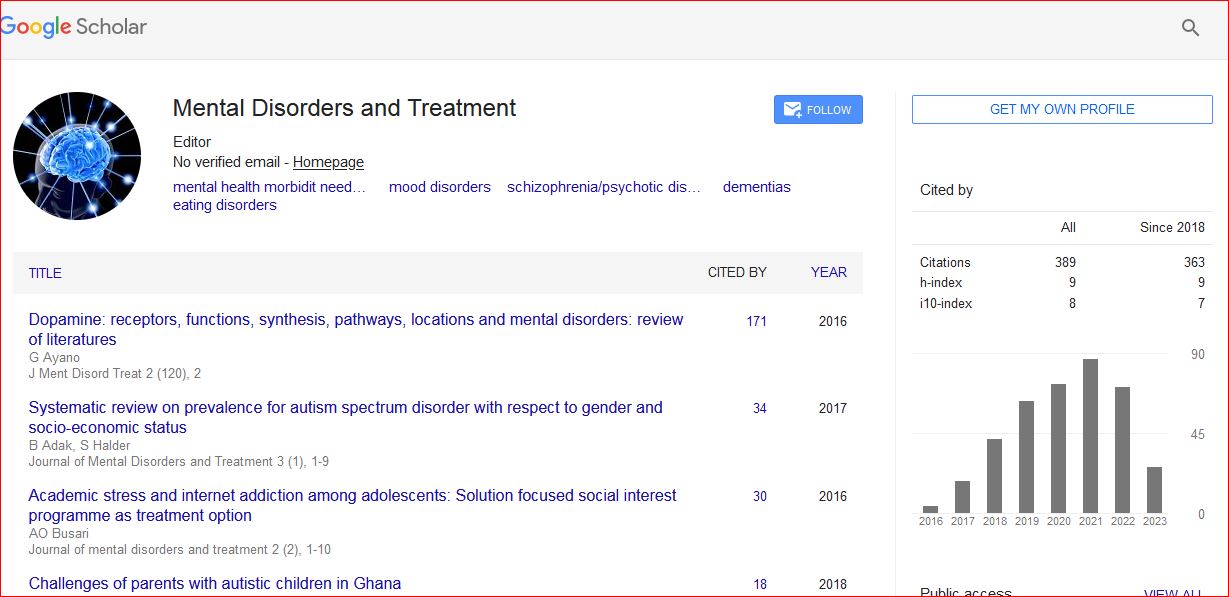
Mental Disorders and Treatment received 556 citations as per Google Scholar report