Opinion - (2025) Volume 16, Issue 4
Received: 01-Aug-2025, Manuscript No. jmbd-26-179490;
Editor assigned: 04-Aug-2025, Pre QC No. P-179490;
Reviewed: 14-Aug-2025, QC No. Q-179490;
Revised: 21-Aug-2025, Manuscript No. R-179490;
Published:
29-Aug-2025
, DOI: 10.37421/2155-9929.2025.16.716
Citation: Dupont, Natalie. ”High-Throughput Biomarker Discovery: Transforming Diagnostics and Medicine.” J Mol Biomark Diagn 16 (2025):716.
Copyright: © 2025 Dupont N. This is an open-access article distributed under the terms of the Creative Commons Attribution License, which permits unrestricted use,
distribution and reproduction in any medium, provided the original author and source are credited.
High-throughput technologies have revolutionized biomarker discovery, significantly advancing molecular diagnostics by enabling the identification of novel markers at an unprecedented scale. These advancements are driven by sophisticated computational analysis and the integration of multi-omics data, shifting the paradigm from single-target approaches to comprehensive molecular profiling for enhanced disease detection and personalized medicine [1].
The application of single-cell multi-omics provides a powerful lens to dissect cellular heterogeneity in disease states, offering deeper insights into disease mechanisms and the promise of more precise diagnostic markers. By simultaneously analyzing genomics, transcriptomics, and epigenomics from individual cells, researchers can pinpoint rare cell populations or specific molecular signatures linked to disease onset and progression [2].
Liquid biopsies represent a significant leap forward in non-invasive biomarker discovery for various cancers, focusing on circulating tumor DNA (ctDNA), circulating tumor cells (CTCs), and extracellular vesicles (EVs). These sources are pivotal for diagnostic and monitoring biomarkers, with high-throughput methods facilitating their isolation and analysis for early detection and treatment response assessment [3].
A novel computational framework for integrating multi-omics data has been developed to identify robust diagnostic biomarkers for neurodegenerative diseases. This approach combines genomic, proteomic, and metabolomic datasets, illustrating how machine learning algorithms can uncover complex molecular patterns indicative of early disease stages, thereby improving diagnostic accuracy [4].
High-throughput screening of small molecules has emerged as a promising avenue for discovering diagnostic biomarkers for infectious diseases. Utilizing automated liquid handling and advanced detection methods, unique molecular signatures correlating with specific pathogens can be identified, paving the way for rapid and sensitive diagnostic tools [5].
Advances in mass spectrometry-based proteomics are significantly contributing to biomarker discovery in autoimmune diseases. High-throughput mass spectrometry's capability to identify and quantify thousands of proteins enables the discovery of novel protein biomarkers for early diagnosis, disease subtyping, and monitoring therapeutic responses in complex conditions [6].
The potential of digital microfluidics coupled with high-throughput screening for point-of-care biomarker discovery is being explored. This technology facilitates miniaturization and automation of complex assays, allowing rapid analysis of multiple biomarkers from small sample volumes, crucial for accessible diagnostic tools in resource-limited settings [7].
Metabolomics, leveraging high-throughput platforms, plays a vital role in identifying biomarkers for metabolic disorders. Comprehensive analysis of small molecules can reveal metabolic perturbations associated with diseases like diabetes and obesity, offering potential for early diagnosis and personalized treatment strategies, despite challenges in data analysis and validation [8].
High-throughput epigenomic profiling, particularly focusing on DNA methylation patterns, is instrumental in discovering novel biomarkers for cancer detection. Array-based and sequencing-based methods identify epigenetic signatures that distinguish cancer patients, holding potential for early diagnosis and risk stratification [9].
Transcriptomic approaches, utilizing high-throughput RNA sequencing and microarray technologies, are making substantial progress in biomarker discovery for cardiovascular diseases. These methods allow for the identification of gene expression profiles that indicate disease risk, progression, and treatment response, facilitating personalized risk assessment and therapeutic intervention [10].
High-throughput technologies are revolutionizing biomarker discovery by enabling the identification of novel diagnostic and prognostic markers on an unprecedented scale within molecular diagnostics. This is achieved through advancements in genomics, transcriptomics, proteomics, and metabolomics, coupled with sophisticated computational analysis. The integration of multi-omics data and the development of predictive models are driving the shift towards personalized medicine, enabling comprehensive molecular profiling for earlier and more accurate disease detection [1].
Single-cell multi-omics is crucial for dissecting cellular heterogeneity in disease states, which is a fundamental aspect of biomarker discovery. By simultaneously analyzing genomics, transcriptomics, and epigenomics from individual cells, researchers can identify rare cell populations or specific molecular signatures associated with disease onset and progression. This approach provides deeper insights into disease mechanisms and promises more precise diagnostic markers [2].
Liquid biopsies are increasingly utilized for non-invasive biomarker discovery in oncology, with a focus on circulating tumor DNA (ctDNA), circulating tumor cells (CTCs), and extracellular vesicles (EVs). These components serve as vital sources of diagnostic and monitoring biomarkers. High-throughput methods are employed for their isolation and analysis, highlighting their potential for early detection, assessment of treatment response, and monitoring of minimal residual disease [3].
A novel computational framework has been developed to integrate multi-omics data for the identification of robust diagnostic biomarkers for neurodegenerative diseases. By combining genomic, proteomic, and metabolomic datasets, the study demonstrates how machine learning algorithms can uncover complex molecular patterns indicative of early disease stages, thereby improving diagnostic accuracy and identifying potential therapeutic targets [4].
High-throughput screening of small molecules is being explored for their potential as diagnostic biomarkers for infectious diseases. The use of automated liquid handling and advanced detection methods allows for the identification of unique molecular signatures in patient samples that correlate with specific pathogens, leading to the development of rapid and sensitive diagnostic tools [5].
Mass spectrometry-based proteomics has seen significant advancements for biomarker discovery in autoimmune diseases. The capability of high-throughput mass spectrometry to identify and quantify thousands of proteins in biological samples is crucial for discovering novel protein biomarkers for early diagnosis, disease subtyping, and monitoring therapeutic responses in conditions such as rheumatoid arthritis and lupus [6].
Digital microfluidics, when coupled with high-throughput screening, offers significant potential for point-of-care biomarker discovery. This technology enables the miniaturization and automation of complex assays, facilitating the rapid analysis of multiple biomarkers from small sample volumes. This is essential for developing accessible and efficient diagnostic tools for remote or resource-limited settings [7].
High-throughput metabolomics platforms are instrumental in identifying biomarkers for metabolic disorders. Comprehensive analysis of small molecules can reveal metabolic perturbations associated with diseases like diabetes and obesity, offering potential for early diagnosis and personalized treatment strategies. The review also addresses the challenges associated with data analysis and validation in this field [8].
High-throughput epigenomic profiling is being investigated for its role in discovering novel biomarkers for cancer detection. By focusing on DNA methylation patterns, array-based and sequencing-based methods are employed to identify epigenetic signatures that can distinguish cancer patients from healthy individuals, showing potential for early diagnosis and risk stratification [9].
Transcriptomic approaches are crucial for biomarker discovery in cardiovascular diseases. High-throughput RNA sequencing and microarray technologies enable the identification of gene expression profiles that serve as indicators of disease risk, progression, and treatment response. This facilitates personalized risk assessment and targeted therapeutic interventions [10].
High-throughput technologies are transforming biomarker discovery across various fields, including molecular diagnostics, oncology, neurodegenerative diseases, infectious diseases, autoimmune diseases, metabolic disorders, and cardiovascular diseases. These technologies, encompassing genomics, transcriptomics, proteomics, metabolomics, and epigenomics, enable the identification of novel biomarkers through comprehensive molecular profiling. Single-cell multi-omics and liquid biopsies offer advanced insights into disease states and non-invasive diagnostic capabilities. Computational frameworks and advanced screening methods, such as mass spectrometry and digital microfluidics, are enhancing the accuracy, speed, and accessibility of biomarker discovery and diagnostic tools. The ultimate goal is to enable earlier disease detection, personalized medicine, and improved patient outcomes.
None
None
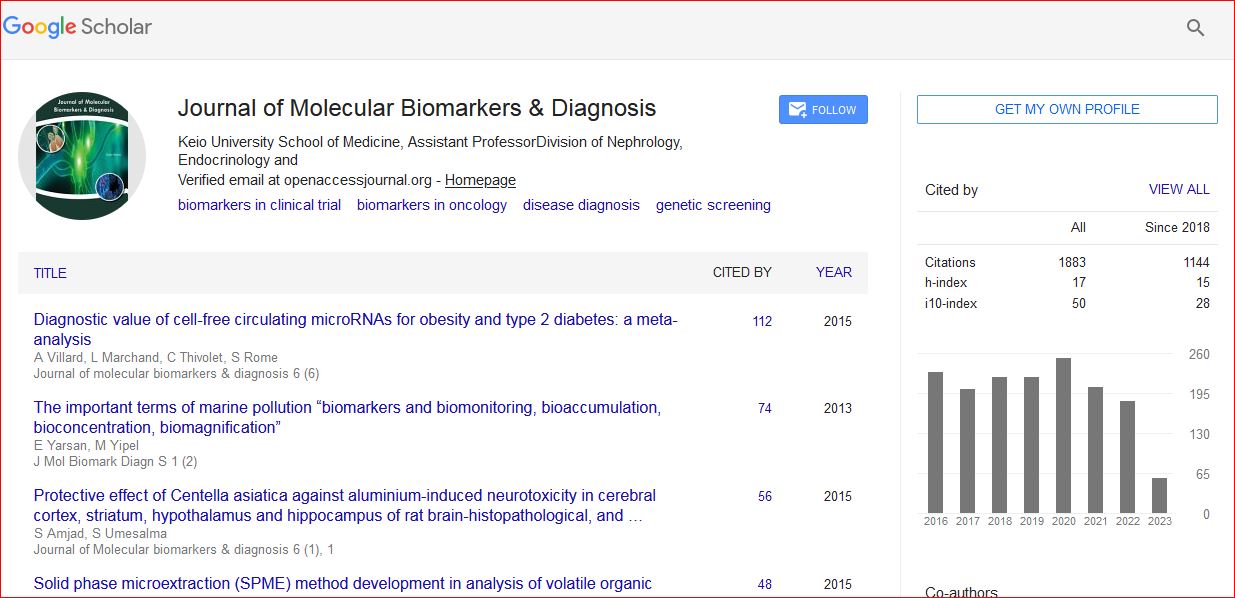
Journal of Molecular Biomarkers & Diagnosis received 2054 citations as per Google Scholar report