Opinion - (2025) Volume 14, Issue 4
Received: 01-Dec-2025, Manuscript No. ara-25-175628;
Editor assigned: 03-Dec-2025, Pre QC No. P-175628;
Reviewed: 17-Dec-2025, QC No. Q-175628;
Revised: 22-Dec-2025, Manuscript No. R-175628;
Published:
29-Dec-2025
, DOI: 10.37421/2168-9695.2025.14.346
Citation: Farrokhzad, Leila. ”Evolving Teleoperation: Haptics, Stability, Diverse Applications.” Adv Robot Autom 14 (2025):346.
Copyright: © 2025 Farrokhzad L. This is an open-access article distributed under the terms of the Creative Commons Attribution License, which permits unrestricted use, distribution and reproduction in any medium, provided the original author and source are credited.
This paper explores how haptic control improves human-robot interaction in situations where people work together with robots or use them to assist in tasks. It specifically looks at enhancing transparency and ensuring stability in teleoperation systems that use haptic feedback. The key takeaway is a new haptic control strategy that helps maintain stable interactions and provides clear force feedback, which is crucial for complex collaborative or assistive teleoperation tasks[1].
This review article traces the evolution of teleoperated robotic surgery from its early stages to current advancements and future prospects. It highlights critical aspects such as technological breakthroughs, clinical applications, and the challenges that still need to be addressed for broader adoption and enhanced capabilities in medical teleoperation. The authors discuss how improvements in haptics, imaging, and autonomy are shaping the next generation of surgical robots[2].
This research addresses the complex issue of time-varying delays in bilateral teleoperation systems, proposing an observer-based control scheme. The core idea is to achieve stable and transparent teleoperation even when communication delays are inconsistent. What's particularly useful here is the method for handling asymmetric communication delays, which often occur in real-world scenarios, ensuring system performance and operator fidelity remain high[3].
Here's the thing: operating aerial manipulators in dangerous places requires intuitive control. This paper introduces a multimodal human-robot interaction approach that lets operators use various input methods to precisely control a robot arm attached to a drone. It covers how vision, gestures, and haptic feedback come together to create a more effective teleoperation experience for tasks in hazardous environments, improving both safety and efficiency[4].
This article presents a model predictive control framework designed for shared-autonomy teleoperation, specifically with haptic assistance. What this really means is combining the precision of automated control with human intuition, using haptic feedback to guide the operator. It addresses how to balance human input with robotic autonomy, ensuring stable and effective control while offering helpful force cues to the human operator, which is vital for precise and delicate tasks[5].
Let's break it down: virtual reality (VR) and augmented reality (AR) are transforming how we interact with distant robots. This review investigates the influence of VR on teleoperation systems, looking at performance metrics and the overall user experience. It highlights how immersive environments can improve spatial awareness and interaction fidelity, but also points out challenges like latency and simulator sickness, providing a comprehensive overview of VR's role in the future of teleoperation[6].
Achieving haptic transparency in teleoperation, especially with unpredictable time delays, is a significant challenge. This paper introduces an energy-preserving bilateral teleoperation scheme that focuses on maintaining realistic force feedback while ensuring system stability, even when communication channels are unreliable. The main contribution is a control strategy that balances the need for accurate force reflection with the imperative of preventing energy accumulation and instability in the presence of uncertain delays[7].
This study delves into robust adaptive bilateral teleoperation specifically for rehabilitation applications, tackling the common problem of uncertain time-varying delays. It proposes an adaptive control approach that ensures stable and effective interaction between a human user and a rehabilitation robot, even under fluctuating network conditions. The core benefit is providing consistent and safe therapeutic support, which is critical for patient recovery and consistent treatment delivery[8].
Operating robots in space presents unique human factors challenges in teleoperation. This review examines these complexities, covering everything from communication delays and restricted sensory feedback to psychological stressors on operators. It identifies key opportunities for improving human-robot interfaces and training protocols to ensure mission success and astronaut safety, offering insights for designing more effective and resilient space teleoperation systems[9].
This paper outlines the development of a teleoperated robotic system for automated tasks within greenhouse environments. The goal is to create a system capable of unmanned operation, helping with agricultural tasks like monitoring or harvesting without direct human presence. It covers the design considerations, control strategies, and practical implementation to demonstrate how teleoperation can significantly boost efficiency and reduce human labor in controlled farming settings[10].
Teleoperation systems are fundamental for extending human capabilities into remote or hazardous environments. A core area of development focuses on enhancing human-robot interaction, particularly through haptic control. For instance, new haptic control strategies are vital for maintaining stable interactions and providing clear force feedback in complex collaborative or assistive teleoperation tasks [1]. Such approaches are crucial for situations where people work closely with robots, ensuring transparency and stability in haptic teleoperation systems [1]. These advancements are also shaping the next generation of robotic systems, moving towards more intuitive and responsive control mechanisms.
One of the persistent challenges in teleoperation involves managing communication delays, which can be inconsistent and time-varying. Researchers are proposing observer-based control schemes to achieve stable and transparent teleoperation even under these conditions, specifically addressing asymmetric communication delays common in real-world scenarios [3]. This ensures system performance and operator fidelity remain high. Similarly, achieving haptic transparency over unpredictable time delays is a significant hurdle, leading to the introduction of energy-preserving bilateral teleoperation schemes [7]. These focus on maintaining realistic force feedback while guaranteeing system stability, preventing energy accumulation and instability even when communication channels are unreliable [7]. Robust adaptive bilateral teleoperation also tackles uncertain time-varying delays, particularly for sensitive applications like rehabilitation, ensuring stable and effective interaction under fluctuating network conditions [8].
The applications of teleoperation span various critical domains. In the medical field, teleoperated robotic surgery has evolved significantly, with ongoing advancements in haptics, imaging, and autonomy promising broader adoption and enhanced capabilities [2]. Beyond surgery, operating aerial manipulators in dangerous places demands intuitive control, leading to multimodal Human-Robot Interaction (HRI) approaches that combine vision, gestures, and haptic feedback for precise control in hazardous environments [4]. This improves both safety and efficiency for drone-based tasks. Teleoperation is also being explored for unmanned operations in controlled agricultural settings, like greenhouses, where robotic systems can boost efficiency and reduce human labor in tasks such as monitoring or harvesting [10].
The integration of advanced interaction methods is another frontier. Model predictive control frameworks are being designed for shared-autonomy teleoperation, where haptic assistance combines automated precision with human intuition [5]. This provides helpful force cues to the human operator, essential for precise and delicate tasks, balancing human input with robotic autonomy for stable and effective control [5]. Additionally, immersive technologies like Virtual Reality (VR) and Augmented Reality (AR) are transforming how we interact with distant robots, improving spatial awareness and interaction fidelity in teleoperation systems [6]. However, this also introduces challenges like latency and simulator sickness that need careful consideration [6].
Operating robots in extreme environments, such as space, introduces unique human factors challenges. These include communication delays, restricted sensory feedback, and psychological stressors on operators, underscoring the need for improved human-robot interfaces and training protocols to ensure mission success and astronaut safety [9]. The ongoing research across these areas highlights a collective effort to push the boundaries of teleoperation, making robots more accessible, controllable, and effective companions or tools for humans in an ever-expanding array of contexts, from Earth-bound assistance to interstellar exploration.
Teleoperation systems are evolving to enhance human-robot interaction across diverse applications. A key focus is improving haptic control for stable and transparent force feedback, crucial for collaborative and assistive tasks. Researchers are addressing challenges like time-varying and asymmetric communication delays, which can compromise system stability and operator fidelity. Novel observer-based and energy-preserving control schemes aim to maintain realistic force reflection even under unreliable network conditions. Applications range from delicate teleoperated robotic surgery, where advancements in haptics, imaging, and autonomy are shaping next-generation systems, to operating aerial manipulators in hazardous environments using multimodal Human-Robot Interaction (HRI) for precise control. Shared-autonomy frameworks, often leveraging haptic assistance, combine automated precision with human intuition, offering vital force cues for delicate tasks. The impact of Virtual Reality (VR) and Augmented Reality (AR) on teleoperation user experience and spatial awareness is also under review, alongside challenges like latency. Furthermore, teleoperation is being adapted for rehabilitation, providing stable therapeutic support despite fluctuating network conditions, and for unmanned operations in agricultural settings like greenhouses. Human factors in extreme environments, such as space teleoperation, are also being studied to improve interfaces and training, ensuring mission success and astronaut safety. Ultimately, the goal is to create more intuitive, stable, and effective remote control systems for robots in complex, diverse, and often critical scenarios.
None
None
Hang Y, Haoyue M, Yuanqing S. "Haptic Control for Human-Robot Interaction during Assistive and Collaborative Teleoperation".IEEE Trans Cybern 53 (2023):1460-1471.
Indexed at, Google Scholar, Crossref
Jun F, Yi L, Hongyu S. "Teleoperated Robotic Surgery: From Past to Future".Annu Rev Control 53 (2022):49-65.
Indexed at, Google Scholar, Crossref
Xiaoyu H, Chengqiang Y, Shougui F. "Observer-Based Asymmetric Bilateral Teleoperation With Time-Varying Delays".IEEE Trans Cybern 53 (2023):6979-6992.
Indexed at, Google Scholar, Crossref
Marco M, Carlo M, Pietro DL. "Multimodal Human-Robot Interaction for Teleoperation of an Aerial Manipulator in Hazardous Environments".Sensors 22 (2022):9807.
Indexed at, Google Scholar, Crossref
Haoyue M, Yuanqing S, Yan C. "A Model Predictive Control Approach for Shared-Autonomy Teleoperation with Haptic Assistance".IEEE Trans Ind Electron 70 (2023):1668-1678.
Indexed at, Google Scholar, Crossref
Fanbo M, Bo Y, Peiqi Z. "Exploring the Impact of Virtual Reality on Teleoperation System Performance and User Experience: A Review".Sensors 23 (2023):6484.
Indexed at, Google Scholar, Crossref
Gang L, Chong S, Yu H. "Energy-Preserving Bilateral Teleoperation With Haptic Transparency Over Uncertain Time-Varying Delays".IEEE Trans Ind Electron 70 (2023):6134-6144.
Indexed at, Google Scholar, Crossref
Rui L, Mingyao D, Tao T. "Robust Adaptive Bilateral Teleoperation for Rehabilitation With Uncertain Time-Varying Delays".IEEE Trans Ind Electron 70 (2023):7257-7268.
Indexed at, Google Scholar, Crossref
Jinyao L, Meng Z, Min F. "A Review on Human Factors in Space Teleoperation: Challenges and Opportunities".Hum Factors Ergon Manuf 33 (2023):3-28.
Indexed at, Google Scholar, Crossref
Qingchun Y, Zhaoxian L, Chao W. "Development of a Teleoperated Robotic System for Unmanned Operation in Greenhouse Environment".Sensors 23 (2023):8689.
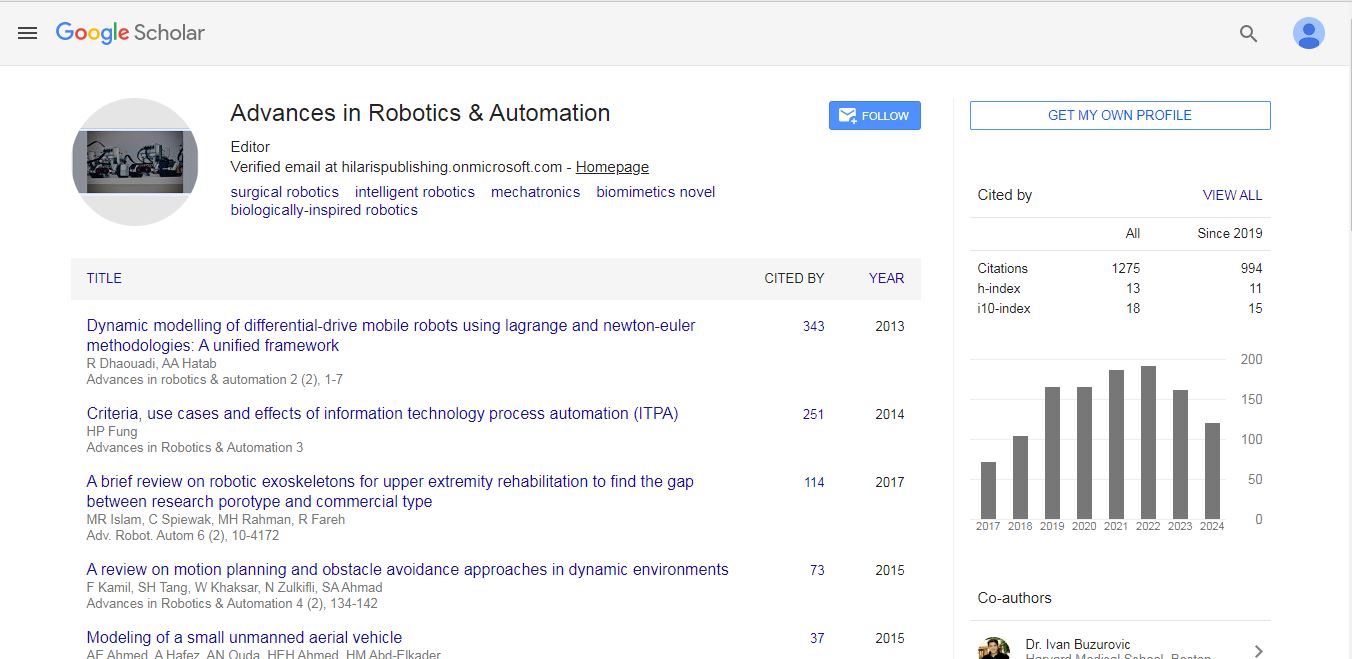
Advances in Robotics & Automation received 1275 citations as per Google Scholar report