Brief Report - (2025) Volume 10, Issue 2
Received: 01-Apr-2025, Manuscript No. jidm-26-188046;
Editor assigned: 03-Apr-2025, Pre QC No. P-188046© 2025 Smith J. This is an open-access article distributed under the ter;
Reviewed: 17-Apr-2025, QC No. Q-188046;
Revised: 22-Apr-2025, Manuscript No. R-188046;
Published:
29-Apr-2025
, DOI: 10.37421/2576-1420.2025.10.389
Citation: Smith, James. ”Evolving Infectious Disease Diagnosis
and Management.” J Infect Dis Med 10 (2025):389.
Copyright: © 2025 Smith J. This is an open-access article distributed under the terms of the Creative Commons Attribution License, which permits unrestricted use, distribution
and reproduction in any medium, provided the original author and source are credited.
The field of infectious disease diagnosis and management is undergoing a profound transformation, propelled by remarkable advancements in molecular diagnostics, artificial intelligence, and innovative therapeutic strategies. The imperative for rapid and accurate pathogen identification remains paramount, directly influencing the timeliness of treatment initiation and the efficacy of containment efforts for infectious outbreaks. Next-generation sequencing (NGS) technologies have emerged as a cornerstone in this evolution, offering unprecedented resolution for detailed outbreak investigations and providing critical insights into antimicrobial resistance profiling.
Concurrently, the landscape of point-of-care testing (POCT) is rapidly expanding, signifying a critical shift towards bringing diagnostic capabilities closer to the patient, thereby facilitating immediate clinical decision-making. In parallel with diagnostic progress, the management of infectious diseases is increasingly embracing personalized medicine approaches, leveraging detailed genomic data to tailor treatment regimens to individual patient profiles and pathogen characteristics. The escalating global challenge of antimicrobial resistance (AMR) necessitates a proactive exploration and implementation of novel therapeutic strategies, encompassing promising avenues such as phage therapy and sophisticated combination treatments designed to overcome resistant strains. Public health initiatives are also actively integrating sophisticated digital tools for enhanced disease surveillance and the development of predictive modeling capabilities to anticipate and respond to emerging threats. The evolving understanding of the human microbiome and its intricate relationship with infectious diseases is opening new frontiers for diagnostic and therapeutic interventions, suggesting that modulating microbial communities may play a significant role in future management strategies. Host-directed therapies (HDTs) represent another significant paradigm shift, focusing on modulating the host's immune response to combat infection rather than solely targeting the pathogen, offering new hope for challenging infections. Digital epidemiology, fueled by real-time data integration from diverse sources, is becoming indispensable for understanding and responding to the complexities of disease outbreaks in a rapidly connected world. The continuous development of novel antimicrobial agents remains a critical area of research, driven by the urgent need to counteract the growing threat of resistance and ensure effective treatment options are available for future infections. The application of artificial intelligence (AI) and machine learning (ML) is further revolutionizing infectious disease management by enabling the analysis of vast and complex datasets to improve diagnostic accuracy, predict disease trajectories, and optimize treatment strategies, heralding a new era of precision in infectious disease care. The field of infectious disease diagnosis and management is undergoing a profound transformation, propelled by remarkable advancements in molecular diagnostics, artificial intelligence, and innovative therapeutic strategies. The imperative for rapid and accurate pathogen identification remains paramount, directly influencing the timeliness of treatment initiation and the efficacy of containment efforts for infectious outbreaks. Next-generation sequencing (NGS) technologies have emerged as a cornerstone in this evolution, offering unprecedented resolution for detailed outbreak investigations and providing critical insights into antimicrobial resistance profiling. Concurrently, the landscape of point-of-care testing (POCT) is rapidly expanding, signifying a critical shift towards bringing diagnostic capabilities closer to the patient, thereby facilitating immediate clinical decision-making. In parallel with diagnostic progress, the management of infectious diseases is increasingly embracing personalized medicine approaches, leveraging detailed genomic data to tailor treatment regimens to individual patient profiles and pathogen characteristics. The escalating global challenge of antimicrobial resistance (AMR) necessitates a proactive exploration and implementation of novel therapeutic strategies, encompassing promising avenues such as phage therapy and sophisticated combination treatments designed to overcome resistant strains. Public health initiatives are also actively integrating sophisticated digital tools for enhanced disease surveillance and the development of predictive modeling capabilities to anticipate and respond to emerging threats. The evolving understanding of the human microbiome and its intricate relationship with infectious diseases is opening new frontiers for diagnostic and therapeutic interventions, suggesting that modulating microbial communities may play a significant role in future management strategies. Host-directed therapies (HDTs) represent another significant paradigm shift, focusing on modulating the host's immune response to combat infection rather than solely targeting the pathogen, offering new hope for challenging infections. Digital epidemiology, fueled by real-time data integration from diverse sources, is becoming indispensable for understanding and responding to the complexities of disease outbreaks in a rapidly connected world. The continuous development of novel antimicrobial agents remains a critical area of research, driven by the urgent need to counteract the growing threat of resistance and ensure effective treatment options are available for future infections. The application of artificial intelligence (AI) and machine learning (ML) is further revolutionizing infectious disease management by enabling the analysis of vast and complex datasets to improve diagnostic accuracy, predict disease trajectories, and optimize treatment strategies, heralding a new era of precision in infectious disease care. The field of infectious disease diagnosis and management is undergoing a profound transformation, propelled by remarkable advancements in molecular diagnostics, artificial intelligence, and innovative therapeutic strategies. The imperative for rapid and accurate pathogen identification remains paramount, directly influencing the timeliness of treatment initiation and the efficacy of containment efforts for infectious outbreaks. Next-generation sequencing (NGS) technologies have emerged as a cornerstone in this evolution, offering unprecedented resolution for detailed outbreak investigations and providing critical insights into antimicrobial resistance profiling. Concurrently, the landscape of point-of-care testing (POCT) is rapidly expanding, signifying a critical shift towards bringing diagnostic capabilities closer to the patient, thereby facilitating immediate clinical decision-making. In parallel with diagnostic progress, the management of infectious diseases is increasingly embracing personalized medicine approaches, leveraging detailed genomic data to tailor treatment regimens to individual patient profiles and pathogen characteristics. The escalating global challenge of antimicrobial resistance (AMR) necessitates a proactive exploration and implementation of novel therapeutic strategies, encompassing promising avenues such as phage therapy and sophisticated combination treatments designed to overcome resistant strains. Public health initiatives are also actively integrating sophisticated digital tools for enhanced disease surveillance and the development of predictive modeling capabilities to anticipate and respond to emerging threats. The evolving understanding of the human microbiome and its intricate relationship with infectious diseases is opening new frontiers for diagnostic and therapeutic interventions, suggesting that modulating microbial communities may play a significant role in future management strategies. Host-directed therapies (HDTs) represent another significant paradigm shift, focusing on modulating the host's immune response to combat infection rather than solely targeting the pathogen, offering new hope for challenging infections. Digital epidemiology, fueled by real-time data integration from diverse sources, is becoming indispensable for understanding and responding to the complexities of disease outbreaks in a rapidly connected world. The continuous development of novel antimicrobial agents remains a critical area of research, driven by the urgent need to counteract the growing threat of resistance and ensure effective treatment options are available for future infections. The application of artificial intelligence (AI) and machine learning (ML) is further revolutionizing infectious disease management by enabling the analysis of vast and complex datasets to improve diagnostic accuracy, predict disease trajectories, and optimize treatment strategies, heralding a new era of precision in infectious disease care. The field of infectious disease diagnosis and management is undergoing a profound transformation, propelled by remarkable advancements in molecular diagnostics, artificial intelligence, and innovative therapeutic strategies. The imperative for rapid and accurate pathogen identification remains paramount, directly influencing the timeliness of treatment initiation and the efficacy of containment efforts for infectious outbreaks. Next-generation sequencing (NGS) technologies have emerged as a cornerstone in this evolution, offering unprecedented resolution for detailed outbreak investigations and providing critical insights into antimicrobial resistance profiling. Concurrently, the landscape of point-of-care testing (POCT) is rapidly expanding, signifying a critical shift towards bringing diagnostic capabilities closer to the patient, thereby facilitating immediate clinical decision-making. In parallel with diagnostic progress, the management of infectious diseases is increasingly embracing personalized medicine approaches, leveraging detailed genomic data to tailor treatment regimens to individual patient profiles and pathogen characteristics. The escalating global challenge of antimicrobial resistance (AMR) necessitates a proactive exploration and implementation of novel therapeutic strategies, encompassing promising avenues such as phage therapy and sophisticated combination treatments designed to overcome resistant strains. Public health initiatives are also actively integrating sophisticated digital tools for enhanced disease surveillance and the development of predictive modeling capabilities to anticipate and respond to emerging threats. The evolving understanding of the human microbiome and its intricate relationship with infectious diseases is opening new frontiers for diagnostic and therapeutic interventions, suggesting that modulating microbial communities may play a significant role in future management strategies. Host-directed therapies (HDTs) represent another significant paradigm shift, focusing on modulating the host's immune response to combat infection rather than solely targeting the pathogen, offering new hope for challenging infections. Digital epidemiology, fueled by real-time data integration from diverse sources, is becoming indispensable for understanding and responding to the complexities of disease outbreaks in a rapidly connected world. The continuous development of novel antimicrobial agents remains a critical area of research, driven by the urgent need to counteract the growing threat of resistance and ensure effective treatment options are available for future infections. The application of artificial intelligence (AI) and machine learning (ML) is further revolutionizing infectious disease management by enabling the analysis of vast and complex datasets to improve diagnostic accuracy, predict disease trajectories, and optimize treatment strategies, heralding a new era of precision in infectious disease care. The field of infectious disease diagnosis and management is undergoing a profound transformation, propelled by remarkable advancements in molecular diagnostics, artificial intelligence, and innovative therapeutic strategies. The imperative for rapid and accurate pathogen identification remains paramount, directly influencing the timeliness of treatment initiation and the efficacy of containment efforts for infectious outbreaks. Next-generation sequencing (NGS) technologies have emerged as a cornerstone in this evolution, offering unprecedented resolution for detailed outbreak investigations and providing critical insights into antimicrobial resistance profiling. Concurrently, the landscape of point-of-care testing (POCT) is rapidly expanding, signifying a critical shift towards bringing diagnostic capabilities closer to the patient, thereby facilitating immediate clinical decision-making. In parallel with diagnostic progress, the management of infectious diseases is increasingly embracing personalized medicine approaches, leveraging detailed genomic data to tailor treatment regimens to individual patient profiles and pathogen characteristics. The escalating global challenge of antimicrobial resistance (AMR) necessitates a proactive exploration and implementation of novel therapeutic strategies, encompassing promising avenues such as phage therapy and sophisticated combination treatments designed to overcome resistant strains. Public health initiatives are also actively integrating sophisticated digital tools for enhanced disease surveillance and the development of predictive modeling capabilities to anticipate and respond to emerging threats. The evolving understanding of the human microbiome and its intricate relationship with infectious diseases is opening new frontiers for diagnostic and therapeutic interventions, suggesting that modulating microbial communities may play a significant role in future management strategies. Host-directed therapies (HDTs) represent another significant paradigm shift, focusing on modulating the host's immune response to combat infection rather than solely targeting the pathogen, offering new hope for challenging infections. Digital epidemiology, fueled by real-time data integration from diverse sources, is becoming indispensable for understanding and responding to the complexities of disease outbreaks in a rapidly connected world. The continuous development of novel antimicrobial agents remains a critical area of research, driven by the urgent need to counteract the growing threat of resistance and ensure effective treatment options are available for future infections. The application of artificial intelligence (AI) and machine learning (ML) is further revolutionizing infectious disease management by enabling the analysis of vast and complex datasets to improve diagnostic accuracy, predict disease trajectories, and optimize treatment strategies, heralding a new era of precision in infectious disease care. The field of infectious disease diagnosis and management is undergoing a profound transformation, propelled by remarkable advancements in molecular diagnostics, artificial intelligence, and innovative therapeutic strategies. The imperative for rapid and accurate pathogen identification remains paramount, directly influencing the timeliness of treatment initiation and the efficacy of containment efforts for infectious outbreaks. Next-generation sequencing (NGS) technologies have emerged as a cornerstone in this evolution, offering unprecedented resolution for detailed outbreak investigations and providing critical insights into antimicrobial resistance profiling. Concurrently, the landscape of point-of-care testing (POCT) is rapidly expanding, signifying a critical shift towards bringing diagnostic capabilities closer to the patient, thereby facilitating immediate clinical decision-making. In parallel with diagnostic progress, the management of infectious diseases is increasingly embracing personalized medicine approaches, leveraging detailed genomic data to tailor treatment regimens to individual patient profiles and pathogen characteristics. The escalating global challenge of antimicrobial resistance (AMR) necessitates a proactive exploration and implementation of novel therapeutic strategies, encompassing promising avenues such as phage therapy and sophisticated combination treatments designed to overcome resistant strains. Public health initiatives are also actively integrating sophisticated digital tools for enhanced disease surveillance and the development of predictive modeling capabilities to anticipate and respond to emerging threats. The evolving understanding of the human microbiome and its intricate relationship with infectious diseases is opening new frontiers for diagnostic and therapeutic interventions, suggesting that modulating microbial communities may play a significant role in future management strategies. Host-directed therapies (HDTs) represent another significant paradigm shift, focusing on modulating the host's immune response to combat infection rather than solely targeting the pathogen, offering new hope for challenging infections. Digital epidemiology, fueled by real-time data integration from diverse sources, is becoming indispensable for understanding and responding to the complexities of disease outbreaks in a rapidly connected world. The continuous development of novel antimicrobial agents remains a critical area of research, driven by the urgent need to counteract the growing threat of resistance and ensure effective treatment options are available for future infections. The application of artificial intelligence (AI) and machine learning (ML) is further revolutionizing infectious disease management by enabling the analysis of vast and complex datasets to improve diagnostic accuracy, predict disease trajectories, and optimize treatment strategies, heralding a new era of precision in infectious disease care. The field of infectious disease diagnosis and management is undergoing a profound transformation, propelled by remarkable advancements in molecular diagnostics, artificial intelligence, and innovative therapeutic strategies. The imperative for rapid and accurate pathogen identification remains paramount, directly influencing the timeliness of treatment initiation and the efficacy of containment efforts for infectious outbreaks. Next-generation sequencing (NGS) technologies have emerged as a cornerstone in this evolution, offering unprecedented resolution for detailed outbreak investigations and providing critical insights into antimicrobial resistance profiling. Concurrently, the landscape of point-of-care testing (POCT) is rapidly expanding, signifying a critical shift towards bringing diagnostic capabilities closer to the patient, thereby facilitating immediate clinical decision-making. In parallel with diagnostic progress, the management of infectious diseases is increasingly embracing personalized medicine approaches, leveraging detailed genomic data to tailor treatment regimens to individual patient profiles and pathogen characteristics. The escalating global challenge of antimicrobial resistance (AMR) necessitates a proactive exploration and implementation of novel therapeutic strategies, encompassing promising avenues such as phage therapy and sophisticated combination treatments designed to overcome resistant strains. Public health initiatives are also actively integrating sophisticated digital tools for enhanced disease surveillance and the development of predictive modeling capabilities to anticipate and respond to emerging threats. The evolving understanding of the human microbiome and its intricate relationship with infectious diseases is opening new frontiers for diagnostic and therapeutic interventions, suggesting that modulating microbial communities may play a significant role in future management strategies. Host-directed therapies (HDTs) represent another significant paradigm shift, focusing on modulating the host's immune response to combat infection rather than solely targeting the pathogen, offering new hope for challenging infections. Digital epidemiology, fueled by real-time data integration from diverse sources, is becoming indispensable for understanding and responding to the complexities of disease outbreaks in a rapidly connected world. The continuous development of novel antimicrobial agents remains a critical area of research, driven by the urgent need to counteract the growing threat of resistance and ensure effective treatment options are available for future infections. The application of artificial intelligence (AI) and machine learning (ML) is further revolutionizing infectious disease management by enabling the analysis of vast and complex datasets to improve diagnostic accuracy, predict disease trajectories, and optimize treatment strategies, heralding a new era of precision in infectious disease care. The field of infectious disease diagnosis and management is undergoing a profound transformation, propelled by remarkable advancements in molecular diagnostics, artificial intelligence, and innovative therapeutic strategies. The imperative for rapid and accurate pathogen identification remains paramount, directly influencing the timeliness of treatment initiation and the efficacy of containment efforts for infectious outbreaks. Next-generation sequencing (NGS) technologies have emerged as a cornerstone in this evolution, offering unprecedented resolution for detailed outbreak investigations and providing critical insights into antimicrobial resistance profiling. Concurrently, the landscape of point-of-care testing (POCT) is rapidly expanding, signifying a critical shift towards bringing diagnostic capabilities closer to the patient, thereby facilitating immediate clinical decision-making. In parallel with diagnostic progress, the management of infectious diseases is increasingly embracing personalized medicine approaches, leveraging detailed genomic data to tailor treatment regimens to individual patient profiles and pathogen characteristics. The escalating global challenge of antimicrobial resistance (AMR) necessitates a proactive exploration and implementation of novel therapeutic strategies, encompassing promising avenues such as phage therapy and sophisticated combination treatments designed to overcome resistant strains. Public health initiatives are also actively integrating sophisticated digital tools for enhanced disease surveillance and the development of predictive modeling capabilities to anticipate and respond to emerging threats. The evolving understanding of the human microbiome and its intricate relationship with infectious diseases is opening new frontiers for diagnostic and therapeutic interventions, suggesting that modulating microbial communities may play a significant role in future management strategies. Host-directed therapies (HDTs) represent another significant paradigm shift, focusing on modulating the host's immune response to combat infection rather than solely targeting the pathogen, offering new hope for challenging infections. Digital epidemiology, fueled by real-time data integration from diverse sources, is becoming indispensable for understanding and responding to the complexities of disease outbreaks in a rapidly connected world. The continuous development of novel antimicrobial agents remains a critical area of research, driven by the urgent need to counteract the growing threat of resistance and ensure effective treatment options are available for future infections. The application of artificial intelligence (AI) and machine learning (ML) is further revolutionizing infectious disease management by enabling the analysis of vast and complex datasets to improve diagnostic accuracy, predict disease trajectories, and optimize treatment strategies, heralding a new era of precision in infectious disease care. The field of infectious disease diagnosis and management is undergoing a profound transformation, propelled by remarkable advancements in molecular diagnostics, artificial intelligence, and innovative therapeutic strategies. The imperative for rapid and accurate pathogen identification remains paramount, directly influencing the timeliness of treatment initiation and the efficacy of containment efforts for infectious outbreaks. Next-generation sequencing (NGS) technologies have emerged as a cornerstone in this evolution, offering unprecedented resolution for detailed outbreak investigations and providing critical insights into antimicrobial resistance profiling. Concurrently, the landscape of point-of-care testing (POCT) is rapidly expanding, signifying a critical shift towards bringing diagnostic capabilities closer to the patient, thereby facilitating immediate clinical decision-making. In parallel with diagnostic progress, the management of infectious diseases is increasingly embracing personalized medicine approaches, leveraging detailed genomic data to tailor treatment regimens to individual patient profiles and pathogen characteristics. The escalating global challenge of antimicrobial resistance (AMR) necessitates a proactive exploration and implementation of novel therapeutic strategies, encompassing promising avenues such as phage therapy and sophisticated combination treatments designed to overcome resistant strains. Public health initiatives are also actively integrating sophisticated digital tools for enhanced disease surveillance and the development of predictive modeling capabilities to anticipate and respond to emerging threats. The evolving understanding of the human microbiome and its intricate relationship with infectious diseases is opening new frontiers for diagnostic and therapeutic interventions, suggesting that modulating microbial communities may play a significant role in future management strategies. Host-directed therapies (HDTs) represent another significant paradigm shift, focusing on modulating the host's immune response to combat infection rather than solely targeting the pathogen, offering new hope for challenging infections. Digital epidemiology, fueled by real-time data integration from diverse sources, is becoming indispensable for understanding and responding to the complexities of disease outbreaks in a rapidly connected world. The continuous development of novel antimicrobial agents remains a critical area of research, driven by the urgent need to counteract the growing threat of resistance and ensure effective treatment options are available for future infections. The application of artificial intelligence (AI) and machine learning (ML) is further revolutionizing infectious disease management by enabling the analysis of vast and complex datasets to improve diagnostic accuracy, predict disease trajectories, and optimize treatment strategies, heralding a new era of precision in infectious disease care.The field of infectious disease diagnosis and management is undergoing a profound transformation, propelled by remarkable advancements in molecular diagnostics, artificial intelligence, and innovative therapeutic strategies. The imperative for rapid and accurate pathogen identification remains paramount, directly influencing the timeliness of treatment initiation and the efficacy of containment efforts for infectious outbreaks. Next-generation sequencing (NGS) technologies have emerged as a cornerstone in this evolution, offering unprecedented resolution for detailed outbreak investigations and providing critical insights into antimicrobial resistance profiling.
Concurrently, the landscape of point-of-care testing (POCT) is rapidly expanding, signifying a critical shift towards bringing diagnostic capabilities closer to the patient, thereby facilitating immediate clinical decision-making. In parallel with diagnostic progress, the management of infectious diseases is increasingly embracing personalized medicine approaches, leveraging detailed genomic data to tailor treatment regimens to individual patient profiles and pathogen characteristics. The escalating global challenge of antimicrobial resistance (AMR) necessitates a proactive exploration and implementation of novel therapeutic strategies, encompassing promising avenues such as phage therapy and sophisticated combination treatments designed to overcome resistant strains. Public health initiatives are also actively integrating sophisticated digital tools for enhanced disease surveillance and the development of predictive modeling capabilities to anticipate and respond to emerging threats. The evolving understanding of the human microbiome and its intricate relationship with infectious diseases is opening new frontiers for diagnostic and therapeutic interventions, suggesting that modulating microbial communities may play a significant role in future management strategies. Host-directed therapies (HDTs) represent another significant paradigm shift, focusing on modulating the host's immune response to combat infection rather than solely targeting the pathogen, offering new hope for challenging infections. Digital epidemiology, fueled by real-time data integration from diverse sources, is becoming indispensable for understanding and responding to the complexities of disease outbreaks in a rapidly connected world. The continuous development of novel antimicrobial agents remains a critical area of research, driven by the urgent need to counteract the growing threat of resistance and ensure effective treatment options are available for future infections. The application of artificial intelligence (AI) and machine learning (ML) is further revolutionizing infectious disease management by enabling the analysis of vast and complex datasets to improve diagnostic accuracy, predict disease trajectories, and optimize treatment strategies, heralding a new era of precision in infectious disease care.The field of infectious disease diagnosis and management is experiencing rapid evolution, driven by significant advancements in molecular diagnostics, AI-powered analytics, and novel therapeutic strategies. The timely identification of pathogens is critical for effective treatment and containment of infectious diseases. Next-generation sequencing (NGS) provides high-resolution capabilities for outbreak investigations and resistance profiling, fundamentally changing how we understand pathogen transmission and evolution.
Next-generation sequencing (NGS) is fundamentally transforming infectious disease diagnostics by enabling rapid, high-resolution pathogen identification and detailed characterization. This technology is proving invaluable for outbreak investigations, allowing for precise tracking of transmission chains and the identification of genomic markers associated with virulence or antimicrobial resistance. Furthermore, metagenomic sequencing offers a culture-independent approach to detect a broad spectrum of pathogens in complex samples, including those that are notoriously difficult to cultivate. The integration of NGS into routine clinical practice is becoming increasingly feasible due to decreasing costs and the continuous improvement of bioinformatics pipelines, making advanced genomic insights more accessible. Point-of-care testing (POCT) for infectious diseases offers the substantial advantage of delivering rapid results in decentralized settings, such as clinics, emergency departments, and even during home visits. This immediacy facilitates quicker clinical decision-making, significantly reducing the time to initiate appropriate antimicrobial therapy and thereby improving patient outcomes. Innovations in microfluidics and biosensor technology are driving the development of more sensitive and specific POCT devices capable of detecting a wide range of pathogens, including respiratory viruses and agents causing bloodstream infections. The expanding reach of POCT is a key strategy in enhancing overall infectious disease management and bolstering outbreak response capabilities. The growing global threat of antimicrobial resistance (AMR) presents a central and persistent challenge in the effective management of infectious diseases. This reality necessitates a dedicated exploration and implementation of novel therapeutic strategies that extend beyond the capabilities of conventional antibiotics. Phage therapy, which utilizes bacteriophages to specifically target and eliminate bacteria, is experiencing a resurgence in interest as a potential solution, particularly for treating multidrug-resistant infections. Moreover, a deeper understanding of the complex interplay between the host microbiome and the immune system is unveiling new avenues for adjunctive therapies designed to modulate the host's response to infection. Continued research into novel antimicrobial compounds and the development of combination therapy approaches remain critical in the ongoing fight against AMR. Artificial intelligence (AI) and machine learning (ML) are increasingly being deployed across the spectrum of infectious disease diagnosis and management. These powerful technologies excel at analyzing vast and complex datasets, encompassing patient clinical data, genomic information, and medical imaging, to identify subtle patterns and predict disease outcomes with remarkable accuracy. AI algorithms can significantly assist in the early detection of infections, optimize treatment regimens for individual patients, and identify those at highest risk for developing complications. Furthermore, AI is proving invaluable in the process of drug discovery and development, accelerating the identification and characterization of novel antimicrobial agents. The responsible and ethical integration of AI holds the promise of substantially enhancing the precision, efficiency, and overall effectiveness of infectious disease care. Host-directed therapies (HDTs) represent a fundamental paradigm shift in infectious disease management, moving beyond the traditional approach of solely targeting the pathogen to focus on modulating the host's intrinsic immune response. By strategically strengthening or dampening specific immune pathways, HDTs can effectively aid in clearing infections and reducing disease severity, particularly in instances of severe inflammation or chronic infections. This approach holds significant promise for managing a range of challenging conditions, including viral infections, tuberculosis, and sepsis, where host responses frequently contribute substantially to the observed pathology. Personalized approaches to HDTs, guided by detailed immunogenomic profiling, are emerging as a key area of intensive ongoing research. Digital epidemiology and real-time surveillance systems are indispensable for comprehending and effectively responding to infectious disease outbreaks. The seamless integration of diverse data sources, including information from social media platforms, electronic health records, and comprehensive genomic sequencing, enables the early detection and precise tracking of disease spread across populations. Predictive modeling, significantly powered by AI and ML technologies, can accurately forecast outbreak trajectories and provide critical evidence to inform public health interventions. This proactive and data-driven approach is absolutely essential for mitigating the impact of emerging and re-emerging infectious threats. The role of the human microbiome in the context of infectious diseases is a rapidly expanding and highly dynamic area of research. Alterations within the delicate balance of microbial communities in the gut, on the skin, or within the respiratory tract can profoundly influence an individual's susceptibility to infection, the subsequent progression of disease, and their response to various therapeutic interventions. Manipulating the microbiome, through methods such as fecal microbiota transplantation or the strategic use of probiotics, is actively being explored as a potential therapeutic strategy for managing recurrent infections, such as those caused by Clostridioides difficile, and holds promise for other infectious conditions. A comprehensive understanding of these intricate host-microbiome interactions is paramount to developing innovative and effective management approaches. Rapid genome sequencing and sophisticated bioinformatics pipelines are revolutionizing the surveillance and control strategies for infectious diseases on a global scale. Real-time genomic data obtained from active outbreaks allows for the precise tracking of pathogen evolution, the elucidation of transmission dynamics, and the identification of emerging drug-resistant strains. This critical information is essential for guiding public health interventions, informing vaccine development efforts, and facilitating the deployment of targeted and effective therapies. The increasing accessibility and remarkable speed of these advanced genomic technologies are establishing them as indispensable tools in modern infectious disease management and public health preparedness. The development of novel antimicrobial agents is of paramount importance in the ongoing global effort to combat escalating antimicrobial resistance. Research efforts are actively exploring a diverse range of approaches, including the sophisticated design of molecules that target novel bacterial pathways essential for survival, the resurrection of previously neglected but potent antibiotics from existing libraries, and the utilization of antimicrobial peptides with unique mechanisms of action. Furthermore, a deep understanding of the molecular mechanisms underlying resistance development is crucial for the rational design of effective countermeasures. Combination therapies, where multiple agents are employed synergistically, also represent a highly promising strategy for overcoming existing resistance patterns and substantially improving treatment efficacy against challenging infections.The field of infectious disease diagnosis and management is rapidly evolving due to advances in molecular diagnostics, AI, and novel therapies. Rapid pathogen identification is crucial, with next-generation sequencing (NGS) offering high resolution for outbreak investigations and resistance profiling. Point-of-care testing (POCT) is expanding to bring diagnostics closer to patients, enabling quicker clinical decisions. Management is shifting towards personalized medicine, using genomic data to tailor treatments. Antimicrobial resistance (AMR) drives the need for new strategies like phage therapy and combination treatments. Digital tools are integrated for surveillance and predictive modeling. The microbiome's role and host-directed therapies (HDTs) are emerging as new management avenues. Real-time genomic surveillance and AI are revolutionizing outbreak control and treatment optimization. Developing novel antimicrobial agents is paramount to combat resistance.
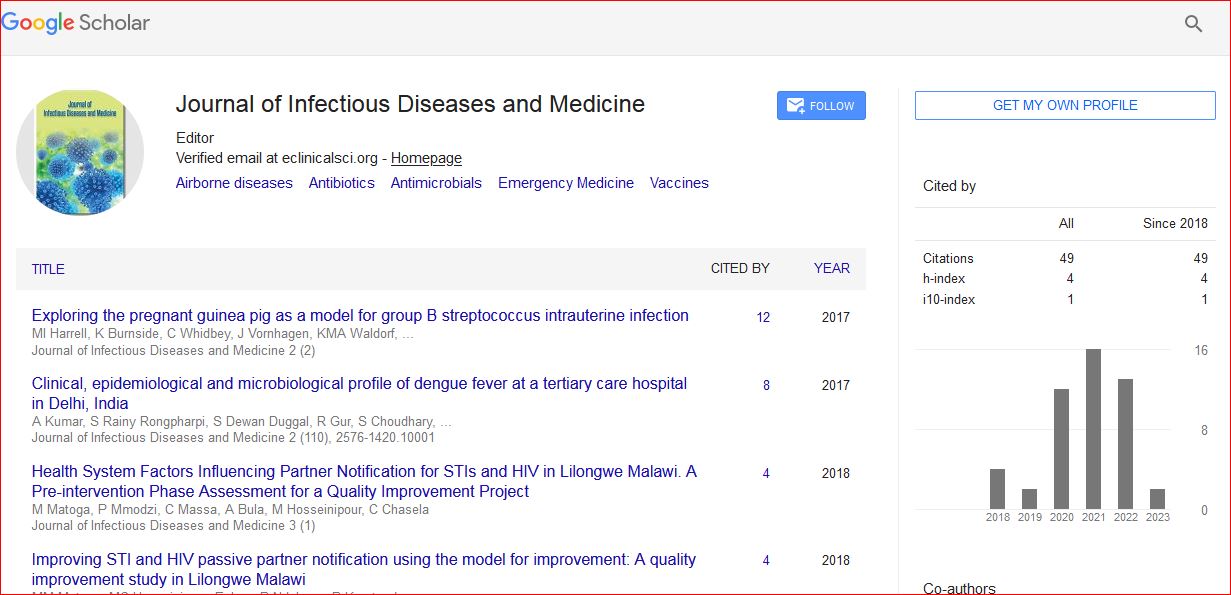
Journal of Infectious Diseases and Medicine received 1059 citations as per Google Scholar report