Brief Report - (2025) Volume 11, Issue 3
Received: 01-Aug-2025, Manuscript No. jotr-25-175590;
Editor assigned: 04-Aug-2025, Pre QC No. P-175590;
Reviewed: 18-Aug-2025, QC No. Q-175590;
Revised: 22-Aug-2025, Manuscript No. R-175590;
Published:
29-Aug-2025
, DOI: 10.37421/2476-2261. 2025.11.314
Citation: Zahidi, Amir. ”Evolving Immunotherapy: New Strategies, Overcoming Challenges.” J Oncol Transl Res 11 (2025):314.
Copyright: © 2025 Zahidi A. This is an open-access article distributed under the terms of the Creative Commons Attribution License, which permits unrestricted use, distribution and reproduction in any medium, provided the original author and source are credited.
Cancer immunotherapy is undergoing rapid evolution, moving beyond traditional immune checkpoint inhibitors to explore novel targets and synergistic combination strategies. It highlights the complex interplay within the tumor microenvironment and discusses how modulating this environment can enhance therapeutic outcomes. The review emphasizes the importance of personalized approaches and biomarker identification for predicting patient responses[1].
This review provides an in-depth analysis of T-cell exhaustion in the context of cancer, outlining its molecular mechanisms, phenotypic characteristics, and impact on anti-tumor immunity. It discusses how exhausted T cells impair the efficacy of current immunotherapies and explores various therapeutic strategies aimed at reversing or preventing T-cell exhaustion, including metabolic reprogramming and novel checkpoint inhibitors[2].
This article examines the significant strides and persistent challenges in applying CAR T-cell therapy to solid tumors. It details the strategies developed to overcome hurdles such as the immunosuppressive tumor microenvironment, antigen heterogeneity, and T-cell trafficking issues. The review also highlights ongoing clinical trials and future directions, including next-generation CAR T-cell designs and combination therapies[3].
This comprehensive review focuses on the critical role of immunosuppressive myeloid cells, such as myeloid-derived suppressor cells (MDSCs) and tumor-associated macrophages (TAMs), within the tumor microenvironment. It discusses their mechanisms of action in promoting tumor progression and resistance to immunotherapy, and explores various therapeutic strategies aimed at targeting these cells to enhance anti-tumor immune responses[4].
This article explores the diverse mechanisms underlying resistance to immune checkpoint blockade (ICB) therapies, which remain a significant challenge in cancer treatment. It categorizes resistance into primary, adaptive, and acquired forms, detailing the roles of tumor-intrinsic factors, the tumor microenvironment, and host-related factors. The review also discusses emerging strategies to overcome resistance, including novel combination therapies and biomarker-driven approaches[5].
This review provides an overview of oncolytic viruses (OVs) as a promising immunotherapeutic strategy for cancer. It describes how OVs selectively infect and lyse cancer cells while simultaneously stimulating anti-tumor immune responses. The article covers the various types of OVs, their mechanisms of action, current clinical applications, and strategies to enhance their efficacy, including combination therapies and genetic modifications[6].
This article explores the potential of Natural Killer (NK) cells as a potent effector cell type in cancer immunotherapy. It details the distinct advantages of NK cells, such as their ability to recognize and kill cancer cells without prior sensitization and their low risk of graft-versus-host disease. The review discusses various NK cell-based therapeutic approaches, including adoptive NK cell transfer, CAR-NK cells, and combination strategies[7].
This review highlights the latest breakthroughs in cancer vaccine development, focusing on new antigen discovery, innovative vaccine platforms (e.g., messenger RNA (mRNA), viral vectors), and strategies to enhance vaccine immunogenicity. It discusses the transition from prophylactic to therapeutic vaccines and the challenges in inducing robust and durable anti-tumor immune responses, particularly in combination with other immunotherapies[8].
Cancer immunotherapy is rapidly advancing, moving beyond traditional immune checkpoint inhibitors to explore novel targets and synergistic combination strategies. This approach recognizes the complex interplay within the tumor microenvironment, aiming to modulate it for enhanced therapeutic outcomes. The review emphasizes personalized approaches and biomarker identification for predicting patient responses [1]. Despite these advancements, significant challenges persist, particularly with resistance to immune checkpoint blockade (ICB) therapies. These resistance mechanisms are diverse, categorized into primary, adaptive, and acquired forms, influenced by tumor-intrinsic factors, the tumor microenvironment, and host-related elements. Addressing this resistance is crucial, driving the exploration of novel combination therapies and biomarker-driven strategies [5].
Key advancements in cellular immunotherapies include CAR T-cell therapy, which has made significant strides, especially for solid tumors. However, hurdles such as the immunosuppressive tumor microenvironment, antigen heterogeneity, and T-cell trafficking issues demand continued innovation. Ongoing clinical trials and future directions focus on next-generation CAR T-cell designs and combination therapies [3]. In parallel, Natural Killer (NK) cells are recognized as potent effector cells due to their ability to recognize and kill cancer cells without prior sensitization and their low risk of graft-versus-host disease. Various NK cell-based therapeutic approaches, including adoptive NK cell transfer, CAR-NK cells, and combination strategies, are actively being developed to harness their full potential [7].
A deeper understanding of T-cell exhaustion in cancer is paramount, outlining its molecular mechanisms, phenotypic characteristics, and profound impact on anti-tumor immunity. Exhausted T cells consistently impair the efficacy of current immunotherapies, driving the exploration of therapeutic strategies to reverse or prevent this exhaustion through avenues like metabolic reprogramming and novel checkpoint inhibitors [2]. Furthermore, the tumor microenvironment critically influences therapeutic responses, notably through immunosuppressive myeloid cells like myeloid-derived suppressor cells (MDSCs) and tumor-associated macrophages (TAMs). These cells significantly contribute to tumor progression and resistance, making their targeted elimination a viable strategy to enhance anti-tumor immune responses [4].
The emerging field of immunometabolism highlights how metabolic pathways within both immune and cancer cells shape anti-tumor immunity. Metabolic reprogramming can foster immune suppression within the tumor microenvironment, thus therapeutic strategies aimed at modulating these metabolic pathways are critical for enhancing the efficacy of immunotherapies [9]. Beyond this, oncolytic viruses (OVs) present a promising approach by selectively infecting and lysing cancer cells while simultaneously stimulating robust anti-tumor immune responses. Research explores various OV types, their mechanisms, clinical applications, and strategies like combination therapies and genetic modifications to boost their effectiveness [6]. Breakthroughs are also occurring in cancer vaccine development, focusing on new antigen discovery, innovative vaccine platforms such as messenger RNA (mRNA) and viral vectors, and methods to enhance vaccine immunogenicity. The goal is to transition from prophylactic to therapeutic vaccines and induce robust, durable anti-tumor immune responses, particularly when combined with other immunotherapies [8].
Finally, the profound impact of the gut microbiome on the efficacy and toxicity of cancer immunotherapies, especially immune checkpoint inhibitors, is increasingly recognized. Specific microbial species can modulate systemic and local immune responses, significantly influencing patient outcomes. Leveraging the microbiome through fecal microbiota transplantation and dietary interventions offers promising avenues to improve therapeutic responses and personalize treatment strategies [10].
Cancer immunotherapy is undergoing rapid evolution, shifting beyond traditional immune checkpoint inhibitors to investigate novel targets and synergistic combination strategies. This progression highlights the intricate dynamics within the tumor microenvironment, where factors like immunosuppressive myeloid cells and metabolic pathways significantly influence therapeutic outcomes, necessitating their modulation. Breakthroughs in cellular therapies, including CAR T-cell and Natural Killer (NK) cell approaches, are showing promise, even as they confront challenges specific to solid tumors. Efforts are continuously focused on developing next-generation designs and combination regimens for these cell-based treatments. A major challenge remains the diverse mechanisms of resistance to immune checkpoint blockade, prompting exploration into biomarker-driven and multi-modal strategies to overcome these hurdles. Other innovative avenues include the application of oncolytic viruses, designed to selectively target cancer cells while boosting immune responses, and advancements in cancer vaccine development with new platforms and immunogenicity enhancements. Furthermore, emerging evidence underscores the profound impact of the gut microbiome on immunotherapy efficacy and toxicity, suggesting novel interventions like fecal microbiota transplantation. Collectively, these diverse strategies emphasize the need for personalized approaches and a comprehensive understanding of the complex biological interactions that govern anti-tumor immunity to maximize therapeutic success.
None
None
Peter VD, Sujin K, Kyu-Chang K. "Beyond immune checkpoints: emerging targets and combination strategies in cancer immunotherapy".Semin Cancer Biol 93 (2023):18-36.
Indexed at, Google Scholar, Crossref
Jian L, Xiaomeng D, Rui C. "T-cell exhaustion in cancer: mechanisms, consequences, and therapeutic strategies".Signal Transduct Target Ther 7 (2022):161.
Indexed at, Google Scholar, Crossref
Di F, Yujun W, Dan G. "CAR T cells for solid tumors: current progress and future directions".Front Immunol 14 (2023):1145465.
Indexed at, Google Scholar, Crossref
Dmitry IG, Antonio S, Luigi L. "Targeting immunosuppressive myeloid cells in the tumor microenvironment for cancer therapy".Nat Rev Clin Oncol 20 (2023):443-465.
Indexed at, Google Scholar, Crossref
Soo L, Dong H, Qi Y. "Mechanisms of resistance to immune checkpoint blockade in cancer: recent advances and future directions".Front Immunol 13 (2022):1004128.
Indexed at, Google Scholar, Crossref
Yi S, Yanjun X, Yang S. "Oncolytic viruses in cancer therapy: advancements, challenges, and future perspectives".Front Immunol 14 (2023):1114569.
Indexed at, Google Scholar, Crossref
Shizhen L, Xiaoyu W, Shuwen Z. "Natural Killer Cell-Based Immunotherapy for Cancer: Current Status and Future Perspectives".Front Immunol 14 (2023):1134045.
Indexed at, Google Scholar, Crossref
Keewon C, Yoon JK, Seul KK. "Recent advances in cancer vaccine development".Exp Mol Med 55 (2023):1159-1172.
Indexed at, Google Scholar, Crossref
Wei H, Jie Y, Maobin W. "Reprogramming tumor immunometabolism for cancer therapy".Signal Transduct Target Ther 7 (2022):367.
Indexed at, Google Scholar, Crossref
Ting Z, Haihong W, Bing Z. "The gut microbiome in cancer immunotherapy: current evidence and future directions".Front Immunol 14 (2023):1133375.
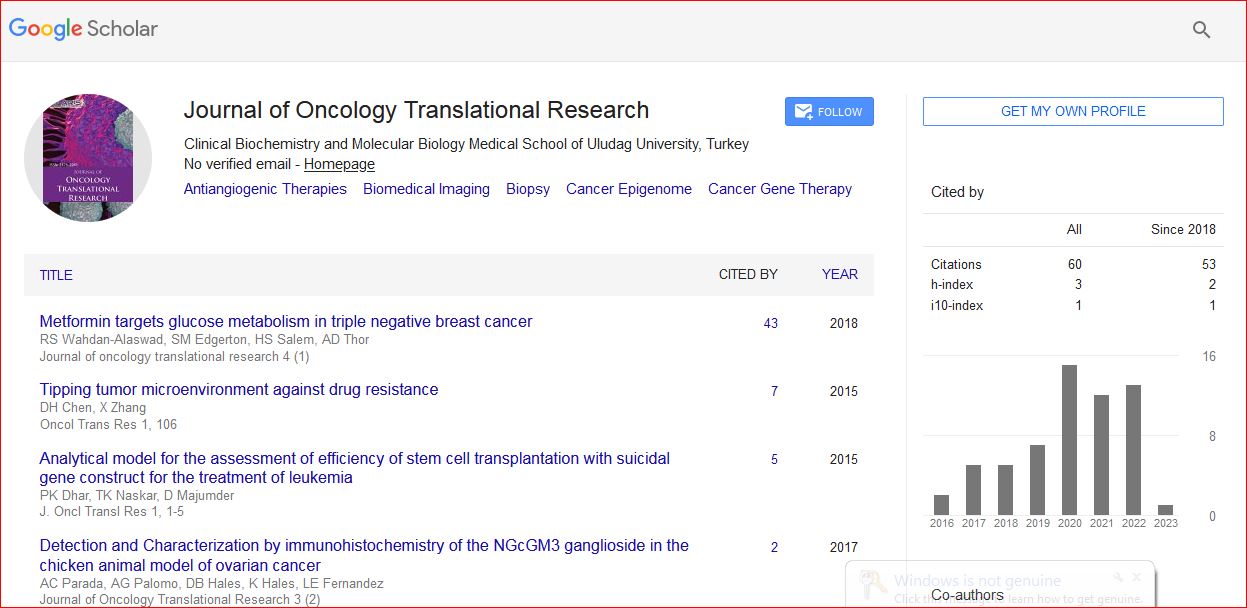
Journal of Oncology Translational Research received 93 citations as per Google Scholar report