Commentary - (2025) Volume 16, Issue 2
Received: 01-Apr-2025, Manuscript No. jar-25-176264;
Editor assigned: 03-Apr-2025, Pre QC No. P-176264;
Reviewed: 17-Apr-2025, QC No. Q-176264;
Revised: 22-Apr-2025, Manuscript No. R-176264;
Published:
29-Apr-2025
, DOI: 10.37421/2155-6113.2025.16.1054
Citation: Gonzalez, Maria. "Evolving HIV: Progress, Disparities,
Future Goals." J AIDS Clin Res 16 (2025):1054.
Copyright: © 2025 Gonzalez M. This is an open-access article distributed under the terms of the Creative Commons Attribution License, which permits unrestricted use,
distribution and reproduction in any medium, provided the original author and source are credited.
This paper offers an up-to-date overview of the global HIV epidemic, detailing current epidemiological patterns, the breadth of prevention strategies, and significant advancements in treatment services. It notably highlights persistent disparities in access and outcomes, which disproportionately affect vulnerable populations and specific regions. The authors stress the necessity for sustained and equitable investment to meet global targets for eradicating HIV [1].
Another comprehensive review provides a thorough examination of the current global HIV epidemic landscape. This includes a detailed look at the substantial progress made in prevention methods, such as Pre-Exposure Prophylaxis (PrEP), the efficacy of current antiretroviral treatments, and the ongoing quest for a definitive cure. Despite these achievements, the article also confronts enduring challenges, including persistent inequalities in access to care, the rise of viral resistance, and the complexities of managing comorbidities, all of which are critical hurdles to overcome for global eradication [2].
A systematic review has thoroughly investigated the profound impact of the COVID-19 pandemic on essential HIV services and the well-being of people living with HIV (PLHIV). This analysis revealed widespread disruptions across HIV testing, prevention, and treatment programs, alongside an increase in psychosocial difficulties experienced by PLHIV. These findings critically underscore the pressing need for the development of resilient health systems that are capable of sustaining vital services even amidst concurrent global crises [3].
Global progress toward the ambitious UNAIDS 90-90-90 targetsâ??focusing on HIV diagnosis, treatment, and viral suppressionâ??has been rigorously assessed. While considerable advancements are evident, particularly in certain geographical areas, the analysis identifies significant remaining gaps, especially in reaching key populations and regions with limited resources. The authors strongly advocate for intensified and precisely targeted interventions to bridge these outstanding gaps and accelerate progress [4].
An updated systematic review meticulously maps the global implementation of HIV Pre-Exposure Prophylaxis (PrEP), evaluating its adoption rates, overall effectiveness, and the barriers impeding its broader accessibility. It details notable progress in PrEP rollout across numerous regions but also points out ongoing challenges related to public awareness, pervasive stigma, cost implications, and equitable distribution, particularly impacting key populations. The review calls for highly customized strategies to optimize PrEP delivery and maximize its global impact [5].
A systematic review and meta-analysis quantitatively demonstrates the pervasive global burden of HIV stigma, illustrating its significant adverse effects on prevention efforts, testing uptake, treatment adherence, and the overall quality of life for people living with HIV. The authors emphasize that stigma remains a formidable obstacle to achieving effective epidemic control and urgently calls for comprehensive, culturally sensitive interventions to mitigate stigmatization worldwide [6].
This article delves into the unique challenges encountered by women within the context of the global HIV epidemic, encompassing both prevention and treatment aspects. It explores the biological vulnerabilities, complex socio-cultural factors, and economic disparities that disproportionately affect women, especially those residing in sub-Saharan Africa. The authors strongly advocate for the adoption of gender-sensitive approaches, integrated healthcare services, and initiatives that empower women to enhance outcomes and accelerate progress toward ending the HIV epidemic [7].
A systematic analysis uncovers critical global trends regarding HIV among older adults, an increasingly significant demographic largely due to the success of effective antiretroviral therapy. It highlights a rising prevalence and incidence within this age group, alongside specific difficulties in accurate diagnosis, consistent treatment, and the management of age-related comorbidities. The authors emphasize the urgent need for specialized healthcare strategies and integrated services designed to address the unique and evolving needs of an aging population living with HIV [8].
Research investigates the influence of global health initiatives (GHIs) on domestic health spending dedicated to HIV programs in Sub-Saharan Africa. The study found that while GHIs significantly increased overall HIV funding, their impact on *domestic* resource allocation proved variable, sometimes resulting in complex substitution effects rather than purely additive financial contributions. The research underscores the critical importance of aligning external aid with national priorities to foster the development of sustainable, self-reliant health systems capable of effectively responding to HIV [9].
A review article offers an extensive overview of current endeavors in HIV vaccine development, summarizing the present status of clinical trials and outlining crucial future research directions. It details various innovative vaccine strategies, including approaches based on broadly neutralizing antibodies and T-cell responses, while also discussing the scientific hurdles and promising advances in the field. The authors underscore the persistent global imperative for an effective preventative vaccine as an ultimate tool to truly halt the epidemic [10].
The global HIV epidemic is a complex and evolving public health challenge, with ongoing efforts to understand its epidemiological patterns, implement effective prevention strategies, and advance treatment services [1]. Significant strides have been made in managing the epidemic, notably through the development of highly effective antiretroviral treatments (ART) and innovative prevention methods like Pre-Exposure Prophylaxis (PrEP) [2]. While PrEP implementation has seen considerable rollout in many regions, persistent challenges such as awareness gaps, social stigma, cost barriers, and equitable distribution issues continue to hinder its broader access, especially for key populations [5]. These advancements and challenges highlight a dynamic landscape where progress is often juxtaposed with ongoing hurdles [2, 5].
Despite progress, the epidemic is characterized by persistent disparities in access to care and health outcomes, particularly impacting vulnerable populations and resource-limited regions [1]. Achieving global targets, such as the UNAIDS 90-90-90 goals for HIV diagnosis, treatment, and viral suppression, has seen significant movement in certain areas. However, critical gaps remain, particularly among key populations and in contexts with limited resources, necessitating accelerated and targeted interventions [4]. A major impediment to effective epidemic control is the pervasive global burden of HIV stigma, which demonstrably harms prevention efforts, testing rates, treatment adherence, and the overall well-being of people living with HIV. Addressing this requires comprehensive, context-specific interventions worldwide [6].
External factors, such as the COVID-19 pandemic, have profoundly disrupted essential HIV services globally, including testing, prevention, and treatment programs. The pandemic also intensified psychosocial challenges for people living with HIV, underscoring the urgent need for resilient health systems capable of maintaining vital services during concurrent crises [3]. Beyond these external pressures, specific demographic groups face unique and often exacerbated challenges. Women, particularly in sub-Saharan Africa, contend with distinct biological vulnerabilities, socio-cultural barriers, and economic disparities that disproportionately affect their HIV prevention and treatment outcomes, calling for gender-sensitive and integrated approaches [7]. Furthermore, an increasingly significant demographic is older adults living with HIV, a group whose rising prevalence and incidence, along with specific challenges in diagnosis, treatment, and managing age-related comorbidities, necessitate tailored healthcare strategies and integrated services [8].
The funding landscape for HIV response is also complex. Global health initiatives (GHIs) have played a crucial role in boosting HIV funding, especially in regions like Sub-Saharan Africa. However, the impact of these initiatives on *domestic* health spending allocation can be varied, sometimes leading to complex substitution effects rather than purely additive funding. This highlights the importance of coordinating external aid with national priorities to foster sustainable and self-reliant health systems for HIV response [9]. Looking ahead, the persistent global need for an effective preventative vaccine remains a critical area of focus. Ongoing efforts in HIV vaccine development encompass various strategies, including broadly neutralizing antibodies and T-cell-based approaches, continually addressing scientific hurdles and advancing promising solutions to ultimately end the epidemic [10].
The global HIV epidemic continues to evolve, with recent analyses highlighting epidemiological patterns, prevention strategies, and advancements in treatment services. Significant progress has been made in prevention methods like Pre-Exposure Prophylaxis (PrEP) and highly effective antiretroviral treatments, alongside ongoing efforts to find a cure. However, persistent disparities in access to care and outcomes remain, particularly among vulnerable populations and in resource-limited regions. These inequalities, coupled with the pervasive burden of HIV stigma, present formidable barriers to achieving global eradication goals. Global initiatives have aimed to meet targets such as the UNAIDS 90-90-90 goals for diagnosis, treatment, and viral suppression, showing considerable strides in some areas but also revealing crucial gaps, especially for key populations. The implementation of PrEP has advanced, yet challenges related to awareness, stigma, cost, and equitable distribution persist, necessitating tailored delivery strategies. Furthermore, the COVID-19 pandemic caused widespread disruptions to essential HIV services, including testing, prevention, and treatment programs, and increased psychosocial challenges for people living with HIV, underscoring the need for resilient health systems. Beyond general trends, specific demographic groups face unique challenges. Women, particularly in sub-Saharan Africa, encounter distinct biological vulnerabilities, socio-cultural factors, and economic disparities that affect their prevention and treatment outcomes. Similarly, older adults living with HIV represent a growing demographic, requiring tailored healthcare strategies to manage rising prevalence, incidence, and age-related comorbidities. While global health initiatives have boosted HIV funding in regions like Sub-Saharan Africa, their impact on domestic spending allocation can be complex. Alongside these efforts, the development of an effective HIV vaccine remains a critical focus, with ongoing research exploring various strategies to address the global need for a preventative solution.
Indexed at, Google Scholar, Crossref
Indexed at, Google Scholar, Crossref
Indexed at, Google Scholar, Crossref
Indexed at, Google Scholar, Crossref
Indexed at, Google Scholar, Crossref
Indexed at, Google Scholar, Crossref
Indexed at, Google Scholar, Crossref
Indexed at, Google Scholar, Crossref
Indexed at, Google Scholar, Crossref
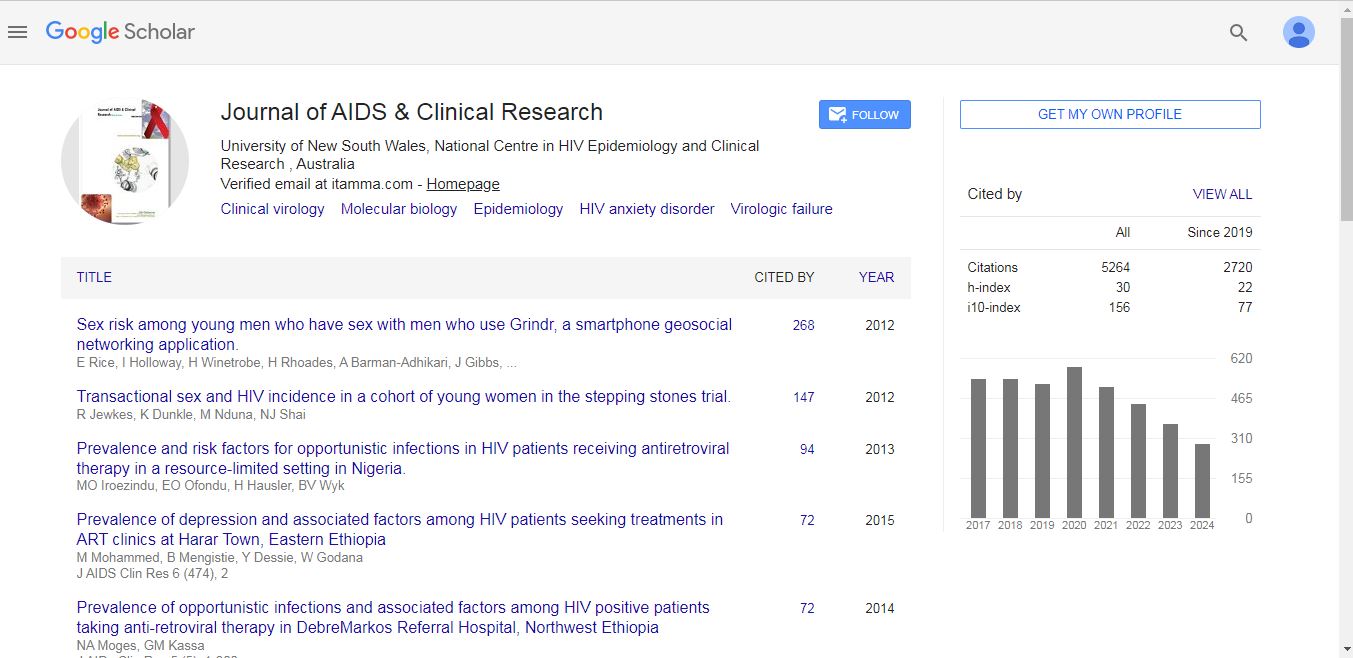
Journal of AIDS & Clinical Research received 5264 citations as per Google Scholar report