Brief Report - (2025) Volume 16, Issue 6
Received: 01-Dec-2025, Manuscript No. jar-25-177622;
Editor assigned: 03-Dec-2025, Pre QC No. P-177622;
Reviewed: 17-Dec-2025, QC No. Q-177622;
Revised: 22-Dec-2025, Manuscript No. R-177622;
Published:
29-Dec-2025
, DOI: 10.37421/2155-6113.2025.16.1091
Citation: Dvornikov, Nikolai. "Evolving Global HIV Resistance
Challenge." J AIDS Clin Res 16 (2025):1091.
Copyright: © 2025 Dvornikov N. This is an open-access article distributed under the terms of the Creative Commons Attribution License, which permits unrestricted use,
distribution and reproduction in any medium, provided the original author and source are credited.
This systematic review and meta-analysis highlights the evolving landscape of multidrug-resistant HIV-1, particularly in treatment-experienced individuals. It underscores the challenges in managing these patients and the need for updated treatment strategies based on resistance patterns. What this really means is, effective treatment for HIV depends heavily on understanding how the virus adapts and becomes resistant to existing drugs [1].
This study delves into drug resistance mutations in HIV-1 Gag and protease among patients in Africa failing second-line ART. The findings reveal specific resistance patterns that compromise the efficacy of lopinavir/ritonavir-based regimens, signaling a critical need for resistance testing to inform subsequent treatment choices. Let's break it down: when second-line treatments fail, it's often due to these specific mutations, making targeted interventions essential [2].
Analyzing trends in HIV-1 drug resistance mutations, this review highlights the increasing prevalence of resistance to first-line antiretroviral therapies over the last decade. This means that public health strategies need to constantly adapt, ensuring surveillance and access to newer drug classes to maintain effective treatment outcomes. Here's the thing: resistance isn't static; it evolves, demanding ongoing vigilance [3].
This study from Botswana reveals a high prevalence of HIV-1 drug resistance mutations among patients on antiretroviral therapy. The findings point to the urgent need for routine drug resistance testing and improved adherence support to preserve the effectiveness of current ART regimens in resource-limited settings. What this really means is that even established treatments face threats from evolving viral resistance [4].
This scoping review explores the emergence of multidrug resistance in HIV-1 among patients receiving ART in Sub-Saharan Africa. It highlights the complex interplay of factors contributing to resistance and emphasizes the importance of surveillance, improved diagnostics, and accessible treatment options to combat this growing public health concern. Let's break it down: a multi-pronged approach is needed to tackle resistance in this region [5].
This systematic review provides a global overview of HIV-1 drug resistance and its clinical implications, mapping out the prevalence of resistance mutations across different regions and drug classes. The insights derived are crucial for guiding clinical practice and informing the development of new antiretroviral drugs. Here's the thing: understanding the global picture helps us anticipate future challenges and tailor responses [6].
Focusing on a vulnerable population, this meta-analysis examines HIV-1 drug resistance in pregnant women on antiretroviral therapy. It highlights the potential for mother-to-child transmission of resistant strains and the need for careful monitoring and individualized treatment regimens in this group. What this really means is, preventing resistance in mothers is critical for the health of both mother and child [7].
This systematic review and meta-analysis identifies the prevalence of HIV-1 drug resistance mutations among children and adolescents in low- and middle-income countries. The findings underscore the unique challenges in pediatric HIV treatment and the urgent need for child-friendly antiretrovirals and resistance surveillance. Let's break it down: children often face different resistance patterns and treatment challenges than adults [8].
Examining integrase strand transfer inhibitor (INSTI) resistance, this review assesses real-world effectiveness and resistance patterns. It highlights the importance of understanding how HIV develops resistance to newer drug classes like INSTIs, which are crucial for treating multidrug-resistant cases. Here's the thing: as new drugs are introduced, we must monitor for new resistance patterns to maintain treatment efficacy [9].
This systematic review and meta-analysis provides a comprehensive look at drug resistance mutations and subtypes of HIV-1 in both ART-naive and treatment-experienced patients. It emphasizes that resistance can emerge even before treatment starts and highlights the need for baseline resistance testing and tailored approaches for effective HIV management. What this really means is, the fight against resistance is complex, affecting patients at all stages of their treatment journey [10].
The persistent evolution of multidrug-resistant HIV-1 strains represents a significant and escalating challenge, particularly among individuals who have undergone extensive treatment regimens. The very foundation of effective HIV management relies on a thorough understanding of the virus's adaptive mechanisms and its ability to develop resistance to current antiretroviral drugs [1]. Analyzing broader trends over the last decade reveals a concerning increase in resistance to first-line antiretroviral therapies. This means that public health strategies must be dynamic, continuously adapting to ensure robust surveillance mechanisms are in place and that patients have access to newer, effective drug classes. Here's the thing: viral resistance is not a static threat; it evolves constantly, demanding unwavering vigilance and proactive measures to sustain effective treatment outcomes [3]. A global overview of HIV-1 drug resistance and its clinical implications is essential, mapping out the prevalence of resistance mutations across diverse geographical regions and various drug classes. The insights garnered from such comprehensive reviews are indispensable for guiding contemporary clinical practice and critically informing the ongoing development of innovative antiretroviral drugs. Understanding this global picture helps us anticipate future challenges and tailor precise, effective responses [6].
In specific regional contexts, the battle against HIV-1 drug resistance takes on unique complexities. For instance, detailed studies in Africa have delved into the specific drug resistance mutations affecting HIV-1 Gag and protease in patients experiencing failure on second-line ART, particularly those on lopinavir/ritonavir-based regimens. The findings clearly reveal distinct resistance patterns that severely compromise treatment efficacy, highlighting a critical and urgent need for resistance testing to accurately inform subsequent treatment choices. Let's break it down: when second-line treatments falter, it's often these specific mutations that are responsible, making highly targeted interventions absolutely essential [2]. A study from Botswana further illustrates this, revealing a high prevalence of HIV-1 drug resistance mutations among patients currently on antiretroviral therapy. These findings unequivocally point to the urgent necessity for routine drug resistance testing and significantly improved adherence support programs, all aimed at preserving the effectiveness of existing ART regimens, especially within resource-limited settings. What this really means is that even well-established treatments face ongoing threats from continuously evolving viral resistance, necessitating constant adaptation and support [4]. Similarly, a comprehensive scoping review exploring the emergence of multidrug resistance in HIV-1 among patients receiving ART in Sub-Saharan Africa underscores the complex interplay of various factors contributing to this resistance. It strongly emphasizes the critical importance of robust surveillance, enhanced diagnostic capabilities, and widely accessible treatment options as vital components in combating this escalating public health concern. Let's break it down: a multi-pronged, integrated approach is undeniably needed to effectively tackle resistance in this specific region [5].
Vulnerable populations present distinct challenges in the context of HIV-1 drug resistance. A meta-analysis specifically focusing on pregnant women receiving antiretroviral therapy examines the prevalence and implications of HIV-1 drug resistance within this group. It importantly highlights the potential for mother-to-child transmission of these resistant viral strains and, consequently, the critical need for meticulous monitoring and individualized treatment regimens for these mothers. What this really means is, preventing the development and spread of resistance in pregnant mothers is absolutely critical for safeguarding the health and well-being of both the mother and her child [7]. Children and adolescents in low- and middle-income countries represent another particularly vulnerable cohort. A systematic review and meta-analysis specifically identifies the prevalence of HIV-1 drug resistance mutations within this younger demographic. The findings emphatically underscore the unique challenges inherent in pediatric HIV treatment, emphasizing the urgent need for the development of child-friendly antiretrovirals and dedicated resistance surveillance programs. Let's break it down: children frequently encounter different resistance patterns and a distinct set of treatment challenges compared to adults, necessitating specialized approaches [8].
The ongoing introduction of newer drug classes necessitates continuous vigilance regarding emerging resistance. For instance, a review meticulously examines integrase strand transfer inhibitor (INSTI) resistance, assessing its real-world effectiveness and the evolving resistance patterns associated with it. This study highlights the paramount importance of understanding precisely how HIV develops resistance to these newer therapeutic classes, such as INSTIs, which are increasingly vital for managing complex multidrug-resistant cases. Here's the thing: as novel drugs become available, it is absolutely essential to diligently monitor for new resistance patterns to consistently maintain optimal treatment efficacy [9]. Ultimately, the challenge of HIV-1 drug resistance is pervasive, affecting patients across the entire spectrum of their treatment journey. This includes both Antiretroviral Therapy (ART)-naive individuals and those with extensive treatment experience. Research indicates that resistance mutations and various subtypes of HIV-1 can emerge even before treatment initiation, highlighting the profound need for comprehensive baseline resistance testing. Such testing, coupled with carefully tailored approaches, is crucial for achieving effective and sustained HIV management. What this really means is, the fight against resistance is inherently complex, touching patients at every conceivable stage of their interaction with treatment [10].
The pervasive challenge of HIV-1 drug resistance is a critical concern, evolving continuously across diverse patient populations and geographical regions. Research consistently highlights the increasing prevalence of multidrug-resistant strains, particularly in individuals undergoing treatment, underscoring the urgent need for updated treatment strategies tailored to specific resistance patterns. Studies from Africa and Botswana, for example, reveal high rates of resistance mutations in patients failing second-line antiretroviral therapy (ART) or those already on treatment, necessitating routine resistance testing and enhanced adherence support, especially in resource-limited settings. The emergence of resistance affects not only treatment-experienced individuals but also ART-naive patients, emphasizing the importance of baseline resistance testing to guide effective HIV management. Vulnerable groups, such as pregnant women and children, face unique challenges, including the risk of transmitting resistant strains and the need for child-friendly antiretrovirals and specialized surveillance. As newer drug classes, like integrase strand transfer inhibitors (INSTIs), are introduced, continuous monitoring for new resistance patterns is essential to maintain their effectiveness against multidrug-resistant cases. Ultimately, the global landscape of HIV-1 drug resistance demands ongoing vigilance, sophisticated diagnostics, and adaptive public health strategies to ensure sustained treatment efficacy and prevent further spread of resistant viral strains.
Indexed at, Google Scholar, Crossref
Indexed at, Google Scholar, Crossref
Indexed at, Google Scholar, Crossref
Indexed at, Google Scholar, Crossref
Indexed at, Google Scholar, Crossref
Indexed at, Google Scholar, Crossref
Indexed at, Google Scholar, Crossref
Indexed at, Google Scholar, Crossref
Indexed at, Google Scholar, Crossref
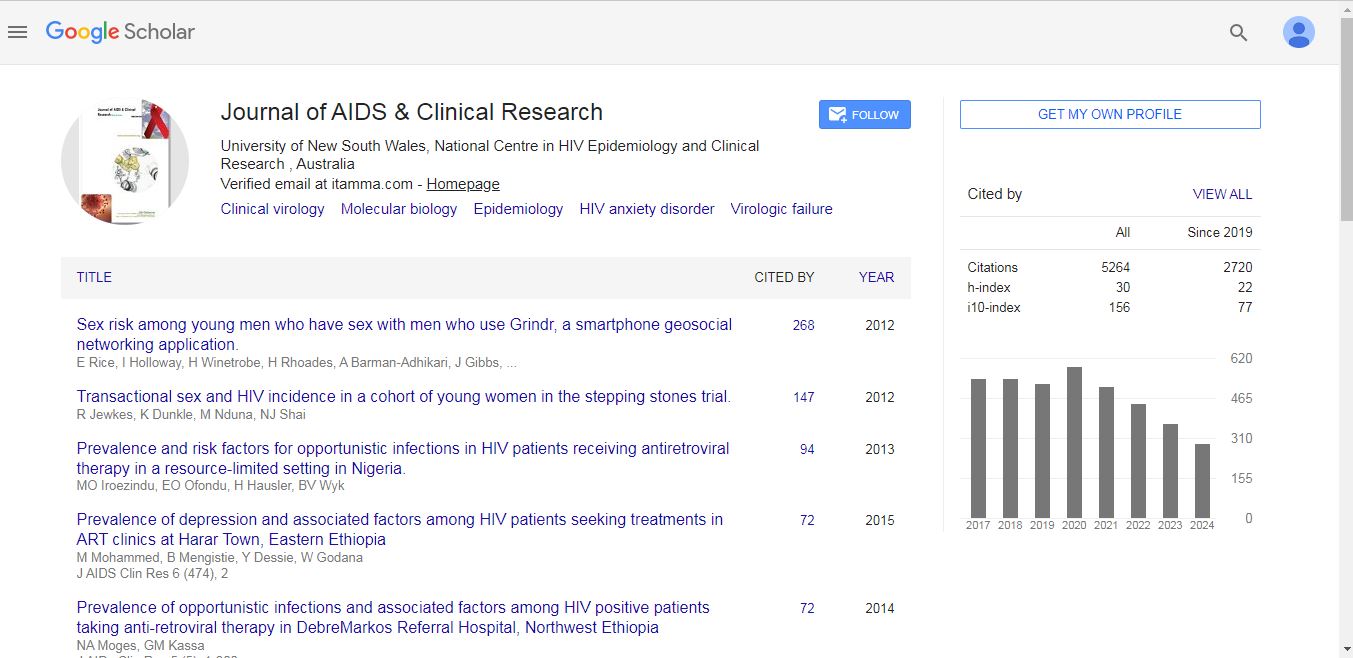
Journal of AIDS & Clinical Research received 5264 citations as per Google Scholar report