Brief Report - (2025) Volume 13, Issue 2
Received: 01-Apr-2025, Manuscript No. jcdd-25-175417;
Editor assigned: 03-Apr-2025, Pre QC No. P-175417;
Reviewed: 17-Apr-2025, QC No. Q-175417;
Revised: 22-Apr-2025, Manuscript No. R-175417;
Published:
29-Apr-2025
, DOI: 10.37421/2329-9517.2025.13.655
Citation: Petrov, Elena. ”Evolving Atherosclerosis: Mechanisms,
Therapies, and Future.” J Cardiovasc Dis Diagn 13 (2025):655.
Copyright: © 2025 Petrov E. This is an open-access article distributed under the terms of the Creative Commons Attribution License, which permits unrestricted use, distribution
and reproduction in any medium, provided the original author and source are credited.
Atherosclerosis is a complex and evolving disease, where thorough examination reveals intricate mechanisms spanning from its initiation to advanced plaque formation. This process critically involves inflammation, lipid metabolism, and immune responses. Research continually highlights these pivotal roles, driving our understanding of the disease and paving the way for more targeted, effective interventions [1].
Moving beyond traditional lipid-lowering strategies, recent work emphasizes the critical role of inflammation in atherosclerosis progression. There's a clear shift towards anti-inflammatory therapies, supported by recent clinical trial findings. These studies identify novel targets with significant promise for preventing cardiovascular events, suggesting a future with combination therapies addressing both lipids and inflammation [2].
Metabolic reprogramming within immune and vascular cells presents a new frontier in atherosclerosis research. Understanding how shifts in cellular metabolism contribute to disease development is crucial. Specific metabolic pathways and enzymes are emerging as potential targets for therapeutic intervention, offering a deeper insight into cellular energy dynamics in disease [3].
Here's the thing: deciphering the genetic underpinnings of atherosclerosis is crucial for effective prevention and treatment. Recent advances in genetic research have pinpointed specific genes and pathways that influence both an individual's susceptibility to the disease and its subsequent progression. These genetic insights are actively translating into innovative therapeutic strategies and personalized medicine approaches for cardiovascular prevention [4].
A growing body of evidence connects the gut microbiome to cardiovascular disease, particularly atherosclerosis. Mechanisms involve gut dysbiosis and microbial metabolites, such as TMAO, which significantly influence plaque development and stability. The takeaway is that modulating the gut microbiota offers exciting novel therapeutic avenues for intervention [5].
Groundbreaking single-cell analyses of human atherosclerotic plaques have revealed the diverse cellular landscape within these lesions. This unprecedented detail identifies cell-type-specific drivers of disease progression, offering specific targets for highly tailored therapies. This really shifts our perspective on the complex heterogeneity of plaque components, enabling more precise interventions [6].
An update on biomarkers in atherosclerosis spans from their discovery to clinical application. It covers the utility of various molecular, imaging, and genetic markers in assessing cardiovascular risk, early diagnosis of subclinical disease, and effective monitoring of treatment efficacy. This work essentially provides a roadmap for leveraging these markers to enhance patient care and facilitate personalized risk assessment [7].
Advanced imaging techniques are transforming the study of atherosclerosis, encompassing non-invasive methods and molecular imaging. These techniques demonstrate current capabilities in detecting early lesions, precisely characterizing plaque composition and vulnerability, and effectively evaluating therapeutic responses. The future points towards integrating these advanced tools for highly precise disease management [8].
Research also investigates the intriguing concept of atherosclerosis regression, exploring the cellular and molecular mechanisms capable of leading to plaque stabilization and actual reduction. Interventions targeting inflammation, lipid efflux, and endothelial function can promote a more favorable plaque phenotype. The implications here are huge for developing therapies that can actively reverse the disease process [9].
Finally, an insightful overview highlights novel therapeutic strategies currently in development for atherosclerosis. This includes advancements in gene therapies, immunomodulation, and nanomedicine approaches, all aimed at comprehensively addressing the complex pathology of the disease. Let's break it down: these developments promise a future where atherosclerosis treatment is far more precise, effective, and potentially transformative for patient outcomes [10].
Atherosclerosis, a multifaceted cardiovascular disease, continues to be an active area of research, with studies consistently refining our understanding of its origins and progression [1]. The disease's intricate mechanisms, from initial lesion formation to advanced plaque development, are profoundly influenced by critical biological processes. Specifically, inflammation, lipid metabolism, and immune responses play pivotal roles, highlighting a complex interplay that drives pathology. What this really means is that a holistic view of these factors is essential for developing effective interventions. Recent advancements have pushed beyond the conventional focus on lipid-lowering. There is now a significant emphasis on the role of inflammation in propelling atherosclerosis progression [2]. This shift has led to explorations of anti-inflammatory therapies, with promising clinical trial findings identifying novel targets for preventing cardiovascular events. We're seeing a definite move towards combination therapies designed to tackle both lipid accumulation and inflammatory processes. Moreover, researchers are delving into metabolic reprogramming within immune and vascular cells, a concept shedding light on how shifts in cellular energy dynamics contribute to disease development [3]. Pinpointing specific metabolic pathways and enzymes offers new targets for therapeutic intervention, signifying a deeper understanding of cellular biology in disease.
Here's the thing: a comprehensive understanding of atherosclerosis necessitates examining its genetic underpinnings. Recent genetic research has been crucial, successfully synthesizing advances that pinpoint specific genes and pathways influencing both an individual's susceptibility to the disease and its subsequent progression [4]. These invaluable genetic insights are actively being translated into innovative therapeutic strategies, paving the way for personalized medicine approaches in cardiovascular prevention. Beyond genetics, there's a growing appreciation for environmental factors, particularly the gut microbiome. A substantial body of evidence links gut microbiota to cardiovascular disease, with a specific focus on atherosclerosis [5]. This involves mechanisms where gut dysbiosis and microbial metabolites, like TMAO, can significantly influence the development and stability of atherosclerotic plaques. The takeaway is that modulating the gut microbiota might offer novel and exciting therapeutic avenues for intervention, opening up entirely new strategies for prevention and treatment.
The landscape of atherosclerosis research is also being reshaped by advanced diagnostic and analytical tools. Groundbreaking single-cell analyses of human atherosclerotic plaques have provided unprecedented detail, revealing the diverse cellular landscape within these lesions [6]. By identifying cell-type-specific drivers of disease progression, this approach offers precise targets for highly specific therapies, fundamentally shifting our perspective on the heterogeneity of plaque components and allowing for more nuanced treatment. This research goes hand-in-hand with an ongoing update on biomarkers in atherosclerosis, covering everything from initial discovery to practical clinical application [7]. The utility of various molecular, imaging, and genetic markers is being assessed for cardiovascular risk assessment, early diagnosis of subclinical disease, and effective monitoring of treatment efficacy. This work essentially provides a roadmap for leveraging these markers to improve patient care and facilitate personalized risk assessment. Parallel to this, advanced imaging techniques, ranging from non-invasive methods to molecular imaging, are proving indispensable [8]. These tools excel in detecting early lesions, accurately characterizing plaque composition and vulnerability, and evaluating therapeutic responses. The future really points towards integrating these sophisticated imaging modalities for precise disease management, enhancing diagnostic accuracy and therapeutic guidance.
A particularly fascinating area of study is the concept of atherosclerosis regression, which investigates the cellular and molecular mechanisms capable of leading to plaque stabilization and actual reduction [9]. Research explores how targeted interventions focused on inflammation, lipid efflux, and endothelial function can promote a more favorable plaque phenotype. The implications here are huge for developing therapies that can actively reverse the disease, moving beyond merely halting its progression. This exploration of regression ties directly into broader novel therapeutic strategies currently in development for atherosclerosis [10]. These advancements encompass a wide array of approaches, including gene therapies, immunomodulation, and cutting-edge nanomedicine. All these innovations are aimed at comprehensively addressing the complex pathology of the disease. Let's break it down: these developments promise a future where atherosclerosis treatment is far more precise, effective, and potentially transformative for patient outcomes.
Atherosclerosis research consistently evolves, with recent studies exploring its complex mechanisms from early initiation to advanced plaque formation [1]. Key drivers include inflammation, lipid metabolism, and immune responses, which are increasingly understood as central to disease progression [1]. Beyond traditional lipid-lowering strategies, there's a significant shift towards anti-inflammatory therapies and combination approaches, reflecting new therapeutic opportunities [2]. Metabolic reprogramming within immune and vascular cells reveals how cellular energy dynamics influence disease development, pointing to novel therapeutic targets [3]. Understanding the genetic underpinnings of atherosclerosis remains crucial, with recent advances identifying specific genes and pathways that affect susceptibility and progression. These genetic insights are paving the way for personalized medicine and new preventive strategies [4]. The gut microbiome also plays a role, with dysbiosis and microbial metabolites like TMAO influencing plaque development, suggesting new avenues for modulating the microbiota to treat the disease [5]. Detailed analyses, such as single-cell atlases of human atherosclerotic plaques, offer unprecedented views into the diverse cellular landscape of lesions, identifying cell-type-specific drivers and highly specific therapeutic targets. This truly shifts our perspective on plaque heterogeneity [6]. Advances in biomarkers, including molecular, imaging, and genetic markers, provide a roadmap for assessing cardiovascular risk, diagnosing subclinical disease, and monitoring treatment efficacy, improving personalized risk assessment [7]. Advanced imaging techniques, from non-invasive methods to molecular imaging, are crucial for detecting early lesions, characterizing plaque composition, and evaluating therapeutic responses. The future really points towards integrating these advanced tools for precise disease management [8]. Furthermore, investigations into atherosclerosis regression highlight mechanisms that can lead to plaque stabilization and reduction through interventions targeting inflammation, lipid efflux, and endothelial function, holding huge implications for actively reversing disease [9]. Overall, novel therapeutic strategies, including gene therapies, immunomodulation, and nanomedicine, promise a more precise and effective future for atherosclerosis treatment [10].
Indexed at, Google Scholar, Crossref
Indexed at, Google Scholar, Crossref
Indexed at, Google Scholar, Crossref
Indexed at, Google Scholar, Crossref
Indexed at, Google Scholar, Crossref
Indexed at, Google Scholar, Crossref
Indexed at, Google Scholar, Crossref
Indexed at, Google Scholar, Crossref
Indexed at, Google Scholar, Crossref
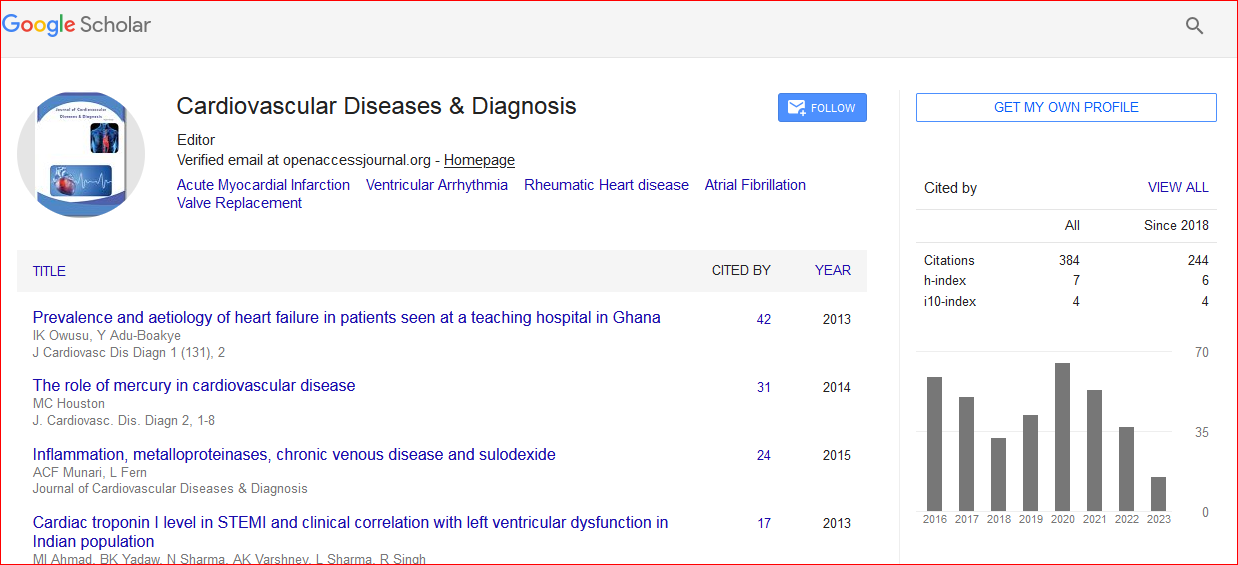
Cardiovascular Diseases & Diagnosis received 427 citations as per Google Scholar report