Short Communication - (2025) Volume 9, Issue 4
Received: 01-Aug-2025, Manuscript No. jgge-25-174614;
Editor assigned: 04-Aug-2025, Pre QC No. P-174614;
Reviewed: 18-Aug-2025, QC No. Q-174614;
Revised: 22-Aug-2025, Manuscript No. R-174614;
Published:
29-Aug-2025
, DOI: 10.37421/2684-4567.2025.9.179
Citation: Tanaka, Hiroshi. ”Evolutionary Genomics: Unveiling Life’s Adaptive Dynamics.” J Genet Genom 09 (2025):179.
Copyright: © 2025 Tanaka H. This is an open-access article distributed under the terms of the Creative Commons Attribution License, which permits unrestricted use,
distribution and reproduction in any medium, provided the original author and source are credited.
The study of evolutionary genomics has proven crucial for tracking the adaptive evolution of pathogens. For example, research delves into how SARS-CoV-2 adapts across both human and animal hosts. It meticulously identifies specific genomic changes that enable the virus to thrive in varied host environments, underscoring the dynamic nature of viral evolution and the ongoing threat of zoonotic spillover events [1].
In the realm of human disease, evolutionary genomics provides fundamental insights into cancer development. A detailed analysis maps the evolutionary landscape of colorectal cancer by examining genomic changes within tumors. This work illuminates the intricate clonal dynamics and selective pressures that drive tumor progression, thereby revealing the core evolutionary processes shaping cancer development [2].
Furthermore, this field is instrumental in understanding the mechanisms of adaptation and speciation in natural populations. Investigations uncover the genomic underpinnings of local adaptation and speciation within rapidly evolving plant groups. It pinpoints specific genes and genomic regions essential for successful adaptation to diverse environmental conditions and the reproductive isolation mechanisms leading to the emergence of new species [3].
The complex ecosystems within the human body are also subject to genomic scrutiny. A comprehensive review explores the evolutionary genomics of the human gut microbiome, meticulously detailing how these microbial communities evolve and interact with their host. This research addresses profound implications for human health and disease, emphasizing the intricate and long-standing co-evolutionary relationships present within the gut environment [4].
Understanding the formation of new species remains a central goal in evolutionary biology, with genomic tools providing novel perspectives. One article critically examines the concept of "genomic islands of speciation." These are identified as distinct regions of the genome exhibiting strong differentiation between nascent species, which are pivotal in facilitating reproductive isolation and driving population divergence, even in the presence of continuous gene flow [5].
Ancient DNA has revolutionized our understanding of human origins. A review highlights the significant contributions of ancient DNA analysis and evolutionary genomics to elucidating hominin evolution. It underscores how genomic data recovered from ancient remains offers critical insights into population movements, interbreeding events among different hominin groups, and crucial adaptive changes observed in both archaic and modern humans [6].
The ceaseless arms race between hosts and pathogens is another focal point. This paper thoroughly investigates the evolutionary genomics of host-pathogen interactions in bacterial systems. It systematically explores the strategies pathogens employ to adapt to host defenses and how hosts, in turn, evolve resistance, utilizing advanced genomic approaches to unravel this dynamic co-evolutionary struggle [7].
Beyond fundamental biology, genomics offers practical solutions for biodiversity preservation. A comprehensive review assesses the substantial progress made in conservation genomics, specifically demonstrating how genomic tools are actively employed to manage endangered species and safeguard overall biodiversity. It discusses key applications such as evaluating genetic diversity, identifying crucial adaptive potential, and informing strategic breeding programs [8].
The mechanisms governing gene expression are fundamental to organismal development and adaptation. This article probes deeply into the evolutionary genomics of gene regulation, exploring precisely how regulatory elements and complex networks evolve to orchestrate organismal development and facilitate adaptation. It meticulously covers the underlying mechanisms through which alterations in gene regulation ultimately drive vast phenotypic diversity across species [9].
Finally, the genetic basis of complex traits is being demystified by modern genomic techniques. This review scrutinizes the powerful intersection of evolutionary genomics and quantitative genetics for comprehending complex traits. It elucidates how the advent of high-throughput sequencing technologies is fundamentally transforming our capacity to dissect the genetic architecture and evolutionary dynamics of diverse traits, ranging from disease susceptibility to vital agricultural yield [10].
Evolutionary genomics serves as a pivotal and expansive field, diligently unraveling the genetic underpinnings of life's vast diversity and profound adaptive capabilities. It offers a comprehensive framework for understanding precisely how organisms, spanning from microscopic viruses to complex multicellular life forms like humans, evolve dynamically and interact intimately with their surrounding environments. This interdisciplinary discipline adeptly leverages advanced genomic tools to meticulously track subtle yet significant genetic changes across diverse populations and distinct species. This provides profound insights into fundamental biological processes, with critical implications for human health, effective disease management, and broader biodiversity conservation efforts. The fieldâ??s expansive scope ranges from tracing pathogen adaptation and cancer development to dissecting speciation mechanisms and elucidating the genetic architecture underlying complex traits.
A critically important area within evolutionary genomics focuses on elucidating pathogen evolution and understanding disease dynamics. Recent research has meticulously utilized evolutionary genomics approaches to track the adaptive evolution of SARS-CoV-2, observing specific genomic changes as the virus successfully navigates and adapts across human and various animal hosts. This work powerfully highlights the dynamic nature of viral adaptation and underscores the potential for new zoonotic spillover events, which carry significant public health implications [1]. In a similar critical vein, the evolutionary landscape of colorectal cancer development is being systematically mapped through in-depth analysis of genomic alterations observed within tumors. This provides crucial clarity on the intricate clonal dynamics and the selective pressures that relentlessly drive disease progression, offering new avenues for therapeutic intervention [2]. The field also vigorously investigates the evolutionary genomics of host-pathogen interactions in bacterial systems, meticulously exploring the continuous co-evolutionary arms race where pathogens continually adapt to host defenses and hosts, in turn, evolve novel resistance mechanisms to survive [7]. These comprehensive studies are essential for developing more effective therapeutic strategies and for predicting and managing disease dynamics.
Understanding the fundamental processes through which new species arise and how existing populations adapt to widely diverse environments represents another central cornerstone of modern evolutionary genomics. Pioneering studies have successfully uncovered the precise genomic basis of local adaptation and speciation within rapidly radiating plant groups, identifying specific genes and distinct genomic regions that are instrumental in facilitating successful adaptation to varied environmental pressures and ultimately leading to robust reproductive isolation [3]. This insightful concept of genetic differentiation extends further to "genomic islands of speciation," which are precisely defined as discrete regions within the genome exhibiting strong and significant differentiation between nascent species. These genomic islands play a profoundly crucial role in actively driving genetic divergence and fostering reproductive isolation, remarkably even when there is ongoing gene flow and hybridization between populations [5]. Such findings provide a much clearer and more detailed picture of the intricate genetic architecture that underpins the magnificent formation of biological diversity observed throughout the natural world.
Evolutionary genomics also yields profound impacts on our understanding of fundamental human biology and our ancient historical past. The intricate human gut microbiome, for instance, represents a complex and dynamic community of microorganisms whose evolutionary genomics is being thoroughly explored to understand how these microbial populations evolve, adapt, and intimately interact with their human host. This critical research has significant implications for both human health and susceptibility to various diseases, effectively shedding light on the intricate and long-standing co-evolutionary relationships that exist within the gut environment [4]. Furthermore, our understanding of hominin evolution has been dramatically revolutionized by the synergistic application of ancient DNA analysis and evolutionary genomics. By meticulously analyzing genomic data recovered from ancient hominin remains, scientists are gaining critical and unprecedented insights into past population movements, significant interbreeding events among different hominin groups, and the crucial adaptive changes that occurred in both archaic and modern human lineages across vast timescales [6].
The practical and applied dimensions of this powerful field extend directly into vital conservation efforts. Conservation genomics rigorously assesses the substantial progress made in leveraging advanced genomic tools to effectively manage endangered species and actively preserve global biodiversity. This encompasses accurately evaluating genetic diversity within threatened populations, precisely identifying crucial adaptive potential for environmental change, and strategically informing robust breeding programs designed to ensure the long-term survival and resilience of vulnerable populations [8]. On a more fundamental and mechanistic level, ongoing research delves deeply into the evolutionary genomics of gene regulation, meticulously exploring how intricate regulatory elements and complex gene networks evolve over time to precisely shape organismal development and facilitate adaptive responses. Understanding these fundamental mechanisms provides invaluable insights into how subtle changes in gene regulation ultimately drive the vast spectrum of phenotypic diversity observed across species [9]. Finally, the powerful and transformative combination of evolutionary genomics with quantitative genetics is fundamentally changing our capacity to accurately dissect the genetic architecture and evolutionary dynamics of highly complex traits, ranging from susceptibility to various diseases to optimizing vital agricultural yields, primarily facilitated by the unprecedented capabilities of high-throughput sequencing technologies [10].
Evolutionary genomics offers a powerful lens to understand the dynamic processes shaping life, from viral adaptation to species formation and human health. This field traces the adaptive evolution of pathogens like SARS-CoV-2 across different hosts, identifying genomic changes that drive viral spread and potential zoonotic events. It also illuminates the complex progression of diseases such as colorectal cancer, revealing clonal dynamics and selective pressures through genomic analysis. Beyond disease, evolutionary genomics provides insight into the genomic underpinnings of local adaptation and speciation in diverse organisms, including rapidly evolving plant groups. It identifies specific genomic regions facilitating reproductive isolation and driving population divergence. The human gut microbiome presents another frontier, with genomic studies exploring how microbial communities evolve, interact with their host, and influence health outcomes. Historical perspectives are also enriched by ancient DNA analysis, which uses evolutionary genomics to reconstruct hominin evolution, tracing population movements, interbreeding, and adaptive changes in archaic and modern humans. The discipline further explores host-pathogen co-evolution in bacteria, examining how pathogens adapt to host defenses and how hosts develop resistance. Conservation efforts significantly benefit from genomics, utilizing these tools to assess genetic diversity, identify adaptive potential, and guide breeding programs for endangered species. Research extends to the evolution of gene regulation, dissecting how regulatory elements shape development and adaptation, and driving phenotypic diversity. Finally, evolutionary genomics combined with quantitative genetics is transforming our understanding of complex traits, applying high-throughput sequencing to unravel the genetic architecture of traits like disease susceptibility and agricultural yield.
None
None
Xiaoyu S, Qiang Z, Wenbo L. "Adaptive evolution of SARS-CoV-2 in humans and animals".Nat Microbiol 7 (2022):860-870.
Indexed at, Google Scholar, Crossref
Andrea D, Adam JH, Trevor AG. "The evolutionary landscape of colorectal tumorigenesis".Nat Ecol Evol 5 (2021):1618-1632.
Indexed at, Google Scholar, Crossref
Pengcheng Z, Jinliang W, Liangsheng Z. "Genomic basis of local adaptation and speciation in a rapidly radiating plant group".Nat Ecol Evol 8 (2023):257-270.
Indexed at, Google Scholar, Crossref
Trevor DL, Falk H, Jeroen R. "Evolutionary genomics of the human gut microbiome and its impact on health and disease".Nat Rev Genet 23 (2022):367-386.
Indexed at, Google Scholar, Crossref
Daniel JM, Catherine EW, Jeffrey PG. "Genomic islands of speciation: a hitchhiker's guide".Mol Ecol 28 (2019):2596-2615.
Indexed at, Google Scholar, Crossref
Mateja H, Katerina D, Tom H. "Evolutionary genomics and ancient DNA of hominins".Curr Opin Genet Dev 69 (2021):114-121.
Indexed at, Google Scholar, Crossref
Benjamin CJ, Jessica EM, Matthew GJ. "Evolutionary genomics of host-pathogen interactions in bacteria".Genome Biol Evol 12 (2020):1612-1627.
Indexed at, Google Scholar, Crossref
Jennifer RR, John MF, Thomas ABB. "Conservation genomics: how far have we come?".Trends Ecol Evol 37 (2022):5-18.
Indexed at, Google Scholar, Crossref
Matthew DJ, Gregory EM, Casey LR. "Evolutionary genomics of gene regulation".Curr Opin Genet Dev 81 (2023):102075.
Indexed at, Google Scholar, Crossref
Matthew RR, Grant WC, Naomi ERW. "The evolutionary genomics of complex traits: quantitative genetics in the era of high-throughput sequencing".Annu Rev Ecol Evol Syst 50 (2019):569-591.
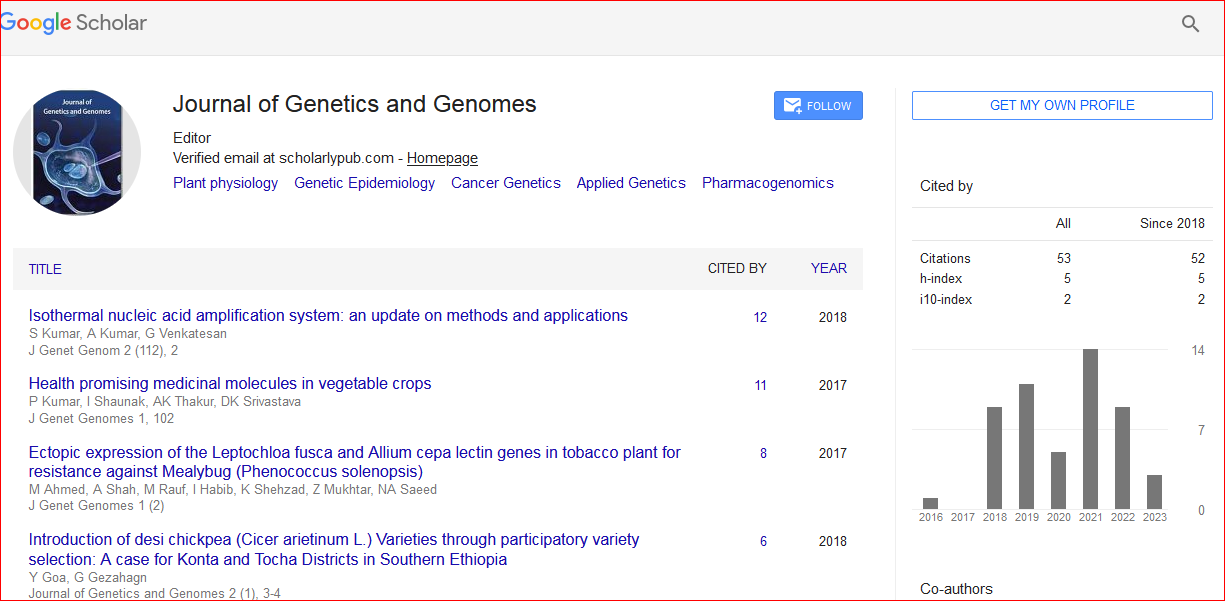
Journal of Genetics and Genomes received 65 citations as per Google Scholar report