Brief Report - (2025) Volume 10, Issue 4
Received: 01-Jul-2025, Manuscript No. apn-26-179132;
Editor assigned: 03-Jul-2025, Pre QC No. P-179132;
Reviewed: 14-Jul-2025, QC No. Q-179132;
Revised: 22-Jul-2025, Manuscript No. R-179132;
Published:
29-Jul-2025
, DOI: 10.37421/2573-0347.2025.10.437
Citation: MartÃnez, Ava. âEvidence-Based Practice: Improving Critical Care Outcomes.â J Adv Practice Nurs 10 (2025):437.
Copyright: © 2025 MartÃnez A. This is an open-access article distributed under the terms of the Creative Commons Attribution License, which permits unrestricted use,
distribution and reproduction in any medium, provided the original author and source are credited.
Evidence-based practice (EBP) has emerged as a cornerstone in the evolution of advanced nursing care, fundamentally shaping how patient health is addressed. Integrating EBP ensures that the care provided is not merely routine but is deeply rooted in the most current and robust research findings, thereby elevating patient outcomes and the overall quality of healthcare delivery. This foundational principle guides advanced nursing roles towards a more precise and effective approach to patient management [1].
The adoption of EBP by advanced practice nurses (APNs) has been shown to exert a profound positive influence on the quality of care, particularly within demanding critical care environments. Studies have revealed a discernible correlation between the consistent application of EBP and a notable reduction in the incidence of adverse patient events, such as hospital-acquired infections and patient falls, underscoring its protective role [2].
Beyond its clinical impact, there is a compelling ethical imperative driving the integration of EBP into advanced nursing practice. It is increasingly recognized that the failure to utilize the best available evidence in patient care can be construed as a breach of the fundamental ethical duty owed to patients, highlighting the moral obligation of nurses to remain current with best practices [3].
To facilitate the seamless incorporation of EBP into the daily routines of advanced practitioners, practical models are essential. Such models focus on actionable strategies for evidence retrieval, critical appraisal, and direct application within clinical settings, often leveraging point-of-care resources and continuous education to enhance diagnostic accuracy and patient satisfaction [4].
Translating the wealth of research evidence into tangible advancements in advanced nursing practice, especially in community health, presents both challenges and opportunities. Overcoming barriers such as time constraints, limited access to research databases, and resistance to change requires proactive solutions that foster a culture of inquiry and evidence utilization [5].
Educational interventions play a critical role in equipping advanced practice nurses with the necessary skills for EBP. Systematic reviews indicate that multifaceted educational approaches, which combine theoretical learning with practical application and mentorship, are the most effective in promoting EBP competency and sustained use among these professionals [6].
The lived experiences of advanced practice nurses further illuminate the path towards successful EBP implementation. Qualitative research highlights the indispensable nature of organizational support, peer collaboration, and intrinsic personal motivation as key themes that enhance confidence and the ability to provide high-quality, individualized patient care [7].
Clinical leadership is an indispensable driver in the widespread adoption of EBP within advanced nursing care settings. Effective leaders are instrumental in cultivating an environment that not only values research but also actively supports innovation and empowers nurses to critically engage with and utilize evidence in their practice [8].
The synergistic potential of interprofessional collaboration cannot be overstated when considering the implementation of EBP within advanced nursing teams. When nurses, physicians, and allied health professionals work together, the translation of research findings into clinical practice is significantly accelerated, fostering a unified approach to evidence-informed care [9].
Finally, the direct impact of EBP on patient safety outcomes in advanced nursing practice settings is a critical area of research. Studies demonstrate that the systematic implementation of EBP can lead to statistically significant reductions in medication errors and improvements in adherence to evidence-based protocols, thereby enhancing overall patient safety [10].
Evidence-based practice (EBP) stands as a critical component in advancing the quality and efficacy of nursing care, particularly within specialized and advanced practice roles. Its integration ensures that patient interventions are consistently informed by the most current and rigorously validated research findings, ultimately leading to improved patient outcomes and a higher standard of healthcare services across various settings [1].
Within the high-stakes environment of critical care nursing, the impact of EBP on patient care quality is significant. Advanced practice nurses who embrace EBP demonstrate a marked ability to reduce adverse patient events, including common complications like hospital-acquired infections and patient falls, thereby enhancing patient safety and care delivery [2].
The ethical dimension of advanced nursing practice is intrinsically linked to the principle of EBP. Adhering to EBP is considered an ethical obligation, ensuring that patients receive care based on the most robust available evidence. This principle guides APNs in navigating ethical complexities and upholding their commitment to patient well-being [3].
To effectively embed EBP into the daily clinical workflow of nurse practitioners, especially in primary care, practical and accessible models are crucial. These models emphasize efficient methods for finding, evaluating, and applying research evidence, leading to enhanced diagnostic accuracy and increased patient satisfaction when implemented [4].
Bridging the gap between research findings and their practical application in advanced nursing, particularly in community health, involves addressing specific challenges. Overcoming barriers such as time constraints and limited access to research resources necessitates strategic solutions like dedicated EBP champions and improved access to literature for sustainable integration [5].
Educational strategies are paramount in developing and enhancing the EBP skills of advanced practice nurses. Research indicates that comprehensive educational programs, which blend theoretical knowledge with practical application and mentorship, are most effective in fostering competency and consistent utilization of EBP [6].
Exploring the personal experiences of advanced practice nurses in adopting EBP reveals the importance of supportive environments. Factors such as strong organizational backing, collaborative peer relationships, and individual motivation are key facilitators that bolster confidence and enable the delivery of personalized, high-quality care [7].
Clinical leadership plays a pivotal role in championing and facilitating the adoption of EBP in advanced nursing. Leaders are essential in cultivating a culture that prioritizes research, embraces innovation, and empowers nurses to effectively integrate evidence into their practice, thereby driving systemic change [8].
The collaborative synergy within interprofessional advanced nursing teams significantly enhances the implementation of EBP. By fostering communication and shared governance structures, teams can more effectively translate research into practice, promoting a unified approach to evidence-informed care delivery [9].
Investigating the direct effects of EBP on patient safety in advanced nursing practice settings has yielded significant findings. The implementation of EBP protocols has been associated with a measurable reduction in adverse events, underscoring its vital role in ensuring patient safety and improving care quality [10].
Evidence-based practice (EBP) is fundamental to advanced nursing care, ensuring patient care is grounded in the latest research for improved outcomes. Its adoption in critical care reduces adverse events, while its ethical imperative is increasingly recognized. Practical models and educational interventions are key to integrating EBP, with organizational support and clinical leadership playing crucial roles. Interprofessional collaboration further enhances EBP implementation, and its positive impact on patient safety is well-documented through reduced errors and improved protocols.
None
None
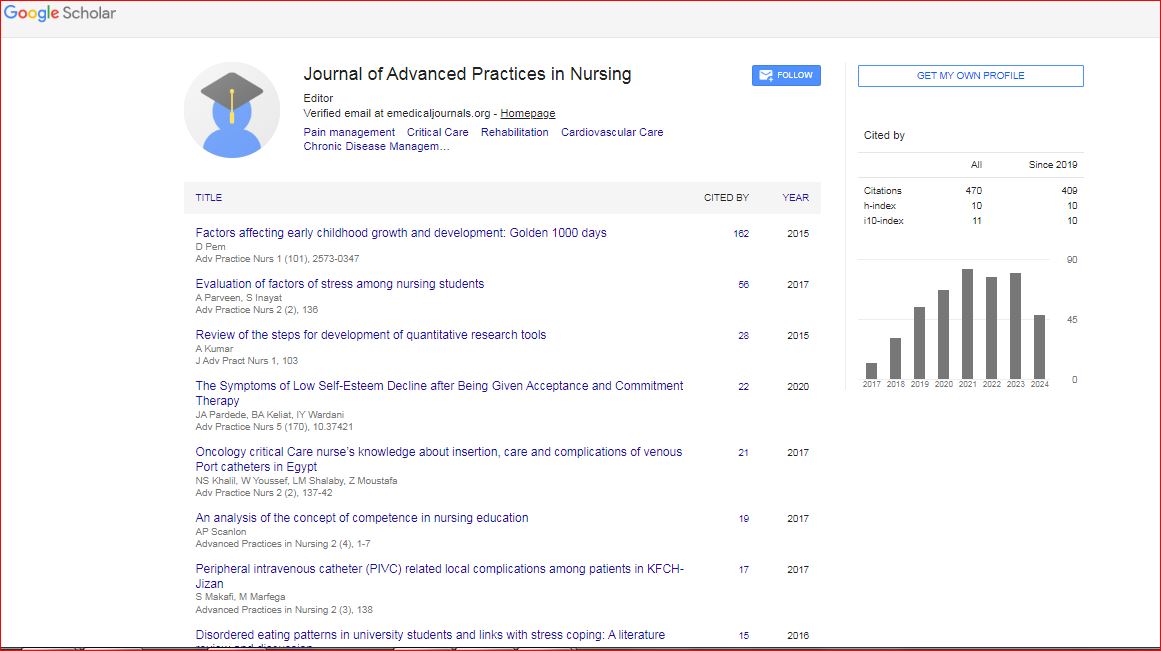
Journal of Advanced Practices in Nursing received 410 citations as per Google Scholar report