Research Article - (2026) Volume 17, Issue 1
Received: 21-Oct-2024, Manuscript No. HYCR-24-150592;
Editor assigned: 24-Oct-2024, Pre QC No. HYCR-24-150592 (PQ);
Reviewed: 08-Nov-2024, QC No. HYCR-24-150592;
Revised: 10-Feb-2025, Manuscript No. HYCR-24-150592 (R);
Published:
17-Feb-2025
, DOI: 10.37421/2157-7587.2026.17.458
Citation: Kifle, Tamirneh, Demeke Mengist, and Solomon Shibeshi. "Evaluating the Effect of Plant Spacing on Yield and Quality of Roma VF Tomatoes in Irrigated Conditions at Mirabe Badewacho Woreda, Ethiopia."Hydrol Current Res 16 (2026): 573.
Copyright: © 2026 Kifle T, et al. This is an open-access article distributed under the terms of the creative commons attribution license which permits unrestricted use,distribution and reproduction in any medium, provided the original author and source are credited.
Tomato requires warm, clear, dry conditions and altitudes ranging between 700 and 2000 meter above sea level. The optimum temperature for seed germination ranges between 18 and 24°C and the maximum 30°C and minimum 8-1 T'C. Plant population and spacing are important management practices that greatly influence yield and quality of tomato fruits. The distance between plants and between rows depends on the methods and purpose of production, soil fertility, plant structure, vine types and farm equipment. The study was conducted in Hawora kebele of Mirab Badawacho woreda Southern Ethiopia. This study aims evaluating tomato plant spacing on Roma VF varieties (Lycopersicon esculentum Mill.) on yield and quality of Roma VF Tomatoes. Three treatments were arranged in randomized complete block design with five replications under furrow irrigation method. The three treatments were (25 cm × 100 cm, 30 cm × 100 cm and 35 cm × 100 cm) between tomato plants. The ANOVA showed that there is no significant difference between the treatment on marketable, unmarketable and total yield of tomato at (p<0.05). The maximum marketable yield recorded was 21.55 t/ha on 25 cm spacing while the lowest was 19.19 t/ha on 30 cm plant spacing. The population numbers under 25 cm spacing were higher than 30 cm and 35 cm spacing. The size of the fruit under 35 cm spacing is better than 25 cm and 30 cm spacing. Therefore, in area where land resource is sufficient 35 cm spacing is recommended to obtain equivalent yield with large fruit size, but in land scarce area 25 cm spacing is recommended to obtain optimum yield.
Spacing • Tomato • Irrigated agriculture • Furrow irrigation
Tomato (Lycopersicon esculentum Mill.) is one of the most important edible and nutritious vegetable crops, widely cultivated in tropical, sub-tropical and temperate climates in the world. It ranks 1st with respect to world vegetable production and accounts for 14% (over 100 million tons per year) [1]. Tomato is beneficial to human health being rich in minerals, vitamins, essential amino acids, sugars and dietary fibers [2]. In Ethiopia tomato is one of the most important and widely grown vegetable crops, both during the rainy and dry seasons for its fruit by smallholder farmers, commercial state and private farms [3].
The total production of tomato in Ethiopia has shown an increase in the market and became the most profitable crop providing a higher income to small scale farmers compared to other vegetable crops [4]. Lemma, et al. indicated that the total production of tomato in Ethiopia has shown a marked increase, indicating that it has become the most profitable crop providing a higher income to smallholder farmers compared to other vegetable crops.
The supply of vegetable crops like tomato and onion overwhelm the marketing during few months in the dry season, and as a result, the price of the crop drastically decreases. On the other hand, the same crops disappear from the market in the wet season. Disease prevailing during rainy season attributed to the shift of production. If this situation is to continue, forthcoming medium scale irrigation projects may not justify investment on processing plants that may need year round availability of certain commodities such as tomato [5]. The productivity of tomato is influenced by different factors among which environmental conditions, agronomic practices and varietal potential, however blanket recommendations of agronomic packages for all tomato producing areas could contribute to the yield reduction since the agro ecology of production may be quite different from areas where the recommendation was made [6]. The objectives of this investigation were to study the plant spacing effect on tomato yield productivity.
Description of the study area
The study was conducted at Hawora kebele, Mirab Badewacho woreda, Hadeya zone of Southern nation nationality and peoples of Ethiopia. Mirab Badawacho, is one of Woredas (districts) in Hadiya zone which found in SNNPR [7]. It is bordered with Kambata Tambaro zone North and Northeast and East by Misrak Badawacho and with South by Wolaita zone and with Northwest Kachabira woreda. And it is located about 357 km South west of Adis Abeba and 127 km from the regional Capital, Hawassa [8]. The major vegetable crops grown are tomato, onion, head cabbage, hot-pepper. The experimental site was located at an altitude range of 1700-1800 m.a.s.l latitude range of 07°7’-07°10’ N and longitude range 37° 44’-37°47’ E (Figure 1).
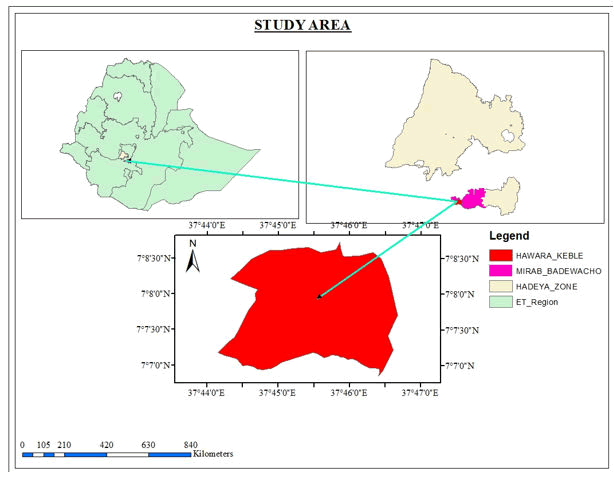
Figure 1. Study area.
Experimental design and treatment
The experiment has three treatments (25 cm, 30 cm and 35 cm b/n the plant) with five replications (farmers were used as a replication) [9]. The experiment was laid out in randomized complete block design and the treatment was conducted under furrow irrigation method. The size of each plot was 10 m × 10 m, between plot is 1 m and space between rows were 100 cm.
Soil data
The soil was analyzed in laboratory, gravimetric method; pH meter method, soil and water ratio method were used to determine soil moisture content, pH value and electrical conductivity respectively [10].
Crop data
Maximum effective Root Zone Depth (RZD) of tomato ranges between 0.7-1.5 m and has allowable soil water depletion fraction (P) of 0.40. Tomato average Kc would be taken after adjustments have been made for initial, mid and late season stage to be 0.6, 1.15 and 0.8, respectively [11]. Yield data like economical yield, unmarketable yield and total yield was measured in the field.
Climatic characteristics of the study area
The average climatic data (Maximum and minimum temperature, relative humidity, wind speed, and sun shine hours) on monthly basis of the study area were obtained from meteorological station. The potential evapotranspiration ETo was estimated using CROPWAT software version 8 (Table 1).
| Month | Min temp (°C) | Max temp (°C) | Humidity% | Wind km/day | Sun hours | Rad MJ/m?/day | ETo mm/day |
| January | 13.3 | 29.1 | 77 | 95 | 8.1 | 19.9 | 3.91 |
| February | 14 | 29.7 | 75 | 104 | 7.6 | 20.3 | 4.18 |
| March | 13.8 | 28.8 | 81 | 173 | 7.5 | 21 | 4.35 |
| April | 13.5 | 28.1 | 92 | 130 | 7.1 | 20.4 | 3.95 |
| May | 13.1 | 26.3 | 93 | 104 | 6.1 | 18.3 | 3.47 |
| June | 12.8 | 24.2 | 94 | 104 | 5.9 | 17.6 | 3.19 |
| July | 12.3 | 22 | 92 | 95 | 3.7 | 14.5 | 2.65 |
| August | 12.1 | 22.5 | 90 | 104 | 4.2 | 15.6 | 2.82 |
| September | 12.8 | 25.5 | 97 | 86 | 5.6 | 17.9 | 3.23 |
| October | 12.8 | 27.2 | 87 | 95 | 7.2 | 19.8 | 3.71 |
| November | 13 | 29.2 | 87 | 69 | 8.8 | 21.1 | 3.96 |
| December | 12.8 | 29 | 72 | 69 | 8.3 | 19.7 | 3.78 |
| Average | 13 | 26.8 | 86 | 102 | 6.7 | 18.8 | 3.6 |
Table 1. The average climatic data.
Crop water determination
Crop water requirement refers to the amount of water that needs to be supplied, while crop evapotranspiration refers to the amount of water that is lost through evapotranspiration [12]. For the determination of crop water requirement, the effect of climate on crop water requirement, which is the reference crop Evapotranspiration (ETo) and the effect of crop characteristics (Kc) are important [13]. The long term and daily climate data such as maximum and minimum air temperature, relative humidity, wind speed, sunshine hours, and rainfall data of the study area were collected to determine reference evapotranspiration, crop data like crop coefficient, growing season and development stage, effective root depth, critical depletion factor of Tomato and maximum infiltration rate and total available water of the soil was determined to calculate crop water requirement using cropwat model.
ETc=ETo × Kc
Where, ETc=crop evapotranspiration, Kc=crop coefficient, ETo= reference evapotranspiration.
Irrigation water management
The Total Available Water (TAW), stored in a unit volume of soil was determined by the expression:
TAW=((Fc-PWP) × BD × Dz)/100
The depth of irrigation supplied at any time can be obtained from the equation
Inet (mm)=ETc (mm)-Peff (mm)
The gross irrigation requirement will be obtained from the expression:
Ig=In/Ea
Ea=application efficiency of the furrows (60%)
The time required to deliver the desired depth of water into each furrow will be calculated using the equation:
t=(d × l × w)/(6 × Q)
Where: d=gross depth of water applied (cm), t=application time (min), l=furrow length in (m), w=furrow spacing in (m), and Q=flow rate (discharge) (l/s)
Data collection
Daily climate like maximum and minimum air temperature, relative humidity, wind speed, sunshine hours and rainfall data was collected to calculate crop water requirement. Soil moisture was determined gravimetrically. Amount of applied water per each irrigation event was measured using calibrated pareshall flume. During harvesting, weight of marketable yield and unmarketable fruit weight were measured from the net harvested area of each plot [14].
Statistical analysis
The collected data were analyzed using Statistical Agricultural Software (SAS 9.0) and Least Significance Difference (LSD) was employed to see a mean difference between treatments and the data collected was statistically analyzed following the standard procedures applicable for RCBD with single factor. The treatment means that were different at 5% levels of significance were separated using LSD test.
Physical and chemical properties of soil
The critical value of bulk density for restricting root growth varies with soil type, but the general bulk density greater than 1.6 g/cm3 tend to restrict root growth. Generally, according to USDA soil classification, a soil with electrical conductivity of less than 2.0 dS/m at 25°C and pH less than 8.5 are classified as normal soil. The laboratory result shows that the experimental site soil textural class was clay according to USDA textural classification with average composition of sand 32%, silt 17.5% and clay 50.5%. The average soil bulk density (1.14 g/cm3) is below the critical threshold level (1.4 g/cm3) and was suitable for crop root growth. The pH of soil was strongly acidic with average pH value of 4.77 which is slightly affect the yield of tomato. EC critical value for agricultural use according to Hillel, is <2.0 ds/m. Thus, the experimental site soil was less than this value (1.005 ds/m) so it is suitable for onion growth (Table 2).
| Soil properties | Soil depth in (cm) | |||||
| 0-20 | 20-40 | 40-60 | 60-80 | Average | ||
| Particle size distribution | Clay% | 46 | 50 | 52 | 54 | 50.5 |
| Sand% | 36 | 30 | 34 | 28 | 32 | |
| Silt% | 18 | 20 | 14 | 18 | 17.5 | |
| Textural class | Clay | Clay | Clay | Clay | Clay | |
| BD (g/cm3) | 1.15 | 1.16 | 1.14 | 1.1 | 1.14 | |
| % Moisture | 11.48 | 29.53 | 23.92 | 30.04 | 23.74 | |
| pH | 4.52 | 4.8 | 4.75 | 5.02 | 4.77 | |
| EC (ds/m) | 1.63 | 1.49 | 1.5 | 1.37 | 1.4975 | |
Table 2. Physical and chemical properties of soil
Tomato response to spacing
In this experiment the yield parameter like marketable yield, unmarketable yield and total yield does not show a significant difference between the treatments. Without significant difference the highest marketable yield was obtained under 25 cm spacing and the highest unmarketable yield was observed under 30 cm spacing (Table 3).
| Treatment | MY(t/ha) | UMY(t/ha) | TY(t/ha) |
| T1 (25 cm) | 21.55 | 6.91 | 28.47 |
| T2 (30 cm) | 19.19 | 8.2 | 27.39 |
| T3 (35 cm) | 20.17 | 7.3 | 27.49 |
| Cv (%) | 13.08 | 28.74 | 13.03 |
| LSD (5%) | Ns | Ns | Ns |
| Note: MY: Marketable Yield; UMY: Unmarketable Yield, TY: Total Yield | |||
Table 3. Tomato response to spacing.
From this research output, under irrigation condition Roma Vf variety tomato does not affected by plant spacing, which have no significant differences between the treatments. Farmers presumption in field observation shows that, the number of population under 25 cm spacing were higher than 30 cm and 35 cm spacing. The size of the fruit under 35 cm spacing is better than 25 cm and 30 cm plant spacing. Therefore, in area where land resource is enough 35 cm spacing is recommended to obtain equivalent yield with large fruit size, but in land scarce area 25 cm spacing is recommended to obtain optimum yield.
Hydrology: Current Research received 2843 citations as per Google Scholar report