Opinion - (2025) Volume 14, Issue 5
Received: 02-Oct-2025, Manuscript No. jeom-26-188208;
Editor assigned: 06-Oct-2025, Pre QC No. P-188208;
Reviewed: 20-Oct-2025, QC No. Q-188208;
Revised: 23-Oct-2025, Manuscript No. R-188208;
Published:
30-Oct-2025
, DOI: 10.37421/2169-026X.2025.14.550
Citation: Patel, Arjun. ”Ethical Leadership: Foundation For Organizational Success.” J Entrepren Organiz Manag 14 (2025):550.
Copyright: © 2025 Patel A. This is an open-access article distributed under the terms of the Creative Commons Attribution License, which permits unrestricted use, distribution
and reproduction in any medium, provided the original author and source are credited.
Ethical leadership is a foundational element in effective organizational management, significantly influencing corporate culture, fostering trust among stakeholders, and ensuring long-term organizational sustainability. Leaders who consistently demonstrate integrity, fairness, and a strong sense of responsibility create environments where employees feel valued, respected, and motivated, which in turn leads to enhanced performance and a reduction in unethical conduct across the organization. This leadership style is characterized by transparent communication channels, unwavering commitment to ethical decision-making, and a genuine concern for the well-being of all stakeholders involved in the organization's operations [1].
Further examination into the impact of ethical leadership on organizational citizenship behaviors and employee engagement reveals a robust positive correlation. When leaders embody ethical principles, employees are more inclined to extend their efforts beyond their prescribed job duties and develop a deeper sense of connection to their work and the organization as a whole. This dynamic cultivates a self-reinforcing cycle of positive employee engagement and unwavering commitment to the organization's goals [2].
The pervasive influence of ethical leadership extends directly to its capacity to mitigate unethical behavior and cultivate a strong, pervasive ethical climate within the organization. Leaders who consistently exhibit exemplary ethical conduct establish clear behavioral expectations and provide a definitive moral compass for their teams, thereby substantially decreasing the incidence of fraudulent activities, corruption, and various other forms of workplace transgressions [3].
Ethical leadership is an indispensable component for fostering innovation and enhancing organizational adaptability in today's dynamic business environments. When leaders actively champion ethical practices, they cultivate an atmosphere of psychological safety, which empowers employees to embrace calculated risks and propose novel ideas without the apprehension of negative repercussions. This climate of openness and trust is absolutely vital for navigating the complexities inherent in modern business landscapes [4].
The demonstrable impact of ethical leadership on corporate social responsibility (CSR) performance is profound and far-reaching. Organizations that are guided by ethically-minded leaders are inherently more predisposed to integrate social and environmental considerations seamlessly into their core business strategies, which consequently enhances their public reputation and bolsters their long-term viability in the market [5].
Moreover, the influence of ethical leadership on the spectrum of employee voice and organizational learning processes is of considerable significance. When leaders diligently create environments where ethical concerns can be articulated freely and without fear of reprisal, it actively fosters open and honest communication. This, in turn, enables organizations to learn effectively from their mistakes and adapt proactively to changing circumstances [6].
Understanding the intricate mechanisms through which ethical leadership positively impacts employee well-being is of paramount importance for organizational health. Ethical leaders contribute significantly to the reduction of workplace stress and burnout by consistently promoting fairness, providing robust support, and instilling a clear sense of purpose among their teams, ultimately enhancing the overall health and resilience of the workforce [7].
Ethical leadership plays a truly pivotal role in the development and maintenance of a strong organizational reputation. The consistent demonstration of integrity by leadership builds a solid and positive brand image, thereby significantly enhancing the trust of external stakeholders. This cultivated trust is an invaluable asset, particularly within highly competitive market environments [8].
The relationship between ethical leadership and various dimensions of employee motivation is complex and multifaceted. Ethical leaders possess the unique ability to inspire intrinsic motivation by nurturing environments that support autonomy, foster competence, and strengthen relatedness among employees. This approach invariably leads to higher levels of job satisfaction and improved overall performance [9].
Finally, ethical leadership stands out as a critical factor in the effective management of organizational change initiatives. Leaders who consistently exhibit integrity and transparency during periods of significant transition successfully build trust among their employees and actively reduce resistance to new strategies and practices, thereby facilitating a much smoother and more efficient adoption process [10].
Ethical leadership serves as a cornerstone for robust organizational management, profoundly shaping the internal culture, cultivating deep-seated trust among all stakeholders, and laying the groundwork for enduring organizational sustainability. Leaders who consciously prioritize integrity, fairness, and accountability foster dynamic environments where employees not only feel genuinely valued but are also intrinsically motivated, leading to demonstrable improvements in overall performance and a notable decrease in instances of misconduct. This approach is fundamentally built upon principles of transparent communication, consistent and principled ethical decision-making, and a deeply ingrained commitment to the well-being of every stakeholder involved [1].
Further scholarly inquiry into the direct impact of ethical leadership on crucial organizational phenomena such as organizational citizenship behaviors and employee engagement has consistently revealed a strong and significant positive correlation. Specifically, when leaders consistently act in an ethically sound manner, employees are demonstrably more likely to willingly go above and beyond the established requirements of their formal job roles and consequently feel a more profound sense of connection to both their work and the broader organization. This positive dynamic initiates and sustains a virtuous cycle of enhanced engagement and unwavering commitment [2].
The multifaceted influence of ethical leadership unequivocally extends to its critical role in mitigating the prevalence of unethical behavior and actively fostering a robust and pervasive ethical climate throughout the organization. Leaders who consistently embody and demonstrate ethical conduct effectively set clear, unambiguous expectations for their teams and provide a clear moral compass, which significantly reduces the occurrence of fraud, corruption, and other detrimental workplace transgressions [3].
In the contemporary business landscape, ethical leadership is identified as an absolutely crucial determinant for driving innovation and enhancing overall organizational adaptability. When leaders actively champion and uphold ethical practices, they intrinsically encourage a climate of psychological safety, which in turn empowers employees to undertake calculated risks and propose innovative ideas without the debilitating fear of unfair reprisal or negative consequences. This atmosphere of openness and security is absolutely vital for effectively navigating the complexities and uncertainties inherent in modern business environments [4].
The significant impact of ethical leadership on the performance of corporate social responsibility (CSR) initiatives is widely acknowledged and extensively documented. Organizations that are under the guidance of ethically-minded leaders are substantially more inclined to integrate crucial social and environmental considerations directly into their strategic business planning and operational execution, which inevitably enhances their public reputation and strengthens their long-term viability [5].
Furthermore, the discernible influence of ethical leadership on the critical functions of employee voice and the broader processes of organizational learning is of substantial importance. When leaders proactively establish and maintain an environment where ethical concerns can be openly raised and discussed without the imposition of fear or intimidation, it significantly fosters a culture of open communication and enables the organization to learn constructively from past mistakes and adapt with greater effectiveness to new challenges [6].
Understanding the specific mechanisms through which ethical leadership directly impacts employee well-being is of paramount importance for fostering a healthy and productive workforce. Ethical leaders play a direct role in reducing levels of workplace stress and preventing burnout by consistently promoting principles of fairness, offering dedicated support, and instilling a meaningful sense of purpose among their employees, thereby contributing to the overall health and resilience of the entire workforce [7].
Ethical leadership assumes a truly pivotal and indispensable role in the effective shaping and maintenance of a strong organizational reputation. The consistent and unwavering demonstration of integrity by organizational leaders is instrumental in building a positive and robust brand image and substantially enhances the trust placed in the organization by its various stakeholders. This carefully cultivated trust is an invaluable asset, particularly in intensely competitive market arenas [8].
The intricate and often complex relationship between ethical leadership and employee motivation operates through multiple interconnected pathways. Ethical leaders possess the unique capability to inspire intrinsic motivation by actively fostering environments that promote autonomy, enhance a sense of competence, and strengthen feelings of relatedness among their employees. This holistic approach consistently leads to higher levels of job satisfaction and ultimately contributes to improved performance outcomes [9].
In conclusion, ethical leadership emerges as a critical and indispensable factor in the successful management of organizational change. Leaders who consistently demonstrate high levels of integrity and transparency during periods of significant transition are highly effective in building trust among their employees and actively mitigating resistance to the adoption of new strategies and practices, thereby facilitating a significantly smoother and more efficient transition process [10].
Ethical leadership is crucial for organizational success, impacting culture, trust, and sustainability. It fosters employee engagement, reduces misconduct, and promotes innovation. Ethically led organizations are more likely to invest in corporate social responsibility and adapt to change. Leaders who demonstrate integrity, fairness, and transparency build trust, enhance employee well-being, and inspire motivation. This approach is essential for navigating complex business environments and ensuring long-term viability. Ethical leadership drives positive outcomes in various organizational functions, from employee voice to innovation and change management.
None
None
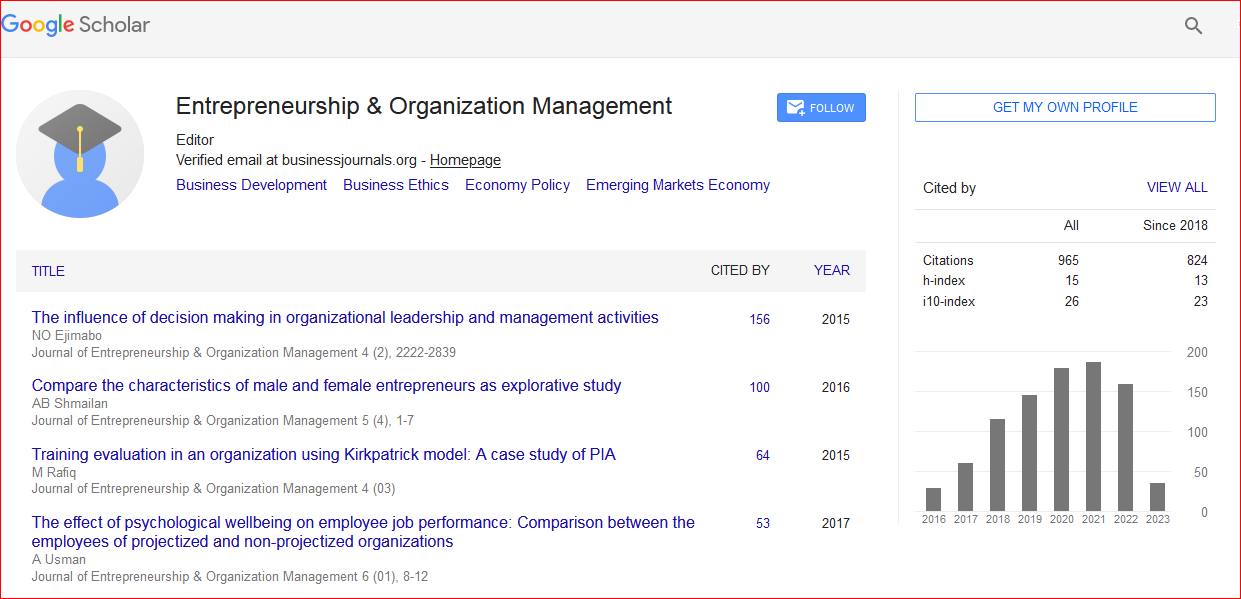
Entrepreneurship & Organization Management received 1115 citations as per Google Scholar report