Brief Report - (2025) Volume 9, Issue 2
Received: 02-Apr-2025, Manuscript No. jgge-25-173723;
Editor assigned: 04-Apr-2025, Pre QC No. P-173723;
Reviewed: 18-Apr-2025, QC No. Q-173723;
Revised: 23-Apr-2025, Manuscript No. R-173723;
Published:
30-Apr-2025
, DOI: 10.37421/2684-4567.2025.9.161
Citation: Nair, Priya K.. ”Epigenomics: From Disease to Agriculture.” J Genet Genom 09 (2025):161.
Copyright: © 2025 Nair K. Priya This is an open-access article distributed under the terms of the Creative Commons Attribution License, which permits unrestricted use,
distribution and reproduction in any medium, provided the original author and source are credited.
The field of epigenetic therapies for breast cancer explores recent advancements in using epigenetic modulators. It discusses the mechanisms by which these therapies work to reprogram cancer cells and their potential to improve patient outcomes, including combination strategies with conventional treatments. This points to a promising future for personalized epigenetic interventions in breast cancer management [1].
Investigations delve into the epigenetic mechanisms underlying Alzheimer's Disease (AD), examining how alterations in DNA methylation, histone modifications, and non-coding RNAs contribute to neurodegeneration. It also covers novel therapeutic strategies targeting these epigenetic changes, aiming to reverse or halt AD progression. The insights provided highlight the complex interplay between epigenetics and AD pathogenesis [2].
Research highlights the burgeoning field of single-cell epigenomics, detailing how it allows researchers to profile epigenetic marks at an unprecedented resolution. It outlines the innovative technologies that enable this analysis and their diverse applications in understanding cellular heterogeneity and disease mechanisms. This brings a deeper insight into how individual cells manage gene expression and respond to their environment [3].
Studies examine how epigenomic dysregulation significantly contributes to the aging process and the development of age-related diseases. It covers various epigenetic modifications, such as DNA methylation and histone acetylation, that change with age, affecting gene expression and cellular function. The insights here are crucial for understanding the molecular basis of aging and for developing interventions to promote healthy longevity [4].
Findings illuminate nutritional epigenomics, demonstrating how dietary components can directly influence our epigenome and, consequently, our health and disease risk. It discusses specific nutrients and dietary patterns that alter DNA methylation and histone modifications, impacting gene expression. The implications here underscore the profound connection between diet and our long-term health trajectory [5].
Epigenomics plays a significant role in modern drug discovery and development. It highlights how understanding epigenetic mechanisms offers new targets for therapeutic interventions across various diseases, including cancer and neurodegenerative disorders. The discussion emphasizes innovative approaches to screening and designing drugs that modulate epigenetic enzymes, promising more effective and targeted treatments [6].
Environmental factors influence our epigenome, leading to an increased risk of chronic diseases. It discusses how exposure to pollutants, diet, and lifestyle can induce epigenetic changes that impact gene regulation and cellular function. This highlights the importance of environmental health policies by showing that our environment has a direct, molecular impact on our health [7].
Epigenomics holds an emerging role in precision medicine, offering a new frontier for personalized healthcare. It explains how individual epigenomic profiles can predict disease susceptibility, guide therapeutic choices, and monitor treatment responses. Integrating epigenomic data promises to revolutionize how we approach diagnostics and tailor medical interventions for each patient [8].
The profound impact of epigenomics on infectious diseases focuses specifically on host-pathogen interactions. It elucidates how pathogens manipulate host epigenetic machinery to establish infection and how host cells, in turn, use epigenetic mechanisms to defend against invaders. Understanding these dynamics opens avenues for novel diagnostic tools and therapeutic strategies against infectious agents [9].
Plant epigenomics provides crucial insights into how epigenetic mechanisms regulate plant responses to various stresses and contribute to crop improvement. It details how DNA methylation, histone modifications, and small RNAs influence traits like yield, disease resistance, and stress tolerance. This knowledge is key for developing more resilient and productive crops in a changing climate [10].
Epigenetic therapies for breast cancer are a growing field, highlighting advancements in using epigenetic modulators. These therapies reprogram cancer cells, improving patient outcomes and showing potential in combination strategies with conventional treatments. This points to a promising future for personalized epigenetic interventions in breast cancer management [1]. Further investigations delve into the epigenetic mechanisms underlying Alzheimer's Disease (AD), examining how alterations in DNA methylation, histone modifications, and non-coding RNAs contribute to neurodegeneration. Novel therapeutic strategies targeting these epigenetic changes aim to reverse or halt AD progression, which highlights the complex interplay between epigenetics and AD pathogenesis [2].
The burgeoning field of single-cell epigenomics allows researchers to profile epigenetic marks at an unprecedented resolution. It outlines innovative technologies enabling this analysis and their diverse applications in understanding cellular heterogeneity and disease mechanisms. This brings a deeper insight into how individual cells manage gene expression and respond to their environment [3]. Investigations reveal epigenomic dysregulation significantly contributes to the aging process and the development of age-related diseases. This covers various epigenetic modifications, such as DNA methylation and histone acetylation, that change with age, affecting gene expression and cellular function. These insights are crucial for understanding the molecular basis of aging and for developing interventions to promote healthy longevity [4].
New findings illuminate nutritional epigenomics, demonstrating how dietary components directly influence our epigenome and, consequently, our health and disease risk. Specific nutrients and dietary patterns alter DNA methylation and histone modifications, impacting gene expression, underscoring the profound connection between diet and our long-term health trajectory [5]. Comprehensive reviews outline how environmental factors influence our epigenome, leading to an increased risk of chronic diseases. Exposure to pollutants, diet, and lifestyle can induce epigenetic changes that impact gene regulation and cellular function. This highlights the importance of environmental health policies by showing that our environment has a direct, molecular impact on our health [7].
Epigenomics plays a significant role in modern drug discovery and development. Understanding epigenetic mechanisms offers new targets for therapeutic interventions across various diseases, including cancer and neurodegenerative disorders. The discussion emphasizes innovative approaches to screening and designing drugs that modulate epigenetic enzymes, promising more effective and targeted treatments [6]. Epigenomics holds an emerging role in precision medicine, offering a new frontier for personalized healthcare. Individual epigenomic profiles can predict disease susceptibility, guide therapeutic choices, and monitor treatment responses. Integrating epigenomic data promises to revolutionize how we approach diagnostics and tailor medical interventions for each patient [8].
The profound impact of epigenomics on infectious diseases focuses specifically on host-pathogen interactions. Pathogens manipulate host epigenetic machinery to establish infection, and host cells, in turn, use epigenetic mechanisms to defend against invaders. Understanding these dynamics opens avenues for novel diagnostic tools and therapeutic strategies against infectious agents [9]. Plant epigenomics provides crucial insights into how epigenetic mechanisms regulate plant responses to various stresses and contribute to crop improvement. This details how DNA methylation, histone modifications, and small RNAs influence traits like yield, disease resistance, and stress tolerance. This knowledge is key for developing more resilient and productive crops in a changing climate [10].
Epigenomics is a rapidly expanding field with widespread implications across various biological disciplines and clinical applications. Researchers are actively exploring epigenetic therapies for breast cancer, focusing on modulators that reprogram cancer cells and improve patient outcomes, often in combination with existing treatments. The field also delves into the complex epigenetic mechanisms underlying neurodegenerative conditions like Alzheimer's Disease (AD), examining alterations in DNA methylation and histone modifications to develop novel therapeutic strategies. Advances in single-cell epigenomics offer unprecedented resolution for profiling epigenetic marks, providing deeper insights into cellular heterogeneity and disease mechanisms. Epigenomic dysregulation is recognized as a significant contributor to aging and age-related diseases, with changes in DNA methylation and histone acetylation impacting gene expression and cellular function. Beyond disease, nutritional epigenomics highlights how dietary components profoundly influence our epigenome, affecting health and disease risk. Environmental factors also play a crucial role, as exposure to pollutants and lifestyle choices can induce epigenetic changes linked to chronic diseases, emphasizing the molecular impact of our surroundings on health. Furthermore, epigenomics is central to modern drug discovery and development, revealing new targets for therapeutic interventions in cancer and neurodegenerative disorders. This emerging area also revolutionizes precision medicine by enabling personalized healthcare through individual epigenomic profiles to predict disease susceptibility and guide treatments. The profound impact extends to infectious diseases, where understanding host-pathogen epigenetic interactions offers avenues for new diagnostics and therapies. Even in agriculture, plant epigenomics provides crucial insights into stress responses and crop improvement, key for developing more resilient and productive crops in a changing climate.
None
None
1. Xiao L, Zhiqiang W, Xiaoyue Z. "Epigenetic Therapy in Breast Cancer: Recent Advances and Future Perspectives".Front Oncol 13 (2023):1174987.
Indexed at, Google Scholar, Crossref
2. Bin T, Tao D, Hong S. "Epigenetic regulation in Alzheimer's disease: Mechanisms and therapeutic strategies".Ageing Res Rev 86 (2023):101886.
Indexed at, Google Scholar, Crossref
3. Jing L, Hui L, Yong L. "Single-Cell Epigenomics in Health and Disease".Genes (Basel) 13 (2022):226.
Indexed at, Google Scholar, Crossref
4. Scott B, Paz J, Bruno BR. "Epigenomic dysregulation in aging and age-related diseases".Trends Mol Med 29 (2023):920-936.
Indexed at, Google Scholar, Crossref
5. Carolina S, Ana A, Carla B. "Nutritional epigenomics: The impact of diet on the epigenome in health and disease".Crit Rev Food Sci Nutr 64 (2024):292-311.
Indexed at, Google Scholar, Crossref
6. Bruno BR, Scott B, Sung YK. "Epigenomics in drug discovery and development".Front Mol Biosci 9 (2022):945532.
Indexed at, Google Scholar, Crossref
7. Vinay S, Abhay KS, Shivani M. "Environmental Epigenomics: Role in Chronic Diseases".Int J Mol Sci 24 (2023):1924.
Indexed at, Google Scholar, Crossref
8. Yong H, Tao L, Zhen L. "Epigenomics and precision medicine: A new era of personalized healthcare".J Transl Med 21 (2023):689.
Indexed at, Google Scholar, Crossref
9. Andrew T, Ziqin T, Qi L. "Epigenomics in Infectious Diseases: A Focus on Host-Pathogen Interactions".Curr Issues Mol Biol 45 (2023):4835-4848.
Indexed at, Google Scholar, Crossref
10. Gyanendra K, Suraj P, Rahul S. "Plant Epigenomics: Insights into Stress Responses and Crop Improvement".Plants (Basel) 12 (2023):854.
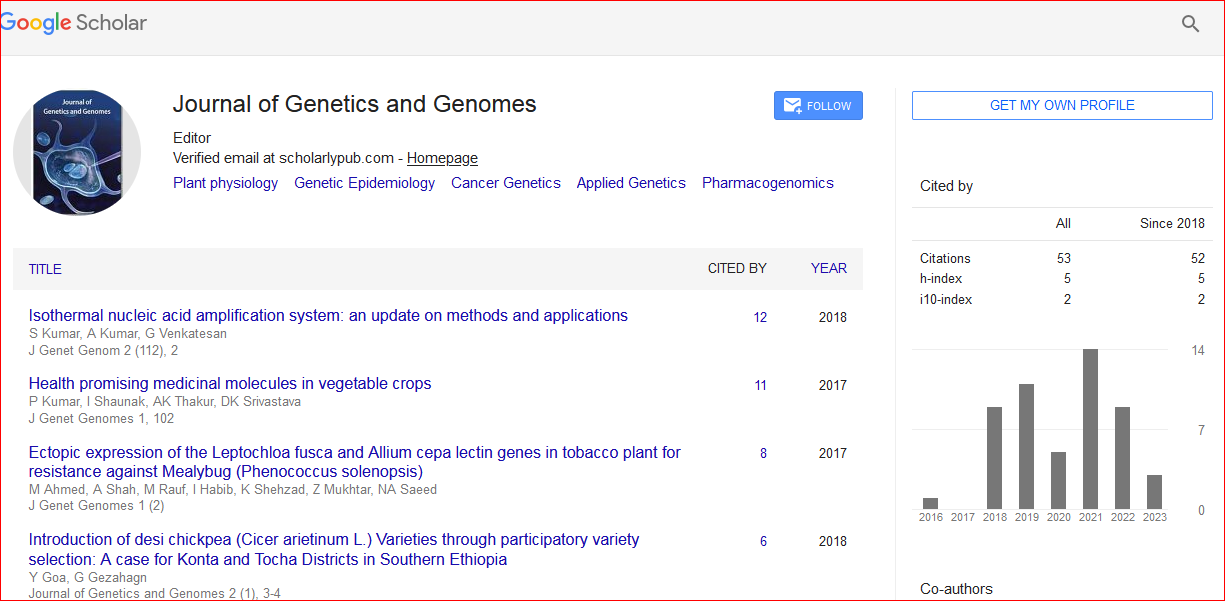
Journal of Genetics and Genomes received 65 citations as per Google Scholar report