Brief Report - (2025) Volume 15, Issue 6
Received: 01-Nov-2025, Manuscript No. jnt-26-178974;
Editor assigned: 03-Nov-2025, Pre QC No. P-178974;
Reviewed: 17-Nov-2025, QC No. Q-178974;
Revised: 24-Nov-2025, Manuscript No. R-178974;
Published:
29-Nov-2025
, DOI: 10.37421/2161-0959.2025.15.592
Citation: Markovic, Ivana. ”Epigenetic Mechanisms in Kidney Disease Progression.” J Nephrol Ther 15 (2025):592.
Copyright: © 2025 Markovic I. This is an open-access article distributed under the terms of the Creative Commons Attribution License, which permits unrestricted use, distribution and reproduction in any medium, provided the original author and source are credited.
Epigenetic modifications represent a fundamental layer of gene regulation that profoundly influences cellular function and development. These alterations, including DNA methylation, histone modifications, and the action of non-coding RNAs, are crucial in the pathogenesis of various renal pathologies. They orchestrate changes in gene expression without altering the underlying DNA sequence, thereby impacting essential kidney functions. Understanding these complex epigenetic mechanisms offers promising avenues for therapeutic intervention in diseases such as diabetic nephropathy, hypertensive nephropathy, and chronic kidney disease [1].
In the context of chronic kidney disease (CKD), significant perturbations in DNA methylation patterns have been observed, contributing to the progression of fibrosis and inflammation. Specific CpG sites within genes vital for renal development and function exhibit differential methylation in CKD patients, suggesting that epigenetic profiling could serve as a valuable biomarker for assessing CKD progression and severity [2].
Histone modifications, encompassing processes like acetylation and methylation, are critical regulators of gene accessibility and transcription within renal cells. In diabetic nephropathy, for instance, the dysregulation of histone deacetylases (HDACs) and histone methyltransferases (HMTs) leads to the aberrant overexpression of pro-fibrotic genes, thereby exacerbating kidney damage [3].
Non-coding RNAs (ncRNAs), a diverse group including microRNAs (miRNAs) and long non-coding RNAs (lncRNAs), are increasingly recognized for their significant roles in the development of renal pathologies. miRNAs, in particular, finely tune gene expression by targeting messenger RNAs, and their aberrant expression is frequently observed across various kidney diseases, influencing cellular proliferation, apoptosis, and inflammatory responses [4].
Epigenetic drugs that specifically target DNA methylation and histone modifications are currently under active investigation as potential therapeutic strategies for a spectrum of renal diseases. Preclinical models of kidney fibrosis and inflammation have shown promising results with inhibitors of DNA methyltransferases (DNMTs) and HDACs, pointing towards a future where epigenetically-guided therapies are integral to nephrology practice [5].
Hypertensive nephropathy is another renal condition where epigenetic mechanisms play a significant role in mediating vascular remodeling and podocyte injury. The altered expression of genes involved in blood pressure regulation and glomerular filtration, driven by epigenetic modifications, underlies the progressive damage to kidney tissue observed in hypertension [6].
The role of long non-coding RNAs (lncRNAs) in the pathogenesis of kidney fibrosis is becoming increasingly elucidated. Specific lncRNAs function as molecular scaffolds or decoys for transcription factors and microRNAs, effectively modulating the expression of profibrotic mediators such as TGF-β and collagen, and consequently driving fibrotic processes within the kidney [7].
MicroRNAs are actively engaged in the pathological processes underlying glomerular diseases. For example, the dysregulated expression of miR-21 has been strongly implicated in the mesangial cell proliferation and extracellular matrix accumulation characteristic of IgA nephropathy, underscoring the potential of miRNAs as diagnostic and therapeutic targets [8].
The epigenome of kidney cells is subject to dynamic changes throughout the aging process, contributing to the age-related decline in renal function. Epigenetic drift and the cumulative accumulation of epigenetic alterations can impair the normal functioning of the kidney and heighten its susceptibility to age-related renal pathologies [9].
Metabolic dysregulation, a common feature of conditions like diabetes and obesity, exerts a profound impact on the renal epigenome. These metabolic states can induce significant alterations in DNA methylation and histone modification patterns, thereby contributing to the development and progression of diabetic nephropathy and other kidney diseases associated with metabolic derangements [10].
Epigenetic modifications, encompassing DNA methylation, histone modifications, and non-coding RNAs, are central to the development and progression of numerous renal pathologies. These regulatory mechanisms operate without altering the DNA sequence but significantly impact gene expression, thereby influencing critical cellular processes that maintain kidney function. The investigation of these epigenetic pathways has opened new therapeutic avenues for conditions such as diabetic nephropathy, hypertensive nephropathy, and chronic kidney disease [1].
In chronic kidney disease (CKD), distinct alterations in DNA methylation patterns are frequently observed, which contribute to the pathological processes of fibrosis and inflammation. Evidence suggests that specific CpG sites in genes crucial for renal development and function exhibit differential methylation in CKD patients. This finding indicates that epigenetic profiling may serve as a valuable biomarker for tracking the progression and severity of CKD [2].
Histone modifications, including acetylation and methylation, are pivotal in regulating gene accessibility and transcriptional activity within renal cells. In the context of diabetic nephropathy, the dysregulation of key enzymes such as histone deacetylases (HDACs) and histone methyltransferases (HMTs) has been linked to the increased expression of pro-fibrotic genes, which ultimately exacerbates kidney damage [3].
Non-coding RNAs (ncRNAs), such as microRNAs (miRNAs) and long non-coding RNAs (lncRNAs), are increasingly recognized for their critical roles in the pathogenesis of renal diseases. miRNAs, by targeting messenger RNAs, can precisely regulate gene expression, and their aberrant expression patterns are consistently observed in various kidney diseases, influencing crucial cellular functions like proliferation, apoptosis, and inflammation [4].
Emerging therapeutic strategies for renal diseases are focusing on epigenetic drugs designed to target DNA methylation and histone modifications. Inhibitors of DNA methyltransferases (DNMTs) and HDACs have demonstrated encouraging results in preclinical models of kidney fibrosis and inflammation, suggesting a promising future for epigenetically-guided treatments in nephrology [5].
In hypertensive nephropathy, epigenetic mechanisms contribute significantly to vascular remodeling and the injury of podocytes. The altered expression of genes essential for blood pressure regulation and glomerular filtration, orchestrated by epigenetic changes, is a key factor in the progression of kidney damage associated with hypertension [6].
The involvement of long non-coding RNAs (lncRNAs) in the development of kidney fibrosis is becoming progressively clearer. Specific lncRNAs can act as molecular adaptors or decoys for transcription factors and microRNAs, thereby modulating the expression of profibrotic factors like TGF-β and collagen, and consequently promoting fibrotic processes in the kidney [7].
MicroRNAs play an active role in the pathogenesis of glomerular diseases. A notable example is the dysregulated expression of miR-21, which has been implicated in mesangial cell proliferation and the accumulation of extracellular matrix in IgA nephropathy, highlighting miRNAs as potential diagnostic and therapeutic targets [8].
The epigenome within kidney cells undergoes dynamic transformations during the aging process, contributing to age-related renal functional decline. Epigenetic drift, characterized by the gradual accumulation of epigenetic alterations, can impair kidney function and increase vulnerability to age-related renal pathologies [9].
Metabolic dysregulations, such as those occurring in diabetes and obesity, exert a substantial influence on the renal epigenome. These metabolic conditions can induce profound changes in DNA methylation and histone modifications, leading to the development and progression of diabetic nephropathy and other kidney diseases linked to metabolic imbalances [10].
Epigenetic modifications, including DNA methylation, histone alterations, and non-coding RNAs, are critical in the development and progression of various kidney diseases like diabetic nephropathy, hypertensive nephropathy, and chronic kidney disease. These changes dysregulate gene expression without altering the DNA sequence, impacting kidney function. Aberrant DNA methylation is observed in chronic kidney disease, contributing to fibrosis and inflammation, and may serve as a biomarker. Histone modifications affect gene accessibility and transcription, with dysregulation contributing to fibrosis in diabetic nephropathy. Non-coding RNAs, such as miRNAs and lncRNAs, are also implicated in kidney pathologies, influencing cellular processes and fibrosis. Epigenetic drugs targeting these modifications are being explored as therapeutic agents. Aging and metabolic dysregulation also impact the renal epigenome, contributing to age-related decline and metabolic kidney diseases. Understanding these epigenetic mechanisms offers potential therapeutic targets for improving kidney health.
None
None
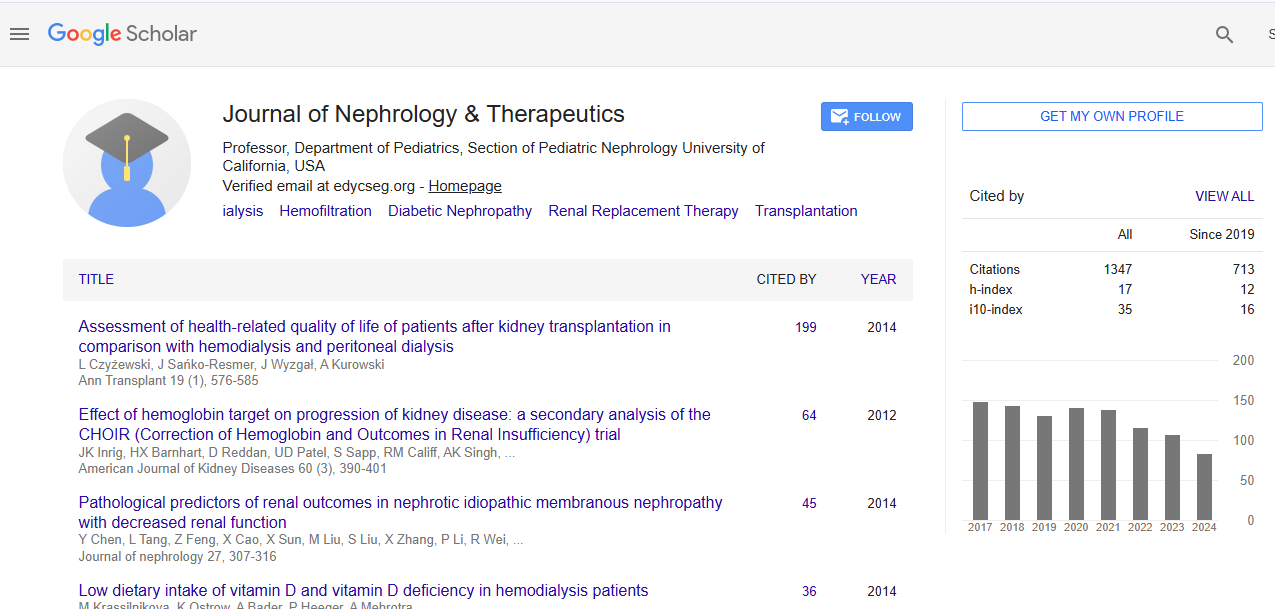
Journal of Nephrology & Therapeutics received 784 citations as per Google Scholar report