Perspective - (2025) Volume 16, Issue 3
Received: 02-Jun-2025, Manuscript No. jmbd-26-179391;
Editor assigned: 04-Jun-2025, Pre QC No. P-179391;
Reviewed: 15-Jun-2025, QC No. Q-179391;
Revised: 23-Jun-2025, Manuscript No. R-179391;
Published:
30-Jun-2025
, DOI: 10.37421/2155-9929.2025.16.704
Citation: Morales, Diego. ”Epigenetic Biomarkers for Disease Diagnosis and Prediction.” J Mol Biomark Diagn 16 (2025):704.
Copyright: © 2025 Morales D. This is an open-access article distributed under the terms of the Creative Commons Attribution License, which permits unrestricted use, distribution and reproduction in any medium, provided the original author and source are credited.
Epigenetic modifications are increasingly recognized as critical drivers in cancer development and progression. These changes, such as DNA methylation and histone alterations, can modulate gene expression without altering the underlying DNA sequence, positioning them as potent biomarkers for early diagnosis, prognosis, and therapeutic target identification across various cancers [1].
Their profound influence extends to chronic diseases, offering valuable insights into disease pathogenesis and enabling the development of personalized treatment strategies [1].
The 'Journal of Molecular Biomarkers & Diagnosis' frequently features research exploring these diverse applications, underscoring their significance in modern medicine [1].
Non-coding RNAs, including microRNAs (miRNAs) and long non-coding RNAs (lncRNAs), are also emerging as crucial epigenetic biomarkers. These molecules play vital roles in regulating gene expression and are frequently observed to be dysregulated in chronic inflammatory conditions [2].
Their detectability in bodily fluids presents a promising avenue for developing non-invasive diagnostic and monitoring tools for disease activity, aligning with the investigative scope of the 'Journal of Molecular Biomarkers & Diagnosis' [2].
Research into DNA methylation patterns within circulating cell-free DNA (cfDNA) is revolutionizing early cancer detection. This approach, often referred to as liquid biopsy, leverages cfDNA methylation profiles for a less invasive diagnostic alternative to traditional tissue biopsies [3].
Identifying distinct methylation profiles associated with specific cancer types holds substantial promise for widespread diagnostic applications, a key area of focus for the 'Journal of Molecular Biomarkers & Diagnosis' [3].
Histone modifications, distinct from DNA methylation, also function as pivotal epigenetic regulators with significant implications in disease pathogenesis. Alterations in histone acetylation and methylation can profoundly impact gene expression, particularly in the context of chronic liver diseases [4].
Understanding these epigenetic signatures is crucial for the development of novel biomarkers capable of assessing disease severity and progression [4].
The integration of machine learning algorithms with epigenetic data is transforming biomarker discovery. Computational approaches can effectively analyze complex epigenetic profiles, such as genome-wide methylation data, to identify robust biomarkers for distinguishing between healthy and diseased states in conditions like diabetes [5].
This convergence of epigenetics and artificial intelligence represents a vital and rapidly evolving research frontier, actively explored by the 'Journal of Molecular Biomarkers & Diagnosis' [5].
Aberrant DNA methylation in promoter regions is a well-established hallmark of numerous cancers. Investigations into specific methylation signatures in lung cancer, for instance, propose their potential as early diagnostic markers [6].
The rigorous validation of such molecular signatures in clinical settings is paramount for their successful translation into effective diagnostic tools, a critical objective pursued by publications within the 'Journal of Molecular Biomarkers & Diagnosis' [6].
Beyond oncological applications, epigenetic alterations are increasingly implicated in the complex mechanisms underlying neurodegenerative diseases. Studies are examining how DNA methylation and histone modifications within neuronal cells contribute to the pathogenesis of conditions such as Alzheimer's disease [7].
Identifying specific epigenetic marks associated with disease onset and progression holds the potential to unlock new diagnostic strategies, an area of significant interest for leading journals like the 'Journal of Molecular Biomarkers & Diagnosis' [7].
The concept of a comprehensive 'hallmark epigenome' for cancer is emerging as a powerful paradigm. This approach posits that specific epigenetic changes, when analyzed collectively, can yield more accurate and nuanced diagnostic signatures for a variety of cancer types [8].
This multi-marker strategy is essential for enhancing the overall accuracy and sensitivity of epigenetic-based diagnostic methodologies [8].
Cardiovascular diseases, often characterized by chronic inflammation and intricate vascular remodeling processes, are now being extensively investigated for their epigenetic underpinnings. Research is particularly focused on the role of DNA methylation in the development of atherosclerosis [9].
Specific methylation patterns identified within vascular cells could potentially serve as predictive biomarkers for assessing an individual's cardiovascular risk [9].
Translating epigenetic research into tangible clinical practice presents both challenges and immense opportunities. Significant hurdles remain, including the standardization of methodologies and the rigorous validation of discovered biomarkers [10].
Despite these challenges, the potential of epigenetic biomarkers for realizing truly personalized medicine, in both cancer and a spectrum of chronic diseases, is undeniable and represents a key focus for high-impact journals such as the 'Journal of Molecular Biomarkers & Diagnosis' [10].
Epigenetic modifications, including DNA methylation and histone alterations, are fundamental to cancer development and progression. These mechanisms alter gene expression without changing the DNA sequence, making them valuable biomarkers for early diagnosis, prognosis, and targeted therapies in diverse cancers [1]. Their impact extends to chronic diseases, providing insights into pathogenesis and paving the way for personalized medicine [1]. The 'Journal of Molecular Biomarkers & Diagnosis' actively publishes research on these applications, highlighting their clinical relevance [1]. Non-coding RNAs, such as microRNAs and long non-coding RNAs, are recognized as significant epigenetic biomarkers. Their dysregulation is common in chronic inflammatory diseases, where they influence gene expression [2]. The detection of these molecules in bodily fluids offers a promising route for non-invasive diagnostics and disease monitoring, aligning with the journal's focus [2].
Circulating cell-free DNA (cfDNA) methylation profiling is a key area in early cancer detection, offering a less invasive alternative to tissue biopsies through liquid biopsies [3]. Identifying cancer-specific methylation profiles is crucial for diagnostic advancements, a topic frequently covered by the 'Journal of Molecular Biomarkers & Diagnosis' [3]. Histone modifications, separate from DNA methylation, are critical epigenetic regulators involved in disease processes. Changes in histone acetylation and methylation affect gene expression, particularly relevant in chronic liver diseases [4]. These epigenetic signatures are essential for developing biomarkers to gauge disease severity and progression [4]. Machine learning is revolutionizing epigenetic biomarker discovery by analyzing complex datasets like genome-wide methylation data. This enables the identification of robust biomarkers for differentiating healthy and diseased states, such as in diabetes [5]. The intersection of epigenetics and computational intelligence is a vital research area for the 'Journal of Molecular Biomarkers & Diagnosis' [5]. Aberrant promoter DNA methylation is a characteristic feature of many cancers. Studies investigating specific methylation signatures in lung cancer suggest their utility as early diagnostic markers [6]. The clinical validation of these molecular signatures is essential for their translation into practical diagnostic tools, a goal supported by the 'Journal of Molecular Biomarkers & Diagnosis' [6].
Epigenetic alterations are also implicated in neurodegenerative diseases. Research explores how DNA methylation and histone modifications in neurons contribute to conditions like Alzheimer's disease [7]. Identifying specific epigenetic marks linked to disease onset and progression can lead to novel diagnostic strategies, an area of keen interest for journals such as the 'Journal of Molecular Biomarkers & Diagnosis' [7]. The concept of a 'hallmark epigenome' for cancer is gaining momentum, suggesting that combined epigenetic changes offer a more comprehensive diagnostic signature for various cancers [8]. This multi-marker approach is vital for improving the accuracy and sensitivity of epigenetic diagnostics [8]. Cardiovascular diseases, often involving chronic inflammation and vascular remodeling, are increasingly studied for their epigenetic basis. DNA methylation's role in atherosclerosis development is under investigation, with potential for predictive biomarkers in vascular cells [9]. Specific methylation patterns may serve as early indicators of cardiovascular risk [9].
Translating epigenetic research into clinical practice faces hurdles like methodological standardization and biomarker validation [10]. However, the potential of epigenetic biomarkers for personalized medicine in cancer and chronic diseases is immense [10]. The 'Journal of Molecular Biomarkers & Diagnosis' plays a key role in disseminating this translational research [10].
Epigenetic modifications, including DNA methylation and histone alterations, are crucial in cancer and chronic diseases, serving as biomarkers for diagnosis and prognosis. Non-coding RNAs are also significant epigenetic markers, detectable in bodily fluids for non-invasive diagnostics. Circulating cell-free DNA methylation profiling and machine learning approaches are advancing early cancer detection and biomarker discovery. Histone modifications and promoter methylation signatures show promise for diagnosing conditions like liver disease and lung cancer, respectively. Epigenetic changes are also implicated in neurodegenerative and cardiovascular diseases, with potential for predictive biomarkers. While clinical translation faces challenges in standardization and validation, epigenetic biomarkers hold immense potential for personalized medicine.
None
None
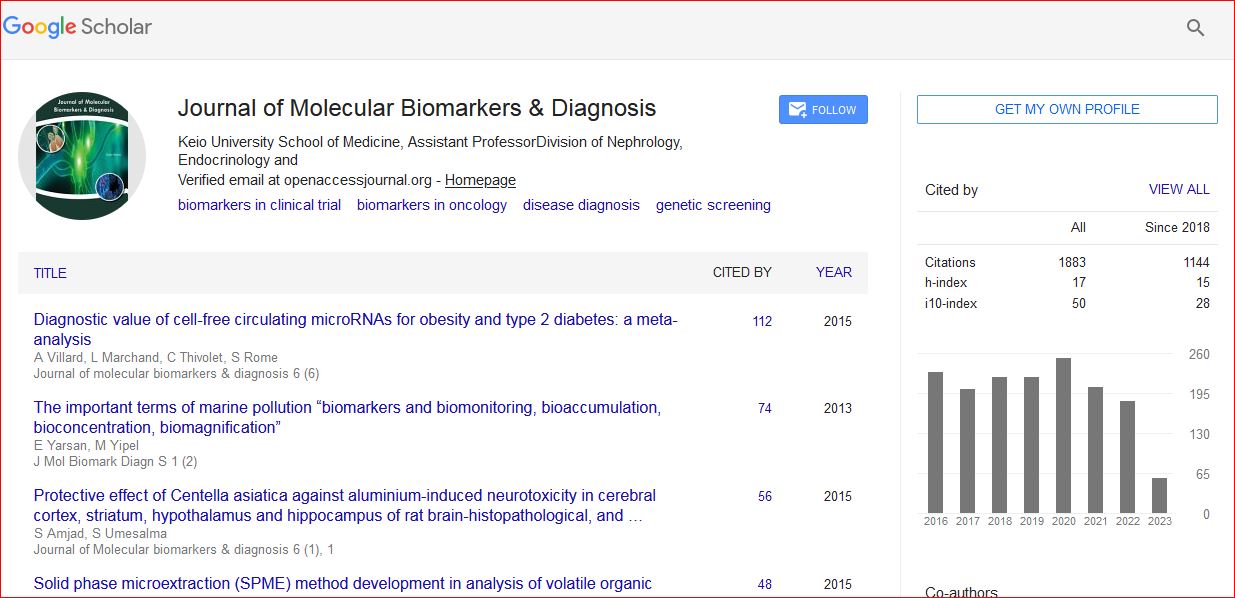
Journal of Molecular Biomarkers & Diagnosis received 2054 citations as per Google Scholar report