Commentary - (2025) Volume 12, Issue 2
Received: 01-Apr-2025, Manuscript No. jreac-26-185796;
Editor assigned: 03-Apr-2025, Pre QC No. P-185796;
Reviewed: 17-Apr-2025, QC No. Q-185796;
Revised: 22-Apr-2025, Manuscript No. R-185796;
Published:
29-Apr-2025
, DOI: 10.37421/2380-2391.2025.12.422
Citation: Moreau, Isabelle. ”Environmental Contaminant Analysis: GC-MS and LC-MS/MS Power.” J Environ Anal Chem 12 (2025):422.
Copyright: © 2025 Moreau I. This is an open-access article distributed under the terms of the Creative Commons Attribution License, which permits unrestricted use, distribution and reproduction in any medium, provided the original author and source are credited.
Gas Chromatography-Mass Spectrometry (GC-MS) and Liquid Chromatography-tandem Mass Spectrometry (LC-MS/MS) have emerged as essential analytical techniques in the field of environmental science, offering unparalleled sensitivity and specificity for the detection and quantification of a wide array of contaminants [1].
GC-MS is particularly adept at analyzing volatile and semi-volatile organic compounds, making it a primary choice for identifying substances such as pesticides and polycyclic aromatic hydrocarbons (PAHs) within environmental matrices [1].
Conversely, LC-MS/MS is preferentially employed for the analysis of non-volatile and thermally labile compounds, including pharmaceuticals, personal care products (PPCPs), and the persistent group of per- and polyfluoroalkyl substances (PFAS) [1].
The combined and complementary application of GC-MS and LC-MS/MS enables a comprehensive screening and detailed quantification of diverse contaminants present in complex environmental samples like water, soil, and air [1].
This dual approach is instrumental in facilitating robust risk assessments and ensuring adherence to stringent regulatory compliance standards for environmental protection [1].
Recent advancements have further solidified LC-MS/MS's role in identifying and quantifying emerging contaminants, such as PFAS, in vital water resources, providing the necessary selectivity to distinguish between various isomers and homologues [2].
GC-MS continues to be a foundational technique for the analysis of organochlorine pesticides (OCPs) and other volatile organic pollutants found in soil and air, offering definitive identification through its mass spectral capabilities [3].
Emerging concerns regarding microplastics in the environment have also seen the application of both GC-MS and LC-MS/MS to identify and quantify organic pollutants adsorbed onto these particles, shedding light on potential risks [4].
Furthermore, the widespread detection of PPCPs in surface and groundwaters has underscored the utility of LC-MS/MS due to its proficiency in analyzing these often polar and complex compounds [5].
The analysis of PAHs in airborne particulate matter is another area where GC-MS demonstrates significant efficacy, providing the necessary separation and spectral identification for comprehensive air quality assessments [6].
The application of GC-MS and LC-MS/MS represents a significant stride in environmental contaminant analysis, providing high levels of sensitivity and specificity crucial for accurate detection and quantification [1].
GC-MS is the technique of choice for analyzing volatile and semi-volatile organic compounds, including pesticides and polycyclic aromatic hydrocarbons (PAHs), which are commonly found in environmental samples [1].
For non-volatile and thermally unstable compounds, such as pharmaceuticals, personal care products (PPCPs), and per- and polyfluoroalkyl substances (PFAS), LC-MS/MS offers superior performance and is therefore preferred [1].
When used together, these powerful analytical techniques allow for a comprehensive assessment of a wide range of contaminants across various environmental matrices like water, soil, and air, supporting informed decision-making [1].
This combined analytical strategy is vital for conducting thorough risk assessments and ensuring that environmental regulations are effectively met and maintained [1].
In the context of water resources, LC-MS/MS plays a pivotal role in the identification and quantification of emerging contaminants, particularly PFAS, by offering the selectivity needed to differentiate between closely related chemical structures [2].
GC-MS remains a cornerstone in the analysis of organochlorine pesticides (OCPs) and other volatile organic pollutants in soil and air, providing definitive identification through its mass spectrometry capabilities [3].
Studies have increasingly employed both GC-MS and LC-MS/MS to investigate organic pollutants that adsorb onto microplastics, offering critical insights into their environmental behavior and potential risks associated with ingestion and bioaccumulation [4].
LC-MS/MS has become the go-to method for monitoring pharmaceuticals and personal care products (PPCPs) in water systems due to their frequently polar and complex molecular structures, enabling assessment of their widespread presence and ecological impact [5].
The analysis of polycyclic aromatic hydrocarbons (PAHs) in airborne particulate matter often utilizes GC-MS, which effectively separates and identifies these compounds, aiding in the evaluation of air quality and human exposure levels [6].
Gas Chromatography-Mass Spectrometry (GC-MS) and Liquid Chromatography-tandem Mass Spectrometry (LC-MS/MS) are indispensable tools for environmental contaminant analysis, providing high sensitivity and specificity. GC-MS excels at analyzing volatile and semi-volatile organic compounds like pesticides and PAHs, while LC-MS/MS is preferred for non-volatile compounds such as PPCPs and PFAS. Their combined use allows for comprehensive screening and quantification in water, soil, and air, aiding risk assessment and regulatory compliance. LC-MS/MS is crucial for emerging contaminants like PFAS and PPCPs due to its selectivity and ability to handle polar structures. GC-MS remains vital for OCPs, VOCs, and PAHs. Both techniques are also used to study pollutants adsorbed on microplastics. Advancements in these methods continue to improve detection limits and expand their applicability in monitoring environmental quality and human health risks.
None
None
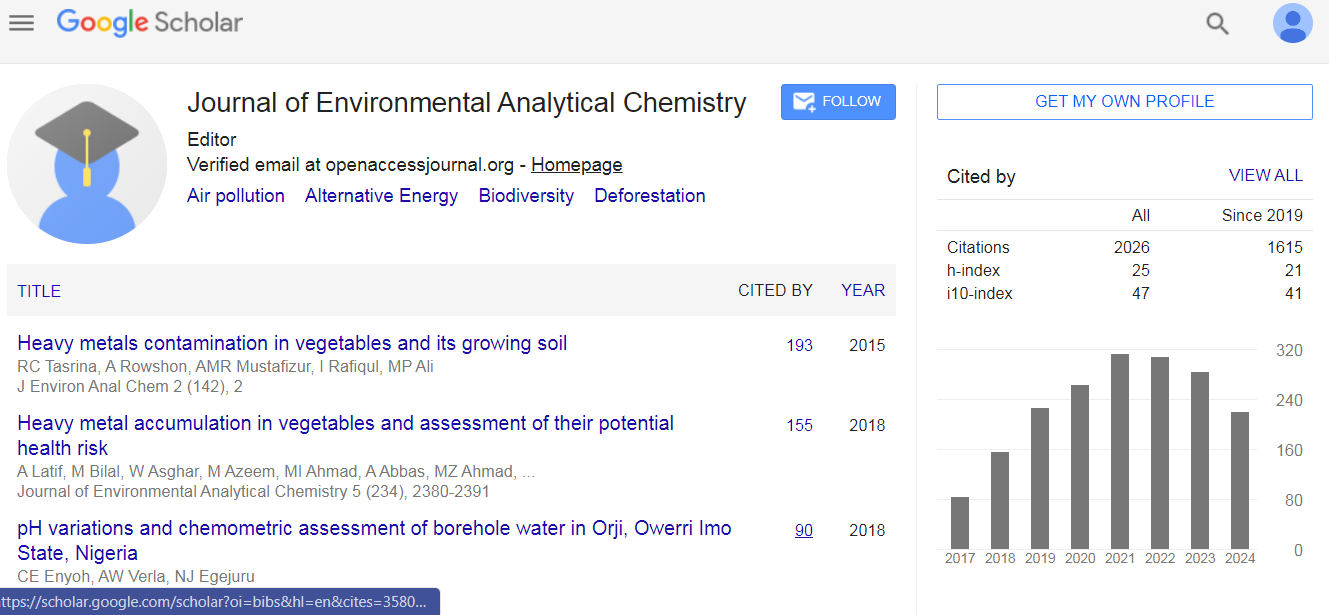
Journal of Environmental Analytical Chemistry received 1781 citations as per Google Scholar report