Brief Report - (2025) Volume 14, Issue 3
Received: 01-Sep-2025, Manuscript No. jms-25-172638;
Editor assigned: 03-Sep-2025, Pre QC No. P-172638;
Reviewed: 17-Sep-2025, QC No. Q-172638;
Revised: 22-Sep-2025, Manuscript No. R-172638;
Published:
29-Sep-2025
, DOI: 10.37421/2167-0943.2024.14.411
Citation: Murphy, Aoife. "Energy Balance: Beyond Simple Calorie Counting." J Metabolic Synd 14 (2025):411
Copyright: © 2025 Murphy A. This is an open-access article distributed under the terms of the Creative Commons Attribution License, which permits unrestricted use,
distribution and reproduction in any medium, provided the original author and source are credited.
This review explores how dietary fat impacts overall energy balance, emphasizing that while fat has a high energy density, its role in weight gain isn't solely about total calories. It highlights the complex interplay of fat intake with satiety, metabolic pathways, and individual responses, suggesting that simply reducing fat doesn't guarantee weight loss; the overall dietary pattern and quality of fat matter more. This nuanced perspective highlights that metabolic individuality and the intricate interplay of dietary components are paramount in understanding weight management [1].
This review delves into the health implications of calorie restriction and various fasting diets, including intermittent fasting and time-restricted feeding. It explains how these approaches can impact metabolic health, reduce inflammation, and potentially extend lifespan by modulating cellular pathways, all while acknowledging the need for careful implementation and further human studies. Understanding these mechanisms is crucial for leveraging fasting as a potential health intervention, demanding careful consideration of individual contexts [2].
This article discusses the evolving field of precision nutrition and its potential to optimize metabolic health by tailoring dietary recommendations, including calorie intake, to individual needs. It highlights how factors like genetics, microbiome composition, and lifestyle can influence nutrient metabolism and energy expenditure, moving beyond one-size-fits-all caloric guidelines for more effective health interventions. This represents a significant shift towards more personalized and effective dietary strategies for optimizing overall well-being [3].
This paper critically assesses the 'energy gap' hypothesis in the context of exercise, energy expenditure, and body weight regulation. It questions the simplicity of calorie-in, calorie-out models, suggesting that the body's adaptive responses to increased physical activity can sometimes attenuate expected weight loss, highlighting complex physiological adjustments beyond simple calorie burn. Such complexity challenges simplistic caloric deficit approaches and advocates for a deeper understanding of physiological adaptations to exercise [4].
This meta-analysis underscores the profound impact of overall diet quality on health outcomes, including all-cause mortality, beyond mere calorie counting. It demonstrates that patterns of healthy eating, rich in fruits, vegetables, and whole grains, are consistently associated with reduced mortality risk, suggesting that the source and nutritional density of calories are more crucial than the total caloric load alone for long-term health. It strongly advocates for a focus on whole, unprocessed foods as a cornerstone of preventive health [5].
This systematic review and meta-analysis evaluates new prediction equations for resting energy expenditure (REE) in healthy adults, aiming to improve the accuracy of estimating an individual's baseline calorie needs. It highlights the variability and limitations of existing formulas, emphasizing the ongoing challenge of precisely quantifying REE, which is critical for personalized nutritional interventions and weight management. Accurate Resting Energy Expenditure (REE) estimation is thus fundamental for crafting effective, individualized dietary plans and managing body weight [6].
This overview explores the intricate relationship between the gut microbiome and energy balance, highlighting how microbial communities influence calorie extraction from food and impact host metabolism. It discusses how dysbiosis can contribute to obesity and metabolic disorders by altering nutrient absorption, energy storage, and appetite regulation, suggesting the gut microbiome as a potential target for weight management strategies. Further research into specific microbial interventions holds promise for novel therapeutic avenues in combating obesity and related conditions [7].
This article investigates how various bioactive compounds found in food can influence energy metabolism and body weight regulation, often independently of their caloric contribution. It details mechanisms such as enhanced fat oxidation, improved insulin sensitivity, and altered gut hormone secretion, suggesting that these compounds offer promising avenues for developing dietary strategies beyond simple calorie restriction for managing obesity and metabolic health. Leveraging these compounds could lead to more effective and sustainable approaches to metabolic health and weight control [8].
This update discusses the current understanding and challenges in establishing Dietary Reference Intakes (DRIs) for energy. It highlights the complexities of determining precise calorie requirements across diverse populations, considering factors like age, sex, physical activity, and metabolic individuality. The article emphasizes the ongoing need for robust data and flexible approaches to guide public health and personalized nutrition recommendations effectively. Developing more adaptable and data-driven guidelines is essential for meeting diverse nutritional needs across populations effectively [9].
This review focuses on brown adipose tissue (BAT) and its significant role in human energy metabolism and health. It elucidates how BAT actively burns calories to produce heat (thermogenesis), contrasting with white adipose tissue's energy storage function. The article discusses strategies to activate or increase BAT activity, presenting it as a promising therapeutic target for combating obesity and related metabolic disorders by enhancing overall energy expenditure. Activating Brown Adipose Tissue (BAT) offers an exciting prospect for enhancing energy expenditure, presenting a potential new frontier in obesity treatment [10].
Understanding energy balance, body weight regulation, and metabolic health is crucial, yet it moves beyond simplistic calorie-in, calorie-out models. Dietary fat, for instance, significantly impacts overall energy balance, but its role in weight gain is not solely dependent on total calories; the quality of fat, along with its intricate interaction with satiety and metabolic pathways, plays a more substantial role [1]. This highlights a paradigm shift from focusing merely on caloric density to considering the physiological effects of different fat types. Similarly, the 'energy gap' hypothesis, which suggests a direct correlation between exercise, energy expenditure, and weight loss, has been critically assessed. This assessment reveals that the body often employs complex adaptive responses to increased physical activity that can sometimes attenuate expected weight loss, highlighting physiological adjustments beyond simple caloric burn [4]. Therefore, effective weight management and health optimization require a multifaceted approach that acknowledges these inherent physiological complexities.
Various dietary interventions, such as calorie restriction and fasting diets, including intermittent fasting and time-restricted feeding, offer significant health implications that extend to metabolic health, inflammation reduction, and potentially increased lifespan through cellular pathway modulation [2]. However, the effectiveness of such approaches, and indeed all dietary recommendations, is increasingly recognized as highly individual-specific. The emerging field of precision nutrition aims to optimize metabolic health by tailoring dietary recommendations, including calorie intake, to individual needs. Factors such as genetics, gut microbiome composition, and lifestyle profoundly influence nutrient metabolism and energy expenditure, advocating for personalized caloric guidelines over a simplistic one-size-fits-all approach [3]. Moreover, a broad meta-analysis underscores the profound impact of overall diet quality on health outcomes, including all-cause mortality, far surpassing mere calorie counting. This demonstrates that healthy eating patterns, rich in fruits, vegetables, and whole grains, are consistently associated with reduced mortality risk, suggesting that the source and nutritional density of calories are more crucial for long-term health than the total caloric load alone [5].
Internal physiological processes are also pivotal in energy regulation and represent key targets for intervention. Accurately estimating an individual's baseline calorie needs, specifically Resting Energy Expenditure (REE), presents an ongoing challenge due to the inherent variability and limitations of existing prediction formulas. Recent systematic reviews and meta-analyses continue to evaluate and improve these prediction equations for healthy adults, emphasizing their critical importance for crafting personalized nutritional interventions and effective weight management strategies [6]. Another burgeoning area of research involves the gut microbiome, which emerges as a key player intricately linked to energy balance. Microbial communities influence calorie extraction from food and impact host metabolism. Dysbiosis within these communities can contribute to obesity and various metabolic disorders by altering nutrient absorption, energy storage, and appetite regulation, thus suggesting the gut microbiome as a potential therapeutic target for novel weight management strategies [7].
Beyond traditional macronutrient and caloric considerations, researchers are exploring how bioactive compounds found in food can significantly influence energy metabolism and body weight regulation, often independently of their caloric contribution. These compounds operate through diverse mechanisms such as enhanced fat oxidation, improved insulin sensitivity, and altered gut hormone secretion, offering promising avenues for developing dietary strategies that extend beyond simple calorie restriction for managing obesity and metabolic health [8]. Furthermore, brown adipose tissue (BAT) plays a significant and often underestimated role in human energy metabolism and health by actively burning calories to produce heat, a process known as thermogenesis. This contrasts sharply with white adipose tissue's primary function of energy storage. Strategies aimed at activating or increasing BAT activity are currently being explored as potential therapeutic targets for combating obesity and related metabolic disorders by enhancing overall energy expenditure [10]. Lastly, the complexities involved in establishing robust Dietary Reference Intakes (DRIs) for energy highlight an ongoing challenge. Determining precise calorie requirements across diverse populations, while considering factors like age, sex, physical activity levels, and metabolic individuality, requires robust data and flexible approaches to effectively guide both public health initiatives and personalized nutrition recommendations [9]. These combined insights emphasize a holistic view of energy balance, moving beyond simple arithmetic to embrace the multifaceted biological and environmental influences on health.
Energy balance and weight management are far more complex than simple calorie counting, encompassing diverse physiological, dietary, and environmental factors. Dietary fat's impact on energy balance relies on its quality and interaction with satiety and metabolic pathways, not just total calories [1]. Similarly, exercise's effect on weight loss isn't always straightforward, as the body adapts in ways that can attenuate expected results, challenging the 'energy gap' hypothesis [4]. Calorie restriction and fasting offer metabolic health benefits, including reduced inflammation and potential lifespan extension, but require careful implementation [2]. Diet quality, emphasizing whole foods, strongly correlates with reduced mortality, highlighting that the nutritional density and source of calories are more crucial than total caloric load for long-term health [5]. Personalized nutrition is gaining traction, with precision nutrition tailoring dietary recommendations based on individual genetics, microbiome, and lifestyle to optimize metabolic health and energy expenditure [3]. The gut microbiome plays a significant role in calorie extraction, metabolism, and appetite regulation, presenting a target for weight management [7]. Bioactive food compounds can influence energy metabolism independently of calories, enhancing fat oxidation and insulin sensitivity [8]. Brown Adipose Tissue (BAT) actively burns calories for heat, offering a promising target for increasing energy expenditure and combating obesity [10]. Meanwhile, accurately predicting Resting Energy Expenditure (REE) remains vital for personalized nutrition [6], and updating Dietary Reference Intakes (DRIs) for energy faces challenges in accounting for metabolic individuality across diverse populations [9].
None
None
Indexed at, Google Scholar, Crossref
Indexed at, Google Scholar, Crossref
Indexed at, Google Scholar, Crossref
Indexed at, Google Scholar, Crossref
Indexed at, Google Scholar, Crossref
Indexed at, Google Scholar, Crossref
Indexed at, Google Scholar, Crossref
Indexed at, Google Scholar, Crossref
Indexed at, Google Scholar, Crossref
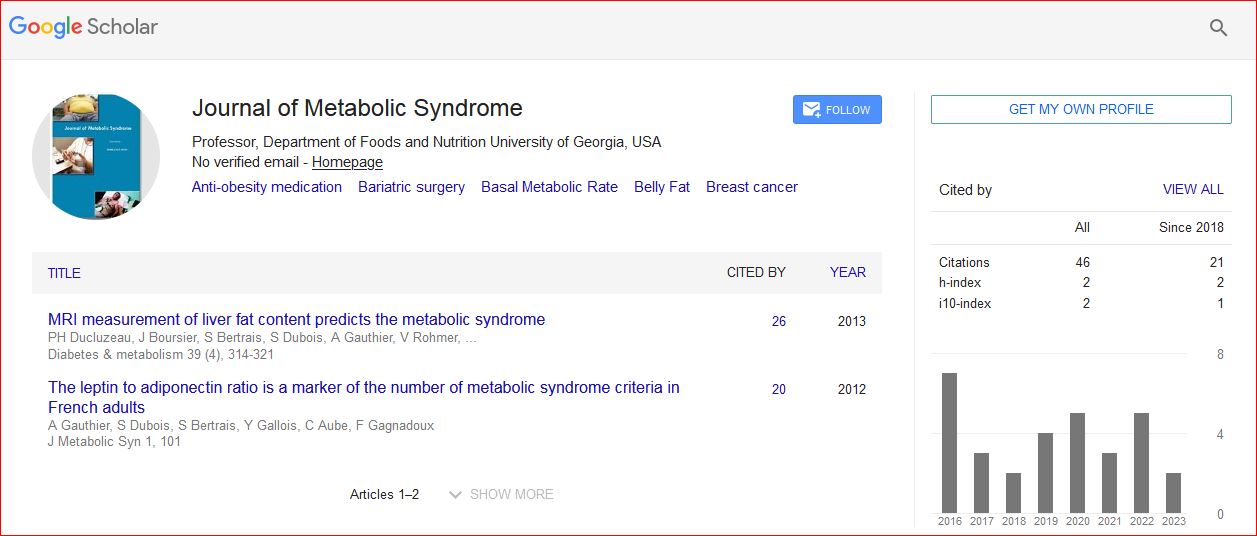
Journal of Metabolic Syndrome received 48 citations as per Google Scholar report