Brief Report - (2025) Volume 13, Issue 5
Received: 01-Oct-2025, Manuscript No. JGPR-26-190225;
Editor assigned: 03-Oct-2025, Pre QC No. P-190225;
Reviewed: 17-Oct-2025, QC No. Q-190225;
Revised: 22-Oct-2025, Manuscript No. R-190225;
Published:
29-Oct-2025
, DOI: 10.37421/2329-9126.2025.13.635
Citation: Mensah, Samuel. ”Effective Doctor-Patient Communication: Key To Better Outcomes.” J Gen Pract 13 (2025):635.
Copyright: © 2025 Mensah S. This is an open-access article distributed under the terms of the Creative Commons Attribution License, which permits unrestricted use, distribution and reproduction in any medium, provided the original author and source are credited.
Effective doctor-patient communication stands as a cornerstone in the delivery of quality general practice care, fundamentally influencing the diagnostic process, patient adherence to treatment plans, and overall patient satisfaction. Key research consistently highlights the profound importance of active listening, the demonstration of empathy, the provision of clear and understandable explanations, and the collaborative approach of shared decision-making in fostering therapeutic relationships. Furthermore, acknowledging and adeptly addressing cultural nuances and varying levels of health literacy are recognized as critical factors in enhancing the efficacy of the therapeutic alliance and improving health outcomes across diverse patient demographics. This foundational element of healthcare is not merely about the exchange of information but also about building trust and ensuring that patients feel understood and respected. The ability of healthcare professionals to communicate effectively can significantly impact a patient's willingness to engage in their own care and follow medical advice. It is through robust communication that practitioners can gain a comprehensive understanding of a patient's condition, enabling more accurate diagnoses and personalized treatment strategies. The nuances of effective communication extend beyond verbal exchanges, encompassing non-verbal cues that can convey empathy and attentiveness, thereby strengthening the patient-physician bond. Understanding the patient's perspective is equally vital, as it informs how medical information is received and acted upon. Therefore, a concerted effort to refine and enhance communication skills within general practice is paramount for achieving optimal patient care and health promotion. The integration of technology also presents new avenues and challenges, requiring a balanced approach to maintain personal connections while leveraging digital tools for improved access and information dissemination. Ultimately, the quality of doctor-patient communication is inextricably linked to the success of healthcare interventions and the well-being of patients. Addressing these multifaceted aspects is essential for the continuous improvement of general practice services and the achievement of positive health trajectories for all individuals. The ongoing evolution of medical practice necessitates a dynamic and responsive approach to communication strategies, ensuring they remain relevant and effective in meeting the ever-changing needs of patients and the healthcare landscape. Continuous professional development in communication skills is therefore not just beneficial, but imperative for healthcare providers aiming to deliver patient-centered care.
The quality of communication within general practice settings has a direct and measurable impact on patient trust and their proactive engagement in the management of chronic conditions. Studies unequivocally demonstrate that physicians who dedicate more time to communicating with their patients, employ plain language in their explanations, and actively involve patients in the goal-setting process, are more likely to achieve superior clinical results and foster greater patient adherence to prescribed regimens. The role of technology in shaping doctor-patient interactions within general practice presents a dual-edged sword, offering significant opportunities for enhanced access and efficient information sharing through modalities like telehealth and patient portals, while simultaneously posing challenges in preserving the essential personal connection and addressing the growing digital divide, which could hinder equitable care delivery. A thorough understanding of patient perspectives on doctor-patient communication is absolutely fundamental to the practice of good medicine. Patients consistently express a strong value for empathy, lucid explanations regarding diagnoses and treatment pathways, and the assurance that their concerns are genuinely heard and acknowledged. Conversely, misunderstandings frequently stem from the use of medical jargon, consultations that feel rushed or hurried, and an insufficient degree of collaborative decision-making between the patient and the practitioner. The impact of non-verbal communication within general practice consultations is often significantly underestimated, yet it plays a crucial role in shaping a patient's perception of their healthcare provider. Subtle cues such as body language, consistent eye contact, and the tone of voice employed by the physician can powerfully convey empathy, attentiveness, and a sense of confidence, thereby profoundly influencing the overall patient experience and the development of trust. Cultural competence in the realm of doctor-patient communication emerges as a critical determinant of effective care, particularly within the context of increasingly diverse patient populations. Acknowledging and respectfully integrating an understanding of differing cultural beliefs, values, and communication styles is instrumental in preventing misunderstandings, enhancing treatment adherence, and cultivating robust and enduring patient-physician relationships. The implementation of shared decision-making (SDM) within general practice serves as a powerful mechanism for empowering patients by actively involving them in the selection of treatment choices. When this collaborative approach is effectively executed, it demonstrably enhances patient comprehension of their conditions and treatment options, boosts satisfaction levels, and encourages greater adherence to agreed-upon care plans, ultimately contributing to improved health outcomes. Health literacy is recognized as a significant influencing factor on the dynamics of doctor-patient communication within general practice. Healthcare professionals are tasked with the essential responsibility of adapting their communication strategies to accommodate a wide spectrum of health literacy levels, employing clear and accessible language alongside visual aids to ensure patients can fully grasp their health conditions and the specifics of their treatment plans. Empathy is undeniably a cornerstone of effective doctor-patient communication in general practice. The deliberate cultivation of empathetic responses and the consistent demonstration of genuine care are potent tools for significantly enhancing patient trust, elevating satisfaction rates, and fostering a greater willingness on the part of patients to disclose sensitive personal health information. Finally, the duration of consultations within general practice has been identified as a key factor influencing the overall quality of doctor-patient communication. Research indicates that longer consultation times provide practitioners with the necessary opportunity to deliver more thorough explanations, facilitate deeper patient understanding, and create ample space for meaningful shared decision-making, all of which collectively contribute to the delivery of superior patient care.
Effective doctor-patient communication in general practice is crucial for accurate diagnosis, treatment adherence, and patient satisfaction. Key elements include active listening, empathy, clear explanations, and shared decision-making. Addressing cultural nuances and health literacy enhances the therapeutic relationship. Physicians spending more time communicating in plain language and involving patients in goal setting achieve better outcomes. Technology like telehealth can improve access but requires maintaining personal connection. Patients value empathy, clear explanations, and feeling heard, with misunderstandings arising from jargon and rushed consultations. Non-verbal communication significantly influences patient perception and trust. Cultural competence prevents misunderstandings and builds stronger relationships in diverse populations. Shared decision-making empowers patients, leading to better understanding, satisfaction, and adherence. Health literacy necessitates adapting communication strategies for clarity and understanding. Empathy fosters trust and encourages disclosure of sensitive information. Longer consultation times allow for better communication, understanding, and shared decision-making, improving patient care.
None
None
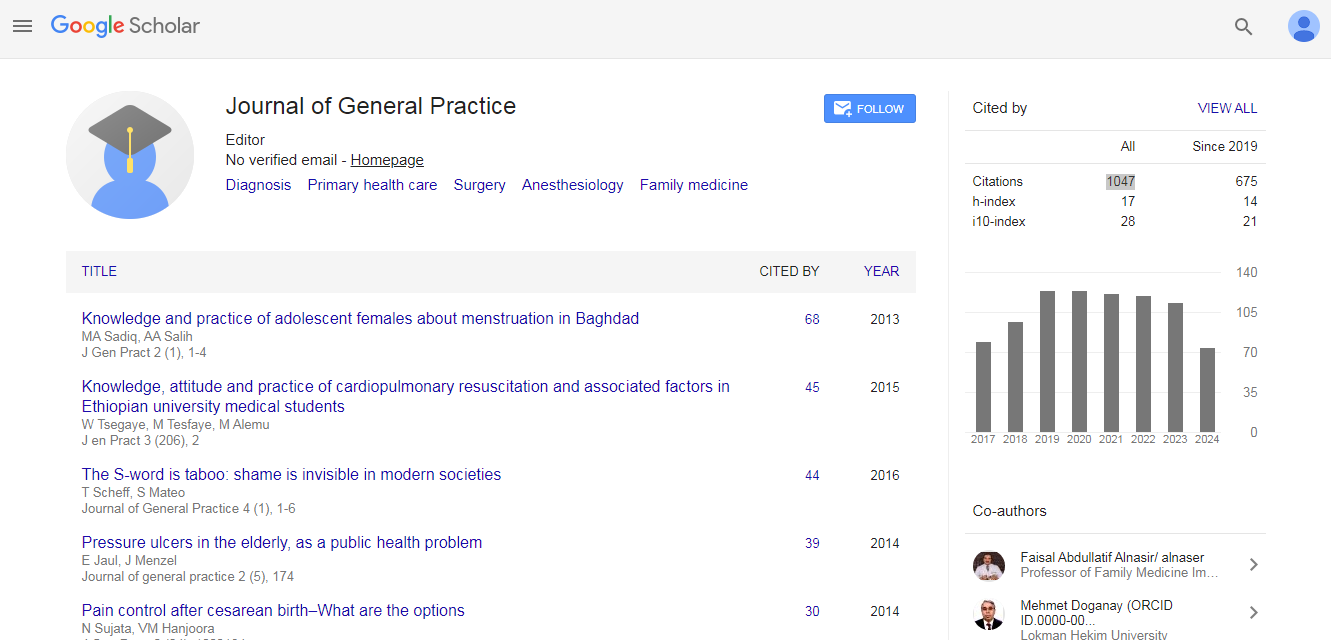
Journal of General Practice received 1047 citations as per Google Scholar report