Brief Report - (2025) Volume 16, Issue 4
Received: 01-Jul-2025, Manuscript No. bej-26-182445;
Editor assigned: 03-Jul-2025, Pre QC No. P-182445;
Reviewed: 17-Jul-2025, QC No. Q-182445;
Revised: 22-Jul-2025, Manuscript No. R-182445;
Published:
29-Jul-2025
, DOI: 10.37421/2161-6219.2025.16.562
Citation: Thompson, Elliot. ”Economics: Foundation for Business
Success and Growth.” Bus Econ J 16 (2025):562.
Copyright: © 2025 Thompson E. This is an open-access article distributed under the terms of the Creative Commons Attribution License, which permits unrestricted use,
distribution and reproduction in any medium, provided the original author and source are credited.
Economics serves as a foundational discipline for informed business decision-making, offering essential frameworks and analytical tools to navigate the complexities of the market. It enables businesses to understand market dynamics, to strategically allocate scarce resources, and to predict consumer behavior, all of which are critical for assessing profitability. By diligently applying economic principles, enterprises can make well-judged choices concerning pricing strategies, production levels, investment opportunities, and overarching strategic planning, thereby fostering a sustainable competitive advantage and driving long-term growth [1].
Microeconomic principles are of paramount importance in comprehending the competitive landscape within which businesses operate. Concepts such as supply and demand, price elasticity, and the various market structures provide a lens through which to understand market forces and to establish optimal pricing strategies. Businesses that possess a deep understanding of these microeconomic tenets are better equipped to anticipate shifts in market conditions and to adapt their operational and strategic plans accordingly, leading to enhanced operational efficiency and increased revenue generation [2].
Macroeconomic factors, encompassing broad economic indicators like inflation rates, prevailing interest rates, and the overall Gross Domestic Product (GDP) growth, exert a significant influence on the general business environment. Businesses are compelled to closely monitor these macroeconomic trends to make prudent decisions regarding substantial long-term investments, ambitious expansion plans, and robust risk management strategies. A failure to acknowledge and account for these broader economic forces can inadvertently lead to substantial and detrimental strategic missteps [3].
Behavioral economics offers profound insights into the psychological underpinnings that shape decision-making processes, affecting both consumers and business managers. A thorough understanding of common cognitive biases and mental heuristics can pave the way for the development of more effective marketing strategies and the enhancement of internal decision-making procedures. This perspective injects a vital layer of nuance into the application of traditional economic models [4].
Econometrics, as a discipline, furnishes the empirical tools necessary for rigorously testing economic theories and for developing accurate forecasts of future trends. Businesses can effectively leverage sophisticated econometric models to predict future sales volumes, to meticulously analyze the impact of diverse marketing campaigns, and to optimize resource allocation based on robust, data-driven insights. This empirical approach significantly bolsters the predictive accuracy of business strategies [5].
The economic concept of opportunity cost is absolutely critical when evaluating the trade-offs inherent in any resource allocation decision. It is a fundamental truth that every decision made necessitates the forgoing of other potentially valuable uses of those same resources. A clear comprehension of opportunity cost empowers businesses to strategically prioritize those investments and activities that promise the greatest net benefit, ensuring optimal utilization of limited resources [6].
Game theory presents an invaluable framework for understanding and analyzing the strategic interactions that occur between competing firms in an industry. By carefully analyzing these interdependent decision-making processes, businesses can more effectively anticipate the likely actions of their competitors and subsequently formulate more potent and successful competitive strategies. Essentially, it is about understanding the intricate 'game' of business and planning moves accordingly [7].
The economic principle of marginal analysis is indispensable for making optimal decisions at the margin across various business functions. Whether applied to production output, marketing expenditures, or investment choices, marginal analysis enables businesses to precisely compare the incremental benefit of an action against its incremental cost. This comparison allows for the identification of the most profitable level of activity, maximizing returns [8].
An understanding of market failures, such as externalities and the prevalence of information asymmetry, equips businesses with the ability to identify novel opportunities for innovation and to navigate complex regulatory environments more effectively. This economic perspective is instrumental in the development of products or services that not only meet market demands but also address societal needs or contribute to improved market efficiency [9].
The economics of information is a critical area of study that significantly shapes our understanding of competition, market signaling mechanisms, and the inherent value derived from research and development initiatives. Businesses that excel at effectively managing and strategically leveraging information are positioned to gain a substantial competitive advantage and to make significantly more astute and profitable strategic decisions [10].
Economics provides an indispensable foundation for making sound business decisions, offering a comprehensive suite of frameworks and analytical tools essential for understanding market dynamics. It facilitates the effective allocation of scarce resources, aids in predicting consumer behavior, and is crucial for assessing profitability. By applying core economic principles, businesses are empowered to make informed choices regarding pricing, production, investment, and strategic planning, ultimately leading to the cultivation of a competitive advantage and the promotion of sustainable growth [1].
Microeconomic concepts, including the fundamental laws of supply and demand, the nuances of price elasticity, and the characteristics of various market structures, are vital for gaining a clear understanding of the competitive arena. Businesses that internalize these principles are better positioned to anticipate market fluctuations and to adjust their strategies proactively, thereby enhancing operational efficiency and improving revenue generation capabilities [2].
Macroeconomic influences, such as inflation, interest rate movements, and national GDP growth, profoundly shape the broader business climate. Companies must diligently monitor these overarching economic trends to guide their long-term investment strategies, their expansion initiatives, and their overall risk management approaches. Disregarding these significant macroeconomic forces can lead to critical strategic errors with far-reaching consequences [3].
Behavioral economics offers invaluable insights into the psychological factors that influence decision-making processes, impacting both consumer choices and managerial actions. Recognizing and understanding common biases and heuristics enables businesses to craft more effective marketing campaigns and to refine internal decision-making protocols, adding a layer of psychological depth to traditional economic frameworks [4].
Econometrics equips businesses with the empirical methodologies required to test economic theories and to forecast future economic trajectories. The application of econometric models allows for the prediction of sales figures, the quantitative analysis of marketing campaign effectiveness, and the optimization of resource allocation based on concrete data, thereby improving the predictive power of strategic planning [5].
The economic principle of opportunity cost is fundamental to evaluating the inherent trade-offs involved in resource allocation decisions. Every choice made by a business entails the sacrifice of other potential opportunities for utilizing those same resources. A robust understanding of this concept enables businesses to prioritize investments and activities that yield the highest net benefit, maximizing the value derived from every decision [6].
Game theory provides a powerful analytical lens through which to examine the strategic interactions between rival firms. By dissecting these interdependent decision-making scenarios, businesses can better predict competitor behavior and develop more effective strategies for gaining a competitive edge. This approach helps in understanding and navigating the complex dynamics of market competition [7].
Marginal analysis is a cornerstone economic tool for optimizing decisions at the edge, applicable across production, marketing, and investment. By systematically comparing the marginal benefit of an action with its marginal cost, businesses can precisely determine the most profitable level of output or activity, ensuring efficiency and maximizing returns [8].
Recognizing and understanding market failures, such as externalities and information asymmetry, empowers businesses to identify opportunities for innovation and to navigate the complexities of regulatory landscapes. This economic viewpoint is crucial for developing products and services that address unmet societal needs or enhance overall market efficiency [9].
The economics of information is pivotal in understanding competitive dynamics, the effectiveness of market signaling, and the strategic importance of research and development. Businesses that adeptly manage and utilize information can secure a significant competitive advantage and formulate more insightful strategic decisions in today's dynamic markets [10].
Economics is fundamental to sound business decision-making, providing frameworks for understanding markets, allocating resources, and predicting behavior. Microeconomic principles like supply and demand guide pricing and strategic adjustments. Macroeconomic factors such as inflation and GDP growth influence long-term planning and risk management. Behavioral economics sheds light on psychological influences in decision-making, while econometrics offers tools for forecasting and performance analysis. Opportunity cost is crucial for evaluating trade-offs, and game theory aids in understanding competitive interactions. Marginal analysis optimizes decisions by comparing benefits and costs. Awareness of market failures drives innovation and regulatory navigation, and the economics of information is key to competitive advantage. These economic concepts collectively enable businesses to make informed choices, enhance efficiency, and achieve sustainable growth.
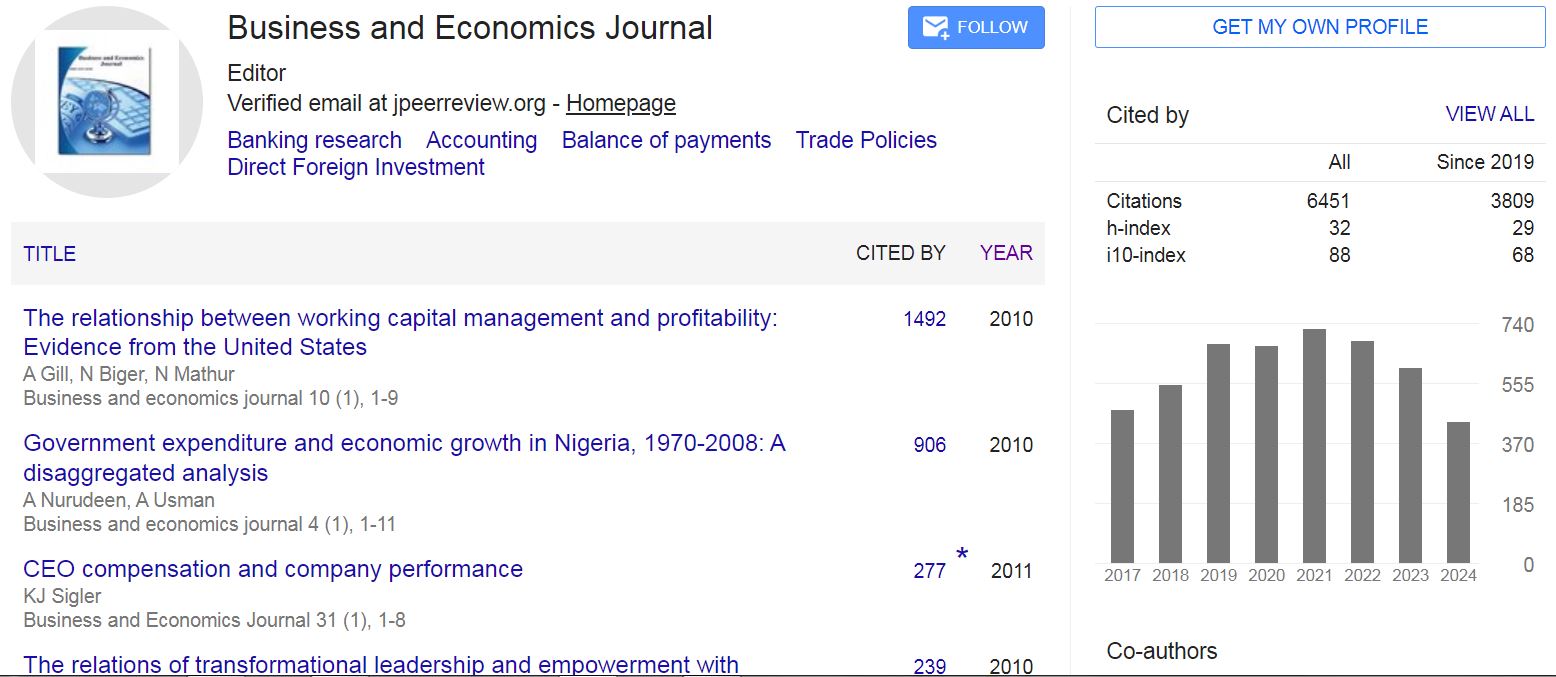
Business and Economics Journal received 6451 citations as per Google Scholar report