Brief Report - (2025) Volume 10, Issue 3
Received: 01-May-2025, Manuscript No. PE-26-179275;
Editor assigned: 05-May-2025, Pre QC No. P-179275;
Reviewed: 19-May-2025, QC No. Q-179275;
Revised: 22-May-2025, Manuscript No. R-179275;
Published:
29-May-2025
, DOI: 10.37421/2472-1042.2025.10.281
Citation: Zhang, Wei. ”Economic Value of Vaccination: A Public Health Imperative.” Pharmacoeconomics 10 (2025):280.
Copyright: © 2025 Zhang W. This is an open-access article distributed under the terms of the Creative Commons Attribution License, which permits unrestricted use, distribution and reproduction in any medium, provided the original author and source are credited.
Economic evaluations of vaccination programs are fundamental for guiding resource allocation and demonstrating value for money in public health initiatives. These analyses often encompass cost-effectiveness, cost-utility, and budget impact assessments, comparing vaccination strategies against no intervention or alternative approaches. Key insights derived from these evaluations frequently center on identifying optimal vaccination schedules, defining target populations, and quantifying the long-term economic benefits of disease prevention, including the reduction of healthcare costs and enhancements in productivity. The inherent dynamic nature of infectious diseases, coupled with evolving economic landscapes, underscores the critical need for continuous re-evaluation of vaccination program efficiency [1].
The rigorous economic modeling of new vaccine introductions into national immunization programs is an essential undertaking. Such analyses focus on metrics like incremental cost-effectiveness ratios (ICERs), which compare the additional cost of an intervention to the additional health gains achieved, often measured in quality-adjusted life years (QALYs). Findings from these detailed studies can illuminate whether the upfront investment in novel vaccines translates into favorable long-term economic returns, especially when compared to established willingness-to-pay thresholds [2].
Budget impact models play a crucial role in estimating the financial feasibility of expanding vaccination coverage. These models are vital for healthcare planners and policymakers seeking to understand the financial implications of implementing or expanding vaccination programs. By accounting for various cost components, such as vaccine procurement and administration, alongside potential savings from reduced disease burden, these analyses provide a clear picture of the short-term and long-term financial landscape [3].
The economic rationale underpinning childhood vaccination programs has long been well-established. However, the necessity for ongoing evaluation remains paramount to adapt to shifts in disease burden, evolving vaccine effectiveness, and emerging epidemiological trends. Re-evaluating established programs with updated data ensures that their economic value is consistently understood and communicated, reinforcing their importance in public health [4].
A growing concern within public health systems is the economic impact stemming from vaccine hesitancy and refusal. Studies modeling the consequences of lower vaccination rates reveal increased healthcare costs and amplified disease transmission. Quantifying the economic burden of preventable outbreaks underscores the substantial societal costs associated with vaccine hesitancy and the imperative for targeted public health interventions to address these issues [5].
Economic evaluations of specific vaccination programs, such as those for human papillomavirus (HPV), are critical for optimizing their implementation and ensuring efficient resource utilization. Comparing different vaccination schedules and target populations allows for the identification of strategies that maximize public health benefits within budget constraints. Such analyses are key to developing evidence-based recommendations for national programs [6].
The economic implications associated with pandemic preparedness and response, particularly concerning vaccination strategies, are profound. Analyzing the cost-effectiveness of various pandemic influenza vaccine deployment strategies, considering factors like vaccine efficacy and rollout speed, is essential. These evaluations highlight the economic imperative of timely and widespread vaccination to mitigate both the health and economic consequences of a pandemic [7].
Societal perspective economic evaluations are indispensable for a comprehensive understanding of the full impact of vaccination programs. By extending beyond direct medical costs to include indirect costs such as productivity losses and caregiver burden, these studies provide a more holistic view of the economic benefits. This broader perspective often demonstrates that the societal benefits of vaccination significantly outweigh their costs [8].
The cost-effectiveness of vaccination programs for specific diseases, such as rotavirus, often reveals substantial returns on investment. Assessing these programs in diverse economic settings, like middle-income countries, is crucial for understanding their applicability and impact on reducing disease burden and associated economic costs. Such evaluations contribute to improving child survival and well-being [9].
Understanding the dynamic interplay between vaccination coverage, disease transmission, and resultant economic outcomes is vital for effective public health policy. Employing mathematical modeling to assess the long-term economic consequences of various vaccination coverage levels for infectious pathogens provides critical insights. These studies emphasize the necessity of sustained high vaccination rates to prevent recurrent outbreaks and associated economic disruptions [10].
Economic evaluations of vaccination programs are indispensable for effective resource allocation and demonstrating public health value. These assessments typically involve cost-effectiveness, cost-utility, and budget impact analyses, comparing vaccination to its absence or to alternative interventions. Central to these studies are the identification of optimal vaccination schedules, the determination of target populations, and the quantification of long-term economic advantages derived from disease prevention, such as reduced healthcare expenditures and increased productivity. The continuously evolving landscape of infectious diseases and economic conditions necessitates ongoing re-evaluation of the efficiency of vaccination programs [1].
Introducing novel vaccines into national immunization programs requires robust economic modeling to ascertain their cost-effectiveness. This process often involves calculating incremental cost-effectiveness ratios (ICERs) and considering metrics like quality-adjusted life years (QALYs) gained. The outcomes of such analyses are critical for informing decisions about vaccine adoption, particularly when the long-term reduction in disease burden translates into a favorable ICER, often aligning with established thresholds for cost-effectiveness [2].
Budget impact models are essential tools for estimating the financial feasibility of expanding vaccination coverage. These models assist in planning healthcare budgets by accounting for the costs associated with vaccine procurement and administration, as well as the potential financial savings resulting from averted illnesses and hospitalizations. Such assessments are crucial for ensuring that vaccination programs are financially sustainable in the long term [3].
The economic rationale supporting childhood vaccination programs is well-established and continues to be reinforced through ongoing evaluation. Adapting these evaluations to account for shifts in disease burden and vaccine effectiveness is crucial. For instance, revisiting the cost-effectiveness of established vaccines like the measles-mumps-rubella (MMR) vaccine with updated epidemiological data reaffirms their strong economic return on investment by preventing significant morbidity, mortality, and associated societal costs [4].
The economic repercussions of vaccine hesitancy and refusal on public health systems are a significant and growing concern. Studies that model the increased healthcare costs and disease transmission resulting from lower vaccination rates quantify the economic burden imposed by preventable outbreaks. This highlights the substantial societal costs associated with vaccine hesitancy and underscores the importance of implementing targeted public health interventions to address these attitudes [5].
Economic evaluations of specific vaccination programs, such as those for the human papillomavirus (HPV), are vital for optimizing their implementation. Research comparing the cost-effectiveness of different HPV vaccination schedules, such as two-dose versus three-dose regimens, and exploring various target populations, can lead to recommendations that maximize public health benefits within budget constraints. This ensures that resources are used efficiently to achieve the greatest impact [6].
Pandemic preparedness and response, particularly concerning vaccination, have profound economic implications. The cost-effectiveness of various pandemic influenza vaccine deployment strategies needs to be analyzed, considering factors like vaccine efficacy and the speed of rollout. Such evaluations emphasize that early and widespread vaccination is critical for mitigating both the health and economic consequences of a pandemic, thereby justifying substantial investment in vaccine infrastructure [7].
Societal perspective economic evaluations are vital for a comprehensive understanding of the full impact of vaccination programs. These evaluations consider not only direct medical costs but also indirect costs such as productivity losses and the burden on caregivers. By adopting a broader economic lens, these studies can demonstrate that the societal benefits of vaccination programs, especially for diseases with high morbidity, significantly outweigh their associated costs [8].
Cost-effectiveness analyses of rotavirus vaccination programs, for example, have consistently shown substantial returns on investment. Assessing these programs in different economic contexts, such as middle-income countries, is important for understanding their impact on reducing diarrheal disease burden and associated economic costs. This ultimately contributes to improved child survival and well-being [9].
Understanding the dynamic relationship between vaccination, disease transmission, and economic outcomes is crucial for public health policy. Mathematical modeling can be employed to assess the long-term economic consequences of different vaccination coverage levels for infectious pathogens. These studies highlight that sustained high vaccination coverage is essential to prevent recurrent outbreaks and their associated economic disruptions, including significant healthcare expenditures and lost economic output [10].
Vaccination programs are essential for public health, with economic evaluations playing a key role in guiding resource allocation and demonstrating value. Studies assess cost-effectiveness, cost-utility, and budget impact, comparing vaccination strategies against alternatives. Key findings include identifying optimal schedules, target populations, and long-term economic benefits like reduced healthcare costs and productivity gains. The dynamic nature of diseases and economies necessitates ongoing re-evaluation. Novel vaccines require rigorous economic modeling, often focusing on ICERs and QALYs. Budget impact models are crucial for financial feasibility. Established programs like MMR and HPV vaccination continue to show strong economic returns. Vaccine hesitancy incurs significant economic burdens due to increased healthcare costs and disease transmission. Pandemic preparedness through vaccination is economically vital. Societal perspective evaluations, including indirect costs, reveal substantial net benefits. Rotavirus vaccination programs demonstrate strong ROI, particularly in middle-income countries. Sustained high vaccination coverage is crucial for preventing economic disruptions from infectious diseases.
None
None
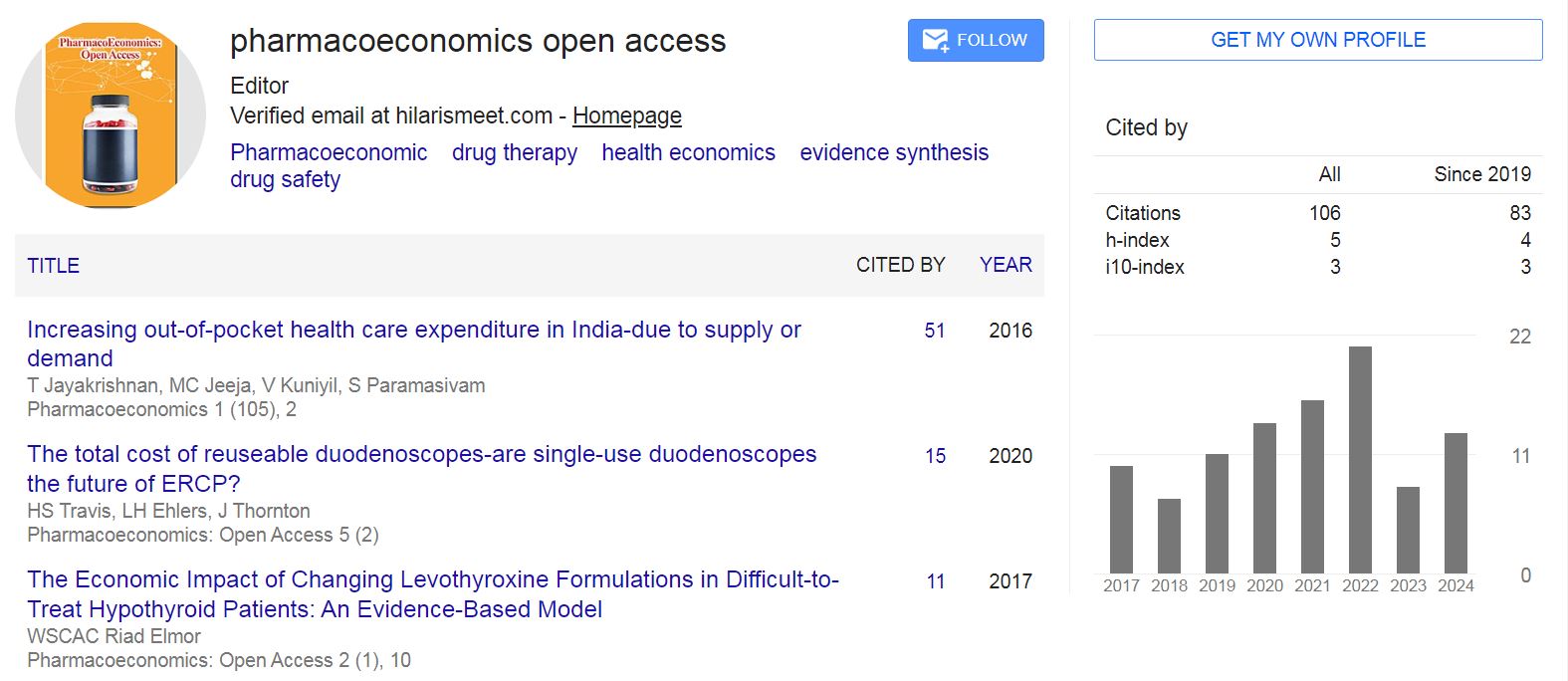
Pharmacoeconomics: Open Access received 106 citations as per Google Scholar report