Brief Report - (2025) Volume 14, Issue 2
Received: 02-Apr-2025, Manuscript No. jnc-25-166190;
Editor assigned: 04-Apr-2025, Pre QC No. P-166190;
Reviewed: 16-Apr-2025, QC No. Q-166190;
Revised: 23-Apr-2025, Manuscript No. R-166190;
Published:
30-Apr-2025
, DOI: 10.37421/2167-1168.2025.14.701
Citation: Forkan, Ozdemir. “Early Recognition and Management of Bloodstream Infections in Primary Care.” J Nurs Care 14 (2025): 701.
Copyright: © 2025 Forkan O. This is an open-access article distributed under the terms of the Creative Commons Attribution License, which permits unrestricted use, distribution and reproduction in any medium, provided the original author and source are credited.
Bloodstream Infections, which occur when bacteria or other pathogens enter the bloodstream, can quickly lead to life-threatening complications such as sepsis, organ failure and death. These infections, while common in hospitalized patients, are also increasingly seen in primary care settings, where early recognition and prompt management can make a significant difference in patient outcomes. The challenge in primary care lies in the subtle and often nonspecific nature of BSI symptoms, which can easily be mistaken for more common, less severe illnesses. Symptoms like fever, chills, fatigue and malaise, which are often present in early stages of BSIs, are not exclusive to these infections and can be attributed to a wide range of conditions. As a result, primary care providers including Nurse Practitioners (NPs), general practitioners and other healthcare professionals are tasked with distinguishing between simple viral illnesses and more serious infections like BSIs that require urgent intervention. The growing burden of Antimicrobial Resistance (AMR) further complicates the management of BSIs, as infections caused by resistant organisms can be more difficult to treat, leading to longer hospital stays and increased mortality rates. Primary care providers must not only be able to recognize the clinical signs of a BSI early but also be proficient in making decisions about when to initiate empirical antibiotic therapy, taking into account resistance patterns and patient history. This is especially important in an era when overuse of antibiotics has contributed to the rise of resistant strains of bacteria. Inadequate or delayed treatment of BSIs can also result in longer-term complications, including chronic infections and damage to vital organs, necessitating more extensive care and rehabilitation [2].
Nurse practitioners and other primary care providers are uniquely positioned to detect and manage bloodstream infections at the earliest stages. With a holistic approach to patient care, they are often the first to notice changes in a patientâ??s baseline health, particularly in individuals with underlying conditions such as diabetes, chronic kidney disease, cancer, or immunosuppressive therapies. Early identification of at-risk populations and proactive monitoring for signs of infection can reduce the likelihood of progression to severe sepsis or septic shock. Furthermore, NPs and primary care clinicians are equipped to initiate appropriate antibiotic therapy while awaiting culture results, minimizing the risk of complications and helping to avoid unnecessary hospitalizations. In addition to direct patient care, primary care providers are essential in promoting education on preventive measures for bloodstream infections, including vaccination; proper wound care and the importance of hand hygiene. Educating patients and caregivers about the signs and symptoms of BSIs empowers individuals to seek medical attention promptly, which is vital for the early initiation of treatment. Furthermore, primary care teams play a crucial role in managing patients with chronic conditions that increase susceptibility to BSIs, ensuring that these individuals receive regular screenings, proper disease management and timely interventions [3].
Despite the pivotal role that primary care plays in managing BSIs, there are challenges related to resources, diagnostic limitations and time constraints. In many outpatient settings, access to advanced diagnostic tools such as blood cultures, imaging, or rapid testing is limited, which can delay diagnosis. Moreover, primary care providers often face competing demands and time pressures, making it more difficult to maintain a high level of vigilance for potentially serious infections. Addressing these barriers through improved access to diagnostic tools, continuing education for healthcare providers and enhanced care coordination is essential for optimizing the early detection and management of bloodstream infections in primary care. To strengthen the role of primary care in managing bloodstream infections, integration of clinical decision support tools (CDSTs) and standardized protocols can be instrumental. These tools, embedded within electronic health record (EHR) systems, can assist clinicians in identifying patients at higher risk of BSIs by flagging abnormal vital signs, laboratory values, or clinical presentations that may warrant further investigation [4].
Incorporating evidence-based screening protocols and sepsis recognition algorithms into daily practice can support timely clinical decision-making, especially in busy primary care environments. Additionally, structured follow-up systems can ensure that at-risk patients receive prompt reassessment, particularly when symptoms persist or worsen. By enhancing clinical workflows through the use of technology and protocol-driven care, primary care practices can more effectively detect early signs of BSIs, initiate appropriate interventions and coordinate timely referrals to higher levels of care when necessary. Collaboration between primary care providers and specialists, such as infectious disease physicians, pharmacists and hospital-based teams, is also critical in improving outcomes for patients with bloodstream infections. Establishing clear communication channels and referral pathways can help streamline transitions of care, ensure continuity in antibiotic management and facilitate comprehensive follow-up for patients recovering from a BSI. Multidisciplinary case reviews and shared care plans can enhance knowledge transfer and support best practices in antimicrobial stewardship. Moreover, continued investment in provider education through workshops, online training modules and case-based learning opportunities will empower nurse practitioners and other primary care professionals to remain current with evolving diagnostic strategies and resistance trends. In this way, primary care can serve not only as the frontline for early detection but also as a cornerstone of long-term prevention and management strategies for bloodstream infections [5].
Google Scholar Cross Ref Indexed at
Google Scholar Cross Ref Indexed at
Google Scholar Cross Ref Indexed at
Google Scholar Cross Ref Indexed at
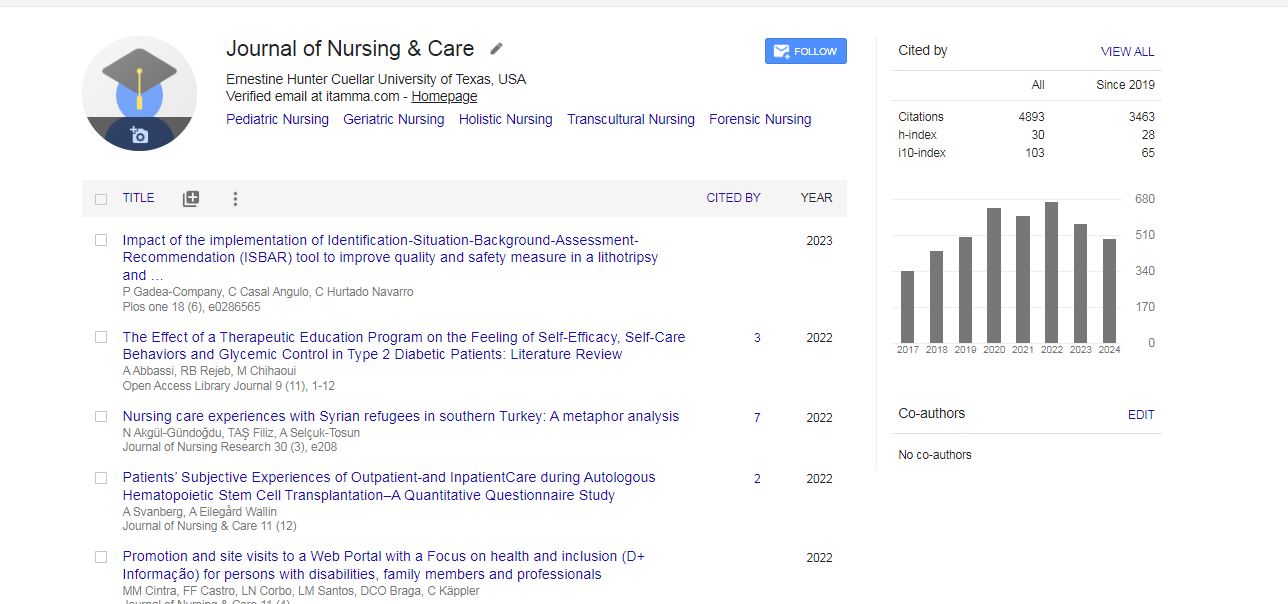
Journal of Nursing & Care received 4230 citations as per Google Scholar report