Commentary - (2025) Volume 9, Issue 5
Received: 01-Sep-2025, Manuscript No. jchd-26-185706;
Editor assigned: 03-Sep-2025, Pre QC No. P-185706;
Reviewed: 17-Sep-2025, QC No. Q-185706;
Revised: 22-Sep-2025, Manuscript No. R-185706;
Published:
29-Sep-2025
, DOI: 10.37421/2684-6020.2024.9.262
Citation: Kim, Daniel. "Early Detection Of Coronary Heart Disease:
Key Indicators." J Coron Heart Dis 09 (2025):262.
Copyright: © 2025 Kim D. This is an open-access article distributed under the terms of the Creative Commons Attribution License, which permits unrestricted use, distribution
and reproduction in any medium, provided the original author and source are credited.
Coronary heart disease (CHD) continues to pose a significant global health challenge, necessitating a thorough understanding of its early indicators for effective management and improved patient outcomes. Recognizing these initial signs is paramount for timely intervention, thereby mitigating the severity and progression of the disease. This review aims to consolidate current knowledge on the multifaceted landscape of CHD, encompassing its diverse etiologies and emerging diagnostic approaches. One critical aspect of early CHD detection involves identifying its overt warning signs. Persistent chest pain or discomfort, often described as pressure or squeezing and potentially radiating to other body parts, is a hallmark symptom that demands attention. Associated symptoms like shortness of breath, unusual fatigue, dizziness, nausea, vomiting, and cold sweats also serve as important signals for potential cardiac issues. Prompt recognition of these manifestations can empower individuals and healthcare providers to initiate prompt diagnostic and therapeutic measures[1].
Beyond clinical symptoms, the investigation into subclinical coronary atherosclerosis has revealed the pivotal role of inflammatory markers. Elevated levels of specific inflammatory mediators, such as high-sensitivity C-reactive protein (hs-CRP) and interleukins, have been demonstrably correlated with the presence and extent of coronary artery calcification and plaque burden. This association underscores inflammation as a key player in the incipient stages of CHD, suggesting that targeting these inflammatory pathways could be a promising avenue for prevention and risk stratification[2].
The intricate interplay between genetic predisposition and environmental factors significantly influences an individual's susceptibility to CHD. Recent large-scale genome-wide association studies have identified novel genetic loci and specific gene polymorphisms that are associated with an increased likelihood of developing early-onset CHD. These genetic insights are crucial for understanding disease etiology and paving the way for personalized risk assessment and tailored preventive strategies[3].
Contemporary perspectives on CHD risk management place a strong emphasis on modifiable lifestyle factors. Diet, physical activity levels, smoking habits, and stress management are critical determinants of cardiovascular health. Public health initiatives and individualized counseling programs are essential to effectively address these lifestyle elements and reduce the burden of CHD, particularly during its early developmental phases[4].
The diagnostic landscape for CHD is continuously evolving with the emergence of novel biomarkers. Beyond traditional risk factors, circulating microRNAs, extracellular vesicles, and advanced lipid profiling are being investigated for their potential to identify individuals at high risk for CHD. The integration of these advanced biomarkers into clinical practice promises earlier diagnosis and more personalized treatment approaches, enhancing the precision of cardiovascular care[5].
In at-risk populations, such as those with metabolic syndrome, the identification of early warning signs preceding cardiovascular events is of utmost importance. Studies have indicated that subtle changes, including diminished exercise tolerance, increased fatigue, and atypical chest discomfort, are frequently reported by individuals prior to experiencing a major cardiac event. Vigilance for these seemingly minor symptoms in vulnerable groups is therefore crucial[6].
Psychosocial factors, including stress and depression, have been consistently linked to an increased risk of developing CHD. A comprehensive meta-analysis confirmed a significant association between psychological distress and heightened cardiovascular risk. This highlights the imperative to integrate mental health screening and management into routine cardiovascular care strategies to identify individuals susceptible to early cardiac issues[7].
Endothelial dysfunction has emerged as a critical early marker for CHD, often preceding the development of overt anatomical changes in the coronary arteries. Non-invasive methods for assessing endothelial function are gaining prominence for their predictive value in identifying individuals at risk of future cardiovascular events. Addressing endothelial dysfunction is therefore a key target for early intervention and disease prevention[8].
Cardiovascular risk scores play an indispensable role in the early identification of individuals predisposed to CHD. Updated guidelines and the application of various scoring systems, such as the ASCVD risk score, are instrumental in stratifying risk and guiding preventive interventions before the onset of clinical symptoms. These tools are vital for proactive cardiovascular care and minimizing the incidence of CHD events[9].
The clinical presentation of Coronary Heart Disease (CHD) is often heralded by a constellation of warning signs that, if recognized promptly, can lead to early diagnosis and intervention. Persistent chest pain or discomfort, characterized by pressure, squeezing, or fullness, and potentially radiating to the arms, neck, jaw, or back, remains a cardinal symptom. Furthermore, unexplained shortness of breath, particularly during minimal exertion or when supine, warrants careful evaluation. Other common indicators include profound fatigue, episodes of dizziness or lightheadedness, feelings of nausea or vomiting, and the occurrence of cold sweats. Acknowledging these subtle yet significant early manifestations is crucial for enabling individuals and healthcare professionals to take proactive steps in managing and preventing the progression of cardiovascular disease[1].
The role of inflammation in the pathogenesis of subclinical coronary atherosclerosis is a significant area of ongoing research. Studies have demonstrated a clear association between elevated levels of inflammatory markers, such as high-sensitivity C-reactive protein (hs-CRP) and various interleukins, and an increased burden of coronary artery calcium and plaque. These findings suggest that inflammation is a key driver in the initial development of CHD, indicating that anti-inflammatory strategies may hold considerable promise for primary and secondary prevention efforts[2].
Genetic factors contribute substantially to an individual's susceptibility to coronary heart disease. Advanced research utilizing genome-wide association studies has successfully identified novel genetic loci and specific gene polymorphisms that are linked to an increased risk of developing early-onset CHD. Understanding these genetic underpinnings is vital for developing personalized risk assessment tools and implementing targeted preventive measures in clinical practice[3].
Modifiable lifestyle factors are central to the contemporary understanding and management of coronary heart disease risk. The impact of dietary habits, regular physical activity, tobacco cessation, and effective stress management on cardiovascular health is well-established. Comprehensive public health strategies coupled with individualized lifestyle counseling are indispensable for effectively mitigating CHD risk, especially in the nascent stages of disease development[4].
The field of diagnostic cardiology is continually advancing with the exploration of novel biomarkers for the early detection of CHD. Beyond conventional risk assessment, emerging markers such as circulating microRNAs, extracellular vesicles, and sophisticated lipid profiling techniques are being investigated for their ability to identify high-risk individuals. The potential integration of these advanced biomarkers into routine clinical practice could revolutionize the early diagnosis and personalized treatment of CHD[5].
For individuals with underlying conditions such as metabolic syndrome, paying close attention to early warning signs preceding cardiovascular events is critically important. Research indicates that subtle changes in an individual's exercise tolerance, a pervasive sense of fatigue, and atypical chest discomfort are frequently reported precursors to major cardiac events. This underscores the necessity of heightened awareness and prompt medical evaluation for such symptoms in at-risk populations[6].
Psychosocial well-being is increasingly recognized as a significant factor influencing cardiovascular health. A comprehensive meta-analysis has confirmed a robust association between psychological distress, including stress and depression, and an elevated risk of developing coronary heart disease. Consequently, the integration of mental health screening and supportive interventions into comprehensive cardiovascular care is essential for identifying and managing individuals predisposed to early cardiac complications[7].
Endothelial dysfunction stands out as a crucial early biomarker for coronary heart disease. This condition, characterized by impaired blood vessel function, often manifests before any significant anatomical changes occur in the coronary arteries. The evaluation of endothelial function using non-invasive methods is proving to be a valuable tool in predicting future cardiovascular events, highlighting its importance in early risk stratification and management strategies[8].
Cardiovascular risk scores are indispensable tools for identifying individuals at elevated risk of developing coronary heart disease. The application of various established scoring systems, such as the ASCVD risk score, is guided by updated clinical guidelines to effectively stratify patient risk and inform the implementation of preventive strategies. Early risk identification through these assessment tools is paramount for initiating interventions before the manifestation of overt symptoms[9].
Environmental factors, particularly air pollution, are recognized as contributors to the incidence of coronary heart disease. Long-term exposure to fine particulate matter (PM2.5) has been linked to an increased risk of developing CHD, independent of traditional risk factors. This highlights the critical importance of considering environmental exposures in cardiovascular health and underscores the need for robust public health measures to mitigate air pollution and its detrimental effects on the heart[10].
Coronary heart disease (CHD) is a major health concern, and early detection is vital. Key warning signs include chest pain, shortness of breath, fatigue, dizziness, nausea, and cold sweats. Inflammation, identified through markers like hs-CRP, plays a significant role in early atherosclerosis. Genetic predispositions also increase risk, with novel gene variants linked to early-onset CHD. Modifiable lifestyle factors such as diet, exercise, smoking, and stress are crucial. Emerging biomarkers like microRNAs and advanced lipid profiling offer potential for earlier diagnosis. Subtle symptoms in at-risk groups, like those with metabolic syndrome, should not be ignored. Psychosocial factors, including stress and depression, are associated with increased CHD risk. Endothelial dysfunction is a critical early marker, and cardiovascular risk scores are essential for identifying high-risk individuals. Environmental factors like air pollution also contribute to CHD incidence.
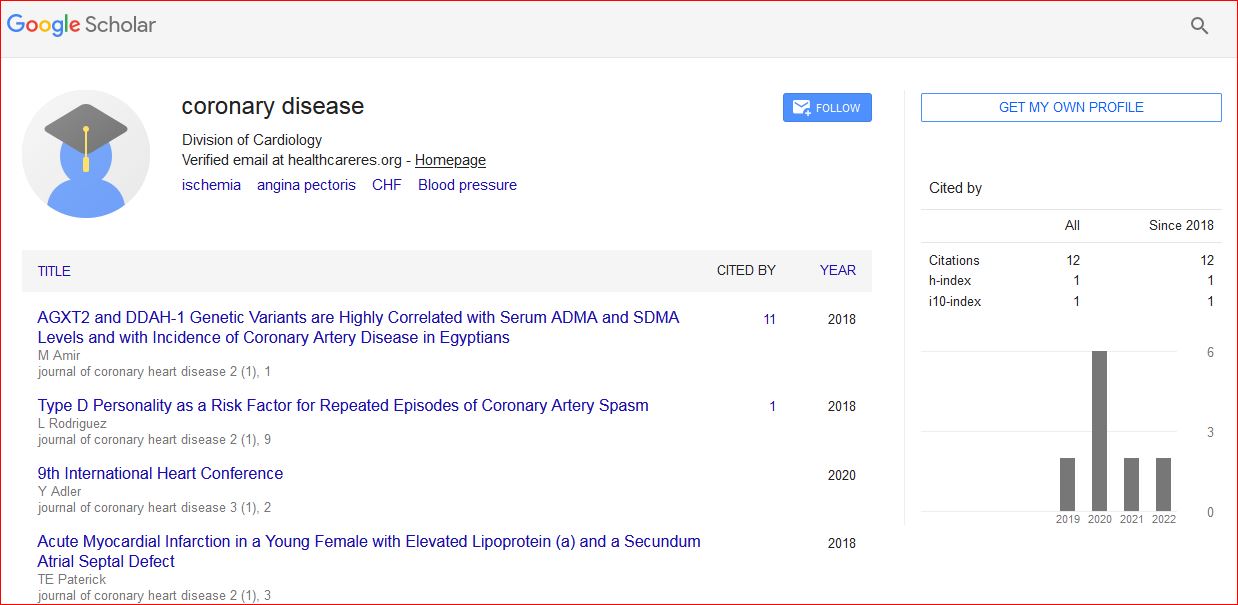
Journal of Coronary Heart Diseases received 15 citations as per Google Scholar report