Short Communication - (2025) Volume 15, Issue 4
Received: 03-Aug-2025, Manuscript No. mccr-25-173799;
Editor assigned: 05-Aug-2025, Pre QC No. P-173799;
Reviewed: 19-Aug-2025, QC No. Q-173799;
Revised: 25-Aug-2025, Manuscript No. R-173799;
Published:
30-Aug-2025
, DOI: 10.37421/2161-0444.2025.15.797
Citation: Richter, Johan. ”Drug Interactions: Risks, Management, Safety.” Med Chem 15 (2025):797.
Copyright: © 2025 Richter J. This is an open-access article distributed under the terms of the Creative Commons Attribution License, which permits unrestricted use, distribution and reproduction in any medium, provided the original author and source are credited.
Drug-drug interactions (DDIs) represent a critical challenge in clinical practice, influencing patient safety and therapeutic outcomes across various medical disciplines. This collection of articles delves into the multifaceted aspects of DDIs, exploring their prevalence, mechanisms, clinical implications, and management strategies across diverse patient populations and therapeutic agents. Understanding these interactions is paramount for effective patient care, from managing chronic conditions in the elderly to navigating complex treatments in oncology and pediatric settings. Polypharmacy, age-related pharmacokinetic and pharmacodynamic changes, and multiple comorbidities significantly increase the risk of drug-drug interactions in older adults. Comprehensive medication reviews and patient education are essential to minimize adverse outcomes in this vulnerable population [1].
For instance, a systematic review identifies the significant prevalence and clinical relevance of drug-drug interactions with Direct Oral Anticoagulants (DOACs). These interactions can profoundly alter DOAC efficacy and safety, necessitating careful consideration and ongoing monitoring in clinical practice to prevent serious thrombotic or bleeding events [2].
In oncology, clinicians frequently encounter relevant drug-drug interactions, particularly in specific patient populations, such as those with renal or hepatic impairment. This area demands detailed therapeutic strategies to manage these interactions effectively, aiming to optimize cancer treatment efficacy while concurrently minimizing toxicity [3].
Another vital area of concern involves psychopharmacological treatment, where significant drug-drug interactions can arise with antidepressants. Clinicians receive updates on these interactions, highlighting their mechanisms, clinical consequences, and management strategies, which are crucial for ensuring safe and effective treatment [4].
The scope of interactions extends beyond prescription medications to include herbal remedies. A comprehensive review delves into herb-drug interactions, explaining their metabolic pathways, underlying mechanisms, and clinical implications. It stresses the importance of understanding these interactions, often overlooked despite the widespread use of herbal remedies, to prevent adverse events and ensure patient safety [5].
Recent global health crises, such as the COVID-19 pandemic, also brought new challenges regarding DDIs. A thorough review addresses potential drug-drug interactions with COVID-19 pharmacotherapies. It details how concomitant medications can affect the efficacy and safety of antiviral treatments and immunomodulators used for COVID-19, offering crucial guidance for clinical management during such health emergencies [6].
Mechanistically, drug transporters play a significant role in drug disposition and interaction profiles. A review explores the clinical relevance of drug-drug interactions mediated by drug transporters, elucidating how alterations in transporter function can impact drug disposition, leading to altered drug efficacy or increased toxicity. It emphasizes the need to consider these mechanisms in pharmacotherapy development and application [7].
Given the complexities, strategies for predicting and preventing drug-drug interactions in clinical practice are continuously being developed, with a specific focus on mitigating adverse drug reactions. This includes underscoring the utility of clinical decision support systems and pharmacogenetic testing in enhancing patient safety and optimizing therapeutic outcomes [8].
Specific demographic groups, such as pediatric patients, require particular attention. A systematic review examines drug-drug interactions in pediatric patients, summarizing current evidence and outlining future research directions. It highlights the unique challenges in children, including developmental changes in drug metabolism and limited evidence, advocating for specialized attention to minimize risks [9].
Finally, therapeutic drug monitoring (TDM) emerges as a crucial tool in managing and understanding drug-drug interactions. The clinical utility and challenges of TDM are discussed in optimizing drug efficacy and minimizing toxicity, especially when multiple medications are co-administered, leading to potential interactions. TDM offers a personalized approach to navigating complex polypharmacy regimens [10].
Collectively, these studies emphasize that a comprehensive understanding of DDIs, encompassing patient-specific factors, drug mechanisms, and advanced monitoring techniques, is indispensable for advancing patient care and safety in an increasingly complex pharmacological landscape.
Drug-drug interactions (DDIs) present a multifaceted challenge in modern medicine, impacting patient safety and the effectiveness of therapies across a wide spectrum of clinical scenarios. A key focus within current research is on vulnerable patient populations and specific drug classes that inherently carry higher DDI risks. Older adults, for instance, face an amplified risk due to factors like polypharmacy, age-related changes in pharmacokinetics and pharmacodynamics, and the presence of multiple comorbidities. This necessitates diligent medication reviews and continuous patient education as primary strategies to mitigate adverse outcomes in this demographic [1]. Similarly, pediatric patients, a particularly sensitive group, present unique challenges. Their developing metabolic systems and the scarcity of dedicated research mean that drug-drug interactions in children require specialized attention and further investigation to minimize potential risks [9]. In the realm of oncology, clinically relevant DDIs are a significant concern, especially for patients with impaired renal or hepatic function. Managing these interactions involves carefully tailored therapeutic strategies designed to optimize cancer treatment efficacy while simultaneously minimizing drug-related toxicity [3].
Specific pharmacological agents and non-pharmaceutical substances are also at the forefront of DDI discussions. Direct Oral Anticoagulants (DOACs) are known for their significant prevalence in interactions. These interactions can critically alter DOAC efficacy and safety, demanding rigorous clinical consideration and monitoring to prevent serious events like thrombosis or bleeding [2]. Antidepressants also frequently engage in significant drug-drug interactions, with studies providing updates on their underlying mechanisms, clinical consequences, and essential management strategies to ensure safe and effective psychopharmacological treatment [4]. It's not just prescription drugs that pose a risk; herb-drug interactions are increasingly recognized as a crucial area of study. Despite the widespread use of herbal remedies, these interactions are often overlooked. Research highlights the importance of understanding their metabolic pathways and mechanisms to prevent adverse events and ensure patient safety [5]. Even newer therapeutic landscapes, like those developed for COVID-19, introduce complex DDI profiles. Comprehensive reviews detail potential interactions with COVID-19 pharmacotherapies, showing how concomitant medications can affect the efficacy and safety of antiviral treatments and immunomodulators, providing vital guidance for clinical management during a pandemic [6].
Beyond specific drugs and populations, the underlying mechanisms of DDIs are a critical area of investigation. Drug transporters, for example, play a pivotal role in drug disposition. Alterations in transporter function can significantly impact how a drug is absorbed, distributed, metabolized, and excreted, leading to changes in its efficacy or an increase in its toxicity. Understanding these transporter-mediated interactions is fundamental for rational pharmacotherapy [7]. This mechanistic insight underpins broader efforts in DDI management.
Given the inherent complexities, proactive strategies for predicting and preventing drug-drug interactions are paramount in clinical practice. The goal is always to mitigate adverse drug reactions, and this involves leveraging advanced tools. Clinical decision support systems and pharmacogenetic testing are increasingly recognized as invaluable in enhancing patient safety and optimizing therapeutic outcomes by providing personalized insights into potential interactions [8]. Furthermore, Therapeutic Drug Monitoring (TDM) serves as an essential tool for both understanding and managing DDIs. TDM offers clinical utility by optimizing drug efficacy and minimizing toxicity, particularly when patients are on multiple medications, which inherently increases the likelihood of interactions [10]. These predictive and monitoring approaches are crucial for navigating the challenges of polypharmacy and ensuring the best possible patient outcomes.
In essence, the literature underscores that a comprehensive approach to drug-drug interactions is indispensable. This approach must integrate an understanding of patient-specific vulnerabilities, the biochemical mechanisms of drug action and interaction, and advanced clinical tools for prediction, monitoring, and proactive management.
This collection of reviews and articles underscores the pervasive challenge of drug-drug interactions (DDIs) across diverse clinical settings and patient populations. A central theme highlights the elevated DDI risk in vulnerable groups such as older adults, primarily due to polypharmacy, age-related physiological changes, and multiple comorbidities, necessitating careful medication management and patient education. Similarly, pediatric patients present unique interaction challenges, often overlooked, given developmental differences in drug metabolism and a scarcity of dedicated research. The data also details DDIs within specific therapeutic areas. It examines the significant prevalence and clinical impact of interactions involving Direct Oral Anticoagulants (DOACs), emphasizing the need for vigilant monitoring to prevent thrombotic or bleeding events. Clinically relevant DDIs in oncology are explored, particularly for patients with renal or hepatic impairment, offering therapeutic strategies to maintain treatment efficacy while minimizing toxicity. Antidepressant-related interactions are also updated for clinical practice, detailing their mechanisms, consequences, and management for safe psychopharmacology. Beyond conventional pharmaceuticals, the dataset stresses the importance of understanding herb-drug interactions, which, despite widespread herbal remedy use, are frequently overlooked. These interactions often involve complex metabolic pathways. Another key mechanism explored is transporter-mediated DDIs, where altered transporter function directly affects drug disposition and can lead to efficacy changes or increased toxicity. The overarching goal across these studies is to enhance patient safety by improving the prediction and prevention of adverse drug reactions, leveraging tools like clinical decision support systems and pharmacogenetic testing. Ultimately, managing DDIs often benefits from Therapeutic Drug Monitoring (TDM) to optimize efficacy and minimize harm when multiple medications are co-administered. The reviews also cover contemporary concerns, such as interactions with COVID-19 pharmacotherapies, providing essential guidance for pandemic-era clinical management.
None
None
1. Vande GJ, Cottrell M, Linnebur S. "Drug-drug interactions in older adults: a narrative review".Ther Adv Drug Saf 11 (2020):2042098620926521.
Indexed at, Google Scholar, Crossref
2. Hylek E, Satumtira B, Goldhaber S. "Prevalence and Clinical Relevance of Drug-Drug Interactions With Direct Oral Anticoagulants: A Systematic Review".J Am Heart Assoc 9 (2020):e014210.
Indexed at, Google Scholar, Crossref
3. Hanrahan T, Gordon D, Hewson S. "Clinically Relevant Drug-Drug Interactions in Oncology: A Review of Specific Populations and Therapeutic Strategies".Cancers (Basel) 14 (2022):386.
Indexed at, Google Scholar, Crossref
4. Spina E, Santoro V, D'Arrigo C. "Drug-Drug Interactions with Antidepressants: An Update for Clinical Practice".Clin Drug Investig 40 (2020):1-18.
Indexed at, Google Scholar, Crossref
5. Zhang J, Zhou H, Ma Y. "Herb-Drug Interactions: A Comprehensive Review on Metabolic Pathways, Mechanisms, and Clinical Implications".Front Pharmacol 11 (2020):601018.
Indexed at, Google Scholar, Crossref
6. Gabor A, Pusztai R, Dóczy E. "Drug-Drug Interactions with COVID-19 Pharmacotherapies: A Comprehensive Review and Clinical Implications".Pharmaceuticals (Basel) 15 (2022):978.
Indexed at, Google Scholar, Crossref
7. Yoshida K, Sata M, Tamai I. "Clinical relevance of drug-drug interactions mediated by drug transporters: A comprehensive review".Drug Metab Pharmacokinet 39 (2021):100412.
Indexed at, Google Scholar, Crossref
8. Ohtsuka K, Miyake K, Kaneko M. "Predicting and Preventing Drug-Drug Interactions in Clinical Practice: A Focus on Adverse Drug Reactions".Int J Environ Res Public Health 18 (2021):11520.
Indexed at, Google Scholar, Crossref
9. Varghese S, Joy A, Puthussery J. "Drug-drug interactions in pediatric patients: A systematic review of current evidence and future perspectives".J Pharm Policy Pract 16 (2023):63.
Indexed at, Google Scholar, Crossref
10. Patel P, Khan I, Khan H. "Therapeutic Drug Monitoring and Drug-Drug Interactions: Clinical Utility and Challenges".Cureus 15 (2023):e44120.
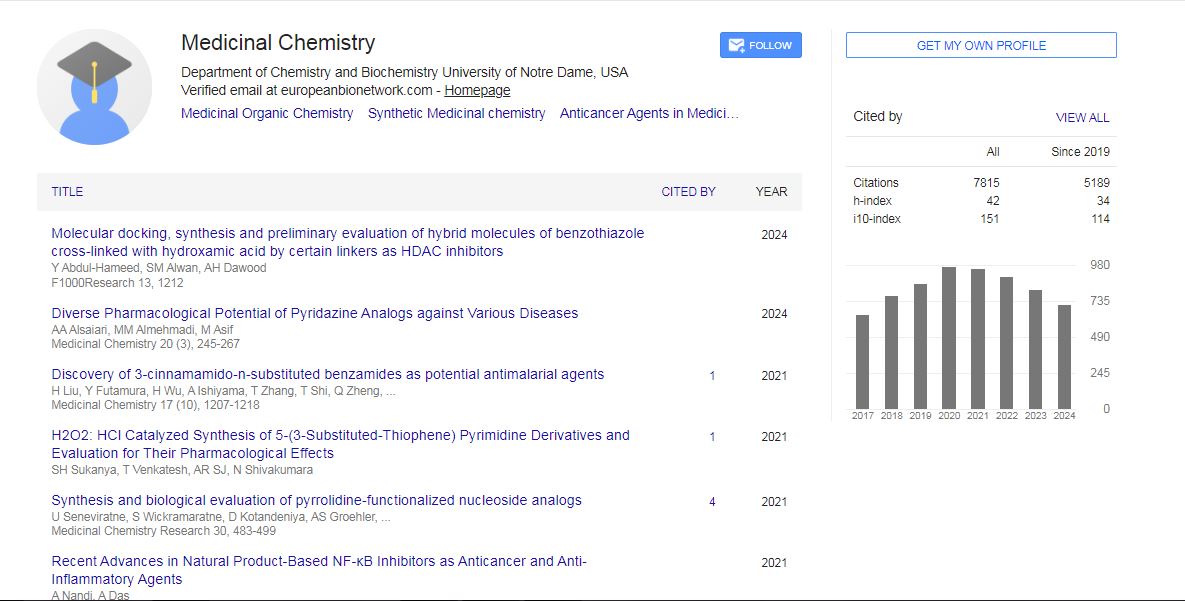
Medicinal Chemistry received 6627 citations as per Google Scholar report