Commentary - (127) Volume 15, Issue 3
Received: 30-May-2025, Manuscript No. jmcj-25-176497;
Editor assigned: 02-Jun-2025, Pre QC No. P-176497;
Reviewed: 13-Jun-2025, QC No. Q-176497;
Revised: 20-Jun-2025, Manuscript No. R-176497;
Published:
27-Jun-2025
, DOI: 10.37421/2165-7912.2025.15.625
Citation: Nur Aisyah Rahman. "Digital Media: Youth Development, Risks, and Resilience." J Mass Communicat Journalism 15 (2025): 625.
Copyright: © 2025 R. Aisyah Nur This is an open-access article distributed under the terms of the Creative Commons Attribution License, which permits unrestricted use, distribution and reproduction in any medium, provided the original author and source are credited.
This study explores the multifaceted impact of social media on adolescent mental health, outlining beneficial aspects like social support and identity exploration, alongside detrimental effects such as cyberbullying, body dissatisfaction, and sleep disturbances, advocating for nuanced approaches in research and intervention [1].
This research underscores a complex dynamic, highlighting both the supportive aspects of online interaction and significant risks that demand careful consideration. Understanding these varied effects is crucial for developing effective strategies to support young people online. A systematic review of media literacy interventions for youth reveals that these programs effectively enhance critical thinking, media discernment, and resilience against misinformation, suggesting a strong potential for integrating media education into school curricula and community initiatives [2].
Such programs are vital in preparing youth to critically engage with digital information. Building on this, research further explores the specific challenges adolescents encounter with misinformation online. It points to the critical role media literacy interventions play in equipping them with necessary evaluation skills for navigating today's complex digital information landscape, emphasizing the need for innovative educational approaches [7].
This cross-national study examines how different forms of news consumption, particularly digital and traditional media, influence youth political engagement [3].
This reveals how diverse media types and national contexts shape civic engagement, stressing that active participation in news consumption is key to fostering involvement in political processes. A systematic review indicates that social media exposure significantly contributes to body image concerns and the development of disordered eating behaviors among adolescents [4].
The pervasive presence of idealized media representations significantly impacts self-perception, making targeted prevention strategies essential to mitigate the development of unhealthy behaviors. This longitudinal study examines the relationship between digital media use patterns and academic achievement in adolescents [5].
It suggests a nuanced relationship where the nature of digital engagement, whether passive or active, educational or recreational, dictates its impact on academic outcomes. A mixed-methods study investigates the dual impact of online gaming on youth well-being and development [6].
This study provides a balanced perspective, acknowledging both the detrimental aspects, such as addiction, and the developmental advantages, like improved problem-solving and social connections, that arise from online gaming. A longitudinal study investigates how digital advertising influences youth consumer behavior, demonstrating that constant exposure shapes preferences, purchasing decisions, and brand loyalty [8].
The constant exposure to digital advertisements profoundly influences young consumers, shaping their brand preferences and purchasing decisions in an increasingly commercialized online environment. This systematic review and meta-analysis consolidates evidence on the relationship between adolescent social media use and sleep quality [9].
This consistent finding highlights a critical public health concern, where increased social media interaction is detrimental to adolescents' sleep patterns and overall well-being. A scoping review investigates the role of prosocial media use in fostering positive youth development [10].
This positive dimension of media use demonstrates its potential for fostering altruism, empathy, and constructive identity formation through engagement with supportive and educational content.
The advent of social media has brought a multifaceted impact on adolescent mental health, presenting both opportunities and significant challenges. Studies highlight beneficial aspects, such as facilitating social support networks and aiding in identity exploration, allowing young individuals to connect and understand themselves better [1]. However, a darker side exists, encompassing detrimental effects like cyberbullying, where online harassment can lead to severe psychological distress. Body dissatisfaction is another prominent concern, largely fueled by the pervasive influence of idealized media representations. This exposure significantly contributes to the development of disordered eating behaviors among adolescents, necessitating robust, targeted prevention strategies to safeguard their well-being [4]. Compounding these issues, research consistently shows a negative correlation between increased social media engagement and sleep quality, resulting in shorter sleep duration, later bedtimes, and poorer sleep efficiency, profoundly affecting the overall health and cognitive function of young people [9].
In an increasingly digital world, the ability to critically evaluate information is paramount. Media literacy interventions designed for youth have proven effective in sharpening critical thinking skills and enhancing media discernment. These programs are instrumental in building resilience against the spread of misinformation, suggesting a strong imperative for their integration into school curricula and broader community initiatives to prepare young generations for a complex information environment [2]. This emphasis on media literacy is further reinforced by studies that specifically address the substantial challenges youth encounter with misinformation online. It highlights the urgent need for innovative educational approaches that equip young individuals with the skills to critically evaluate sources and navigate the intricate landscape of digital information, fostering a more informed citizenry [7].
The relationship between digital media use patterns and adolescent academic achievement is complex and nuanced. Longitudinal studies reveal that while excessive or passive consumption of digital media can negatively impact academic performance and grades, more educational or creative uses may have neutral or even slightly positive effects. This suggests that the quality and purpose of digital engagement are more influential than mere screen time in determining academic outcomes [5]. Beyond the classroom, digital advertising exerts a profound influence on youth consumer behavior. Continuous exposure to online advertisements shapes consumer preferences, influences purchasing decisions, and cultivates brand loyalty from an early age, demonstrating the significant commercial pressures placed on young audiences through various online platforms [8].
Online gaming presents a dual impact on youth well-being and development. On one hand, there are clear risks, including the potential for addiction and social isolation, which can detract from real-world interactions and responsibilities. On the other hand, online gaming offers substantial benefits, such as enhancing cognitive skills, improving problem-solving abilities, and fostering online community building through collaborative play. This highlights the importance of promoting balanced gaming habits to maximize benefits while mitigating risks [6]. Separately, a cross-national study investigating youth news consumption and political engagement illustrates how different forms of media, both digital and traditional, influence civic participation. The study emphasizes that the effects vary based on the specific media type and national context, underlining the critical role of active news engagement in cultivating political awareness and participation among young people [3].
Amidst the various challenges and considerations, the concept of prosocial media use offers a positive outlook for youth development. A scoping review identifies how digital platforms, when utilized intentionally, can foster positive attributes such as altruism, empathy, and constructive identity formation. This occurs when young individuals actively engage with content that promotes civic action, supports learning, and cultivates supportive online communities, demonstrating the potential for media to be a powerful tool for good in fostering positive behaviors and social connections [10].
The landscape of digital media profoundly shapes youth development, presenting a complex interplay of beneficial and detrimental effects across various domains. Social media, in particular, has a multifaceted impact on adolescent mental health, fostering social support and identity exploration while simultaneously contributing to significant challenges. These challenges include cyberbullying, heightened body dissatisfaction often linked to idealized online representations, and pervasive sleep disturbances, underscoring the necessity for balanced engagement and targeted interventions [1, 4, 9]. In response to the pervasive presence of online information, media literacy interventions emerge as crucial tools. These programs effectively enhance critical thinking, media discernment, and resilience against misinformation, equipping young individuals with essential skills to navigate complex digital environments and combat the spread of false narratives [2, 7]. Digital media use also intricately links to academic achievement; its patterns, whether passive or active, educational or recreational, dictate varied impacts on grades and learning outcomes [5]. Online gaming similarly demonstrates a dual influence, offering benefits like enhanced cognitive skills and fostering online communities, while also presenting risks such as addiction and social isolation, advocating for moderation [6]. Beyond personal development, media influences youth political engagement, with different news consumption habits shaping civic participation [3]. Furthermore, digital advertising significantly molds youth consumer behavior, as constant exposure on online platforms shapes preferences, purchasing decisions, and brand loyalty [8]. Ultimately, the research highlights the potential for prosocial media use to foster positive youth development, facilitating altruism, empathy, and constructive identity formation through active engagement with supportive communities [10]. Collectively, these studies emphasize the critical need for nuanced approaches in research, intervention strategies, and educational frameworks to empower young people to navigate their digital lives effectively.
None
None
Indexed at, Google Scholar, Crossref
Indexed at, Google Scholar, Crossref
Indexed at, Google Scholar, Crossref
Indexed at, Google Scholar, Crossref
Indexed at, Google Scholar, Crossref
Indexed at, Google Scholar, Crossref
Indexed at, Google Scholar, Crossref
Indexed at, Google Scholar, Crossref
Indexed at, Google Scholar, Crossref
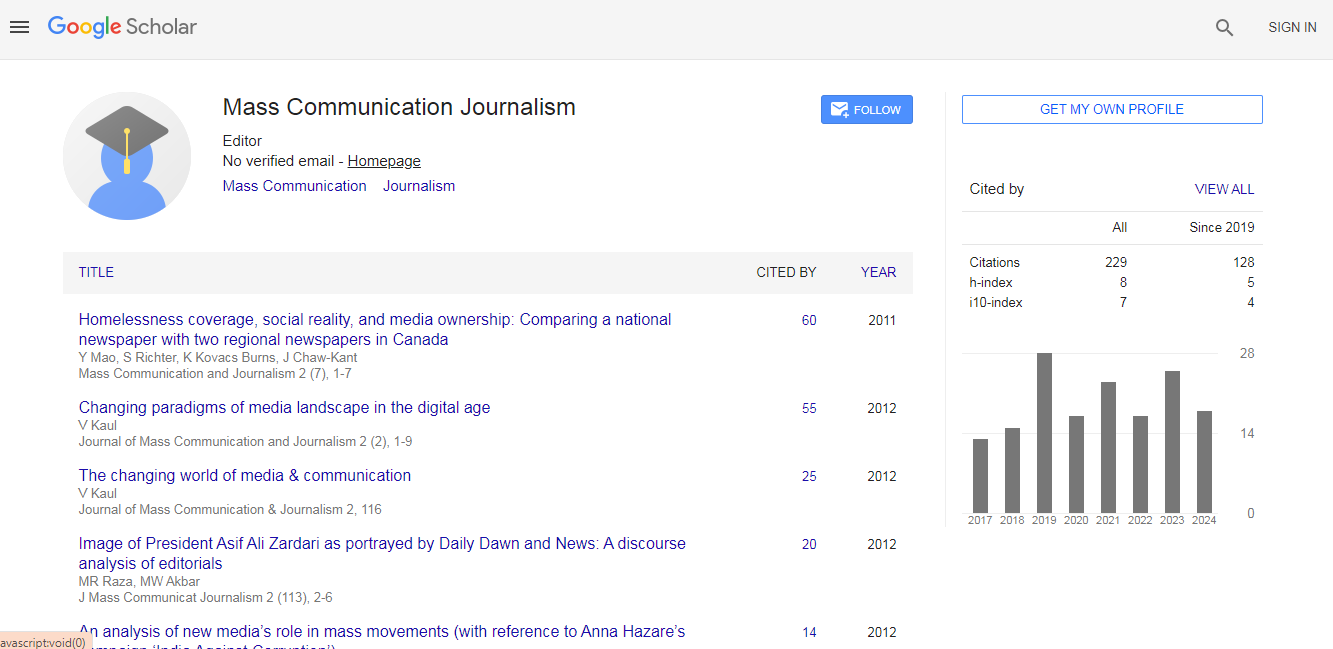
Journal of Mass Communication & Journalism received 205 citations as per Google Scholar report