Short Communication - (2025) Volume 15, Issue 3
Received: 30-May-2025, Manuscript No. jmcj-25-176492;
Editor assigned: 02-Jun-2025, Pre QC No. P-176492;
Reviewed: 13-Jun-2025, QC No. Q-176492;
Revised: 20-Jun-2025, Manuscript No. R-176492;
Published:
27-Jun-2025
, DOI: 10.37421/2165-7912.2025.15.620
Citation: James O’Connor. ”Digital Media: Transforming Global Culture, Society.” J Mass Communicat Journalism 15(2025):620.
Copyright: © 2025 O. James This is an open-access article distributed under the terms of the Creative Commons Attribution License, which permits unrestricted use, distribution and reproduction in any medium, provided the original author and source are credited.
The pervasive and ever-evolving landscape of digital media fundamentally reshapes global cultures, societal structures, and individual experiences. This collection of research highlights the intricate ways these platforms influence diverse aspects of human life, from the nuanced transformation of cultural values in specific geopolitical contexts to their broad impact on public health and identity formation. Understanding these dynamics is crucial for navigating the complexities of our increasingly interconnected world. One significant area of inquiry centers on how digital media platforms reshape cultural values, particularly in nations undergoing transitions from socialist systems. These studies reveal the dynamic interplay between new communication technologies and the preservation or transformation of traditional societal norms and beliefs, underscoring the complexities of global digital influence on local cultures [1].
Further analysis broadens this perspective by critically examining how globalization and digital media actively reshape local cultural practices and identities. Research explores the tension between global homogenization and the essential preservation of unique cultural expressions, delving into the complex influence of international media flows on local cultural dynamics [3].
The impact of digital platforms extends to individual well-being, with studies investigating how social media use affects mental health across varied cultural contexts. These investigations identify both universal trends and culture-specific patterns, highlighting the diverse ways digital platforms interact with societal values and individual psychological states. This emphasizes the critical need for culturally sensitive interventions to mitigate potential negative effects [2].
Beyond individual mental health, digital media also profoundly influences public trust in science and shapes cultural perceptions of scientific knowledge. Research explores the pervasive spread of misinformation and its significant impact on societal beliefs, underscoring the urgent need for effective communication strategies in an increasingly digital world where information, accurate or not, flows freely [4].
Digital media's transformative power is also evident in cultural production, particularly in artistic practices within the Global South. Articles examine new forms of creativity, methods of dissemination, and audience engagement emerging in these regions. They highlight both the considerable opportunities and the inherent challenges local artists face as they navigate global digital platforms and markets, often with limited resources [5].
Youth are particularly susceptible to these influences, making their engagement with digital media a vital research focus. Studies examine the pivotal role of social media in facilitating youth activism and driving cultural change across diverse global contexts. This research explores how digital platforms enable mobilization, amplify voices, and influence social movements, recognizing both the immense opportunities and inherent limitations of online activism [6].
In a related vein, the formation of cultural identities among young people is significantly influenced by global media consumption. Investigations highlight the role of diverse media platforms in shaping values, beliefs, and lifestyles. These studies explore the complexities of identity construction in a digitally interconnected world, where young individuals are exposed to a myriad of cultural influences from various sources [8].
Digital media technologies also offer unprecedented avenues for the preservation, dissemination, and reinterpretation of cultural heritage. Researchers discuss the inherent challenges and substantial opportunities in utilizing digital tools to make heritage accessible, engage new audiences, and foster deeper cross-cultural understanding. This ensures that historical and cultural artifacts remain relevant and accessible for future generations [7].
Furthermore, the influence of media extends to fundamental aspects of daily life, such as food culture. Studies examine its significant impact on dietary choices and public health across different nations. They analyze how media campaigns, advertising, and digital content shape perceptions of healthy eating and broader culinary practices within societies, illustrating a direct link between media and public health outcomes [9].
Finally, the advent of digital platforms is profoundly transforming cultural consumption patterns and audience engagement. Research explores significant shifts from passive reception to active participation and content co-creation. It also highlights the emergence of new forms of cultural capital in the digital era, fundamentally altering how audiences interact with and contribute to cultural content [10].
Collectively, these studies provide a comprehensive view of how digital media acts as a powerful agent of change, shaping not only how societies function and evolve, but also how individuals perceive themselves and interact with their cultural heritage and global community. The insights derived from this research are invaluable for policymakers, educators, and individuals seeking to understand and navigate the complex, dynamic landscape of contemporary digital culture.
The contemporary digital landscape serves as a potent force, actively reshaping cultural values and practices across the globe. One line of inquiry focuses on the specific context of nations transitioning from socialist systems, where digital media platforms are shown to profoundly influence cultural values. This research highlights the complex interplay between new communication technologies and the maintenance or alteration of traditional societal norms and beliefs, revealing the intricate ways global digital influences interact with local cultures [1]. Concurrently, the broader phenomenon of globalization, exacerbated by digital media, is critically examined for its role in transforming local cultural practices and identities. This includes an analysis of the inherent tension between a global trend towards homogenization and the vital need to preserve unique cultural expressions, with international media flows exerting significant influence on local cultural dynamics [3]. These studies collectively underscore the powerful, often contradictory, forces at play as cultures engage with digital platforms.
Beyond broad societal shifts, the impact of digital media extends to individual well-being and public perception. Extensive research investigates the effects of social media use on mental well-being, identifying both universal patterns and culture-specific variations across diverse contexts. This work emphasizes how digital platforms interact uniquely with societal values and individual psychological states, thereby necessitating the development of culturally sensitive interventions to support mental health [2]. A related concern is how digital media shapes public trust in science and cultural perceptions of scientific knowledge. Studies in this area explore the widespread dissemination of misinformation and its tangible impact on societal beliefs, pointing to an urgent need for effective communication strategies in an increasingly digitalized world where information literacy is paramount [4]. These findings highlight the critical role of digital platforms in mediating trust and understanding in public discourse.
The transformative influence of digital media is also profoundly evident in creative spheres and youth engagement. In the Global South, digital media is actively reshaping cultural production, particularly in artistic practices. This involves examining novel forms of creativity, methods of content dissemination, and mechanisms for audience engagement. Researchers highlight both the promising opportunities and the significant challenges that local artists encounter when navigating global digital platforms and markets, often under unique socio-economic conditions [5]. Parallel to this, young people's interaction with digital platforms is a key area of study. Social media, in particular, has emerged as a crucial facilitator for youth activism and cultural change across various global contexts. This research explores how digital platforms empower mobilization, amplify marginalized voices, and influence social movements, while also acknowledging the inherent opportunities and limitations of online activism as a tool for change [6].
The impact on youth extends further to the formation of cultural identities. Global media consumption significantly influences how young people construct their identities, shaping their values, beliefs, and lifestyles. This underscores the complexities of identity construction in a world made digitally interconnected, where exposure to diverse media sources from around the globe is commonplace [8]. Another critical function of digital media lies in the preservation and reinterpretation of cultural heritage. Articles explore how digital technologies contribute to safeguarding, disseminating, and recontextualizing heritage. They discuss the challenges and opportunities associated with using digital tools to enhance accessibility, engage new audiences, and foster greater cross-cultural understanding of historical assets [7].
Finally, the reach of media influences even fundamental aspects of daily life and consumption patterns. The significant influence of media on food culture and its implications for public health across different nations is a notable area of investigation. Studies analyze how media campaigns, advertising, and digital content collectively shape dietary choices, influence perceptions of healthy eating, and alter broader culinary practices within societies [9]. Concurrently, digital platforms are fundamentally transforming cultural consumption patterns and audience engagement. Research explores a marked shift from passive reception to active participation and content co-creation, marking the emergence of new forms of cultural capital in the digital era. This change redefines how audiences interact with and contribute to cultural content, fostering a more participatory cultural landscape [10].
The provided research explores the multifaceted influence of digital media on various aspects of culture and society. Several studies delve into how digital platforms reshape cultural values, particularly in nations transitioning from socialist systems, highlighting the dynamic interplay between new communication technologies and traditional societal norms. This includes examining the tension between global homogenization and the preservation of unique cultural expressions, analyzing the complex influence of international media flows on local cultural dynamics. A significant focus is placed on the impact of social media on individual well-being across diverse cultural contexts, identifying both universal and culture-specific patterns and emphasizing the need for culturally sensitive interventions. Relatedly, the role of media in shaping public trust in science and cultural perceptions of scientific knowledge is investigated, exploring the spread of misinformation and its societal impact. The collection also covers how digital media transforms cultural production, especially artistic practices in the Global South, examining new forms of creativity, dissemination, and audience engagement. Youth are a recurring theme, with research on social media facilitating youth activism and cultural change globally, and how global media consumption influences the formation of cultural identities among young people. Other crucial areas include the contribution of digital media to the preservation, dissemination, and reinterpretation of cultural heritage, discussing challenges and opportunities in using digital tools for accessibility and cross-cultural understanding. Furthermore, the profound influence of media on food culture and its implications for public health across different nations is analyzed. Finally, the transformation of cultural consumption patterns and audience engagement by digital platforms, shifting from passive reception to active participation and co-creation, is explored. This body of work collectively underscores the pervasive and complex ways digital media continues to redefine contemporary cultural and societal structures worldwide.
None
None
Indexed at, Google Scholar, Crossref
Indexed at, Google Scholar, Crossref
Indexed at, Google Scholar, Crossref
Indexed at, Google Scholar, Crossref
Indexed at, Google Scholar, Crossref
Indexed at, Google Scholar, Crossref
Indexed at, Google Scholar, Crossref
Indexed at, Google Scholar, Crossref
Indexed at, Google Scholar, Crossref
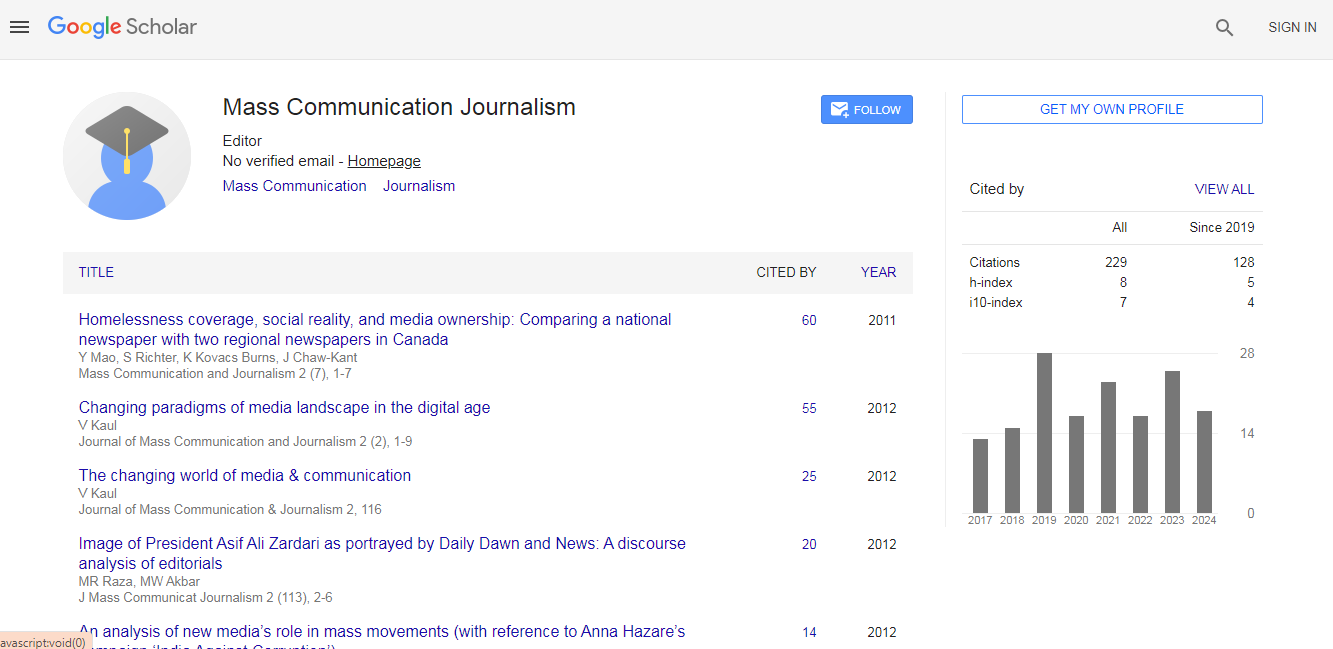
Journal of Mass Communication & Journalism received 205 citations as per Google Scholar report