Research Article - (2025) Volume 15, Issue 6
Received: 04-Nov-2025, Manuscript No. jmcj-25-173001;
Editor assigned: 06-Nov-2025, Pre QC No. P-173001;
Reviewed: 17-Nov-2025, QC No. Q-173001;
Revised: 24-Nov-2025, Manuscript No. R-173001;
Published:
03-Dec-2025
Citation: Wang, Jianglong. “Digital Media: Adapting to the Culture of Digitalized Education.” J Mass Communicat Journalism 15 (2025): 646.
Copyright: © 2025 Wang J. This is an open-access article distributed under the terms of the Creative Commons Attribution License, which permits unrestricted use, distribution and reproduction in any medium, provided the original author and source are credited.
Concomitant with the coming of digitalization in education, a digitalized culture in teaching and learning has emerged in higher education. Effective adaptation to this digitalized communal culture of teaching and learning has been a challenge for educators as pedagogical innovation becomes imperative. In some cases, traditional ways of teaching and learning are quickly replaced by new ways of teaching and learning with digital media and interactive engagement between teachers and learners. From an intercultural perspective, this paper discusses the salient characteristics of this digitalized teaching-learning community, outlines digital literacy and digital competence necessary for its participants and suggests applicable strategies for effective adaptation to digitalization in education. Since cultural adaptation is a two-way street, both educators and learners must mutually adapt to each other in their digitalized learning community. Implications for further research in this burgeoning area of adaptation to digitalization in education are also presented and discussed.
Digital media • Teaching and learning • Adaptation • Digitalization • Culture
The advancement of digital media has certainly made digitalization in education a reality for all, particularly for those in higher education [1, 2]. The pandemic, Covid 19, served as an effective catalyst for the emergence of an online teaching and learning community in which innovative pedagogy becomes imperative for educators on one hand and creative learning efforts are mandatory for university students on the other. Past research [3] has confirmed this phenomenon of digitalization in higher education a natural outcome of the digitalized society that calls for not only innovative policies but also timely training for professionals in education.
Scholars in the field have yet to reach a consensus on defining the concept of digitalization. General agreement tends to delineate it as (1) a focus on the full utilization of digital technologies; and (2) a distinction of the concept of “digitalization” from “digital transformation” [4, 5]. While digitalization in education refers to the use of applicable digital technologies to teaching and learning, the end result of the praxis is primarily digital transformation. The full use of digital technologies to teach and learn online without face-to-face or in-person contacts between instructors and students in a learning space serves as an illustrative example of digitalization in education. The process of teaching and learning is thus facilitated by digital technologies instead of by person-to-person engagements and/or face-to-face instructions. The practice of using digital technologies to engage students in learning, for instance, will inevitably change the instructor’s way of teaching, entailing pedagogical innovations that bring forth transformation of the traditional ways of teaching and learning. Given digital transformation a covering-all term for information technology modernization via digitalization [6], digitalization in education will eventually bring to bear revolutionary changes or transformations for educators and learners in higher education in the days to come.
Recent research [7] further ascertained this digital challenge for both educators and students in higher education, claiming a relationship between student learning outcome and their digital literacy, digital knowledge and skills. Melkumyan A and Sahakyan M [7] also found a positive relationship between some personal traits such as “conscientiousness, agreeableness and academic performance outcome” for the digitalized teaching and learning environment. As such, they claimed that “the ability to adapt to the changing conditions can be explained by personal traits and digital technologies used while the other possible factors can include gender, professional and cultural background” [7].
The purpose of this paper is to review, from an intercultural perspective, the salient characteristics of this online teaching and learning community, outline important traits, competencies required for its participants to succeed in this digitized educational environment and then, suggest applicable strategies for effective adaptation to the culture of digitalization in education. Primary characteristics of the digitized educational culture will be examined first followed by a review of adaptation strategies found in cultural and intercultural communication. Applicable strategies for effective adaptation to the culture of online teaching and learning with digital media will be discussed further before conclusions are drawn and implications for further research in this burgeoning area of adaptation to digitalization in education are explored and presented.
Characteristics of the digitized educational culture
The coming of digital media has ushed in a new era for teaching and learning which has become more of a norm these days rather than an exception for higher education. Traditional pedagogical praxis have quickly been replaced and/or supplemented by innovative methods of teaching via digital media in which participants teach and learn without seeing each other face-to-face. This medialized participatory way of teaching and learning characterizes itself via all participants’ utilization of digital technologies as their media for interactive engagement. Studies found that teaching and learning with digital media have literally transformed the traditional culture of education when digital media generation comes in to facilitate the formation of a participatory culture in education [8]. Dangmei J and Singh A [9] study confirmed that the digital generation of learners are “digitally centric”and technology is their identity.
Further, Evdokimova M [4] argued that “digitalization is experiencing a serious sociocultural transformation in addition to technological changes”. As application of digital technology contributes to the formation of new rules for communication, new principles of interaction and new worldviews, norms and values that are upheld and subscribed by teachers and students involved in their participatory culture of teaching and learning. The communication process has therefore been transformed as members of the participatory culture of education now adopt new ways of relating and affiliating with each other. A new sense of belongness is developing and being reinforced by members of this digitalized educational culture. Wang J [8], for instance, claimed that development of instructional content in digital age appeared to be less important and “Therefore, teachers are now functioning more like coaches and mentors rather than content experts”. Participation in this digitalized participatory culture becomes “different from what it was as sources of information are equally accessible to all members” [8]. Teaching and learning with digital media have since entailed reorganizing the new educational process, encountering new forms of communication with students and colleagues and adapting to the new sociocultural milieu of the digitalized university.
With digitalization in education, in addition to participants’ new ways of affiliation, they also have numerous ways of expressing themselves in this digitalized communal culture as they are no longer limiting themselves in the physical environment of their learning space. Teachers and learners in this digital learning environment “can now express themselves whenever they like and wherever they are” Wang J [8]. Studies further confirmed that in fact, the digitalization of education has transformed the teaching and learning process, which calls for not only significant instruction changes but also alternation of students’ conventional learning styles [8]. In addition, teaching with digital media means instructors and students are engaged in a participatory culture in which teaching of the content becomes less important than how the content will be applied and used. The ability to utilize information is being emphasized in this digitized teaching and learning community. In other words, curricular now tend to be more performance-based, orienting to the development of learners’ competence in applying what is taught. Since teachers in digital age are functioning more like coaches and mentors rather than content experts in education, Lai KW [10] found that teaching with digital media means learning has become a social and communal activity in which learners actively participate in the construction of knowledge and in the diffusion and/or acquisition of knowledge via their participatory culture that features (1) close affiliation, (2) creative expression, (3) collaborative problem-solving and (4) speedy and large-scale circulation of content. All the stated features of their participatory educational culture have come together to characterize the digitalization of the teaching/learning community, or the digitalized educational culture.
Cultural and intercultural adaptation
In the field of intercultural communication, adapting to a culture other than one’s own has been referred to as a two-way street, a process that requires cultural sojourners and the people of the host culture to change their ways of living for the purposes of adjusting to each other’s ways of living [4]. People experience cultural and/or intercultural adaptation in life much more often these days as our globalized world offers numerous opportunities for cross-cultural contacts that facilitate individuals’ development of intercultural communication competence. Adaptation in these contexts is mandatory if people want to be appropriate and effective in the culture they live in. Studies on intercultural adaptation have long confirmed that certain personal and contextual factors are found to be the determinants capable of predicting individuals’ success in adaptation to a new culture or a culture other than their own [11].
Primary personal factors affecting a person’s success in adaptation to a new culture are an individual’s cultural background, personality characteristics and psychological quality, all of which are idiosyncratic in nature [11]. These personal factors may include: (1) cultural predispositions; (2) similarity-difference ratio with the host culture; (3) level of tolerance for ambiguity and for risk-taking. All personal factors contribute together to the person’s potential in being successful in cultural/intercultural adaptation. On the other hand, contextual factors are social/cultural factors from the person’s living environment, i.e., the cultural context. Contextual factors are found to be equally important in accounting for individuals’ success in cultural adaptation [12]. Researchers Richardson also found an intertwined effect between personality traits and the contextual factors on a person’s adaptation success, which is understandable and evident when one lives and/or functions in a culture. In an intercultural setting, contextual factors typically include (1) interaction potential for the individual in the culture to communicate; and (2) receptivity of the people in the host culture who have amiable attitude and are ready to welcome visitors to their culture.
Further, while studying cross-cultural adaptation of organizational leaders, Seiler S [13] developed a pentad model of five significant factors determining effective intercultural leadership. The pentad of Seiler’s model includes: (1) individual competence, (2) team/group traits, (3) organization, (4) situation and (5) context. Seiler S [13] claimed that “successful intercultural leadership behavior is dependent not only on the individual's competencies but on the team, the organization, the general context and the imminent situation as well. Consequently, according to Seiler S [13], successful intercultural leadership development must focus on all five determining factors”. Seiler’s pentad model of successful intercultural leadership has come to highlight the importance of the intertwined relationship between an individual’s personal traits and contextual factors in fostering and/or predicting individuals’ success in adapting to a new culture, further confirming the claim that the development of competence in any given context is contingent upon both the intrinsic traits of the individual and the social/cultural milieu the individual encounters.
Adapting to the culture of digitalized education
In delineating the essence of digital challenge for individuals, Evdokimova M [4] argued that the main difficulties in effectively adapting to the digitalized educational culture of teaching and learning are closed associated with (1) the insufficient material and technical equipment of universities, (2) the constant increase of actual teaching load and (3) the low level of information culture and computer literacy. While “computer literacy” or digital media literacy is attributable to an individual’s personal traits in adapting to the digitized education culture, “insufficient material and technical equipment” or adaptation training programs for teachers and learners are the contextual factor affecting individuals’ (be they teachers, students, administrators and/or staff members) success in adapting to the digitalized teaching and learning environment in higher education.
Digital literacy (knowledge) and digital competence (skills) appears to be central to the issue of successfully adapting to the digitalization of education. Research findings also indicated a correlation between individual students’ digital knowledge and skills and their academic success. Studies show a positive relationship between personal traits (such as attitudes and motivation) and the person’s academic performance outcomes [7]. Further, Arisoy B [1], Hu W [11] and Zhang H and Li M [12] have demonstrated the significant role gender plays in students’ academic achievement since personality traits can influence academic performance and adaptability. Thus, the ability to adapt to the changing conditions of teaching and learning with digital media perhaps can be explained by the participants’ individualistic personal traits and their levels of digital literacy. Similarly, as research findings in intercultural adaptation has demonstrated, training for individuals to become digitally competent appears to be critical and valuable in individuals’ successful adaptation to their digitalized educational culture. Sulphey, for instance, argued that effectiveness in the workplace may largely depend on individual workers’ personal qualities and skills; training to foster individual instructors and students is critical in promoting their adaptation to their digital environment. Fitzgerald also contended that students’ attitudes towards information technology and artificial intelligence, their digital skills, motivation and perception of digital media are closely related to their academic performance in digitalized educational environment. This finding further highlighted the critical value in designing training programs aiming at elevating the attitudes, knowledge and skills of all participates in the digitalized educational culture.
As variation ratios of the cultures are proven to be a significant barrier to people effective intercultural communication, variations in digital literacy among participants in the digitalized educational community hinders their engagement in teaching and learning with digital media [11]. To level the digital literacy disparities on university campuses, training programs aiming to enhance instructors as well learners’ digital literacy must also be designed and implemented to level the playing field for members of this digitalized participatory culture [14-19]. However, during the transition from conventional teaching and learning in a physical place to digitalized teaching and learning in a virtual space, instructors should take the initiative to learn new ways of instruction with digital technologies; to this end, university administration are called upon to run workshops and platforms to facilitate instructor’s adoption of effective pedagogical strategies and techniques for their delivery of instructions and interactive engagement with their students via digital media. Furthermore, to facilitate individuals’ successful adaptation to the digitalized educational culture in higher education, contextual factors such as the insufficient material and technical equipment of universities and the constant increase of actual teaching load must be addressed and improved as they are essential to the development of participants’ digital competence [4, 20-23].
The coming of digital technologies has advanced higher education to a new world where teaching and learning with digital media becomes a norm rather than a novelty. The digitalized teaching and learning community can be described as a participatory culture in which members typically characterize themselves with close affiliation, creative expression, collaborative problem-solving and speedy and large-scale circulation of content. The nature of the interaction between teachers and students is an innovative interaction that features participatory engagement in teaching and learning. This digitalized participatory culture is here to stay and as such, it presents educators and learners valuable opportunities to interactively diffuse and acquire knowledge and skills. At the same time, this digitalized participatory culture also poses significant challenges for its participants as the levels of their digital literacy and competence vary substantially from one another. The challenges of digitalization in education are, however, primarily attributable to the disparity of digital literacy and digital competence among its participants. This disparity primarily lies in their idiosyncratic personal traits and the digital social/cultural milieu they found themselves.
Personal traits are reflected in their different levels of digital literacy, knowledge, skills and attitudes towards applications of digital technologies in their teaching and learning. On the other hand, digital environment or the contextual factors for their successful adaptation to the digital world will either facilitate or hinder their full participation in utilizing digital media in their teaching and learning. Participants’ variations of digital literacy and competence can certainly be enhanced with well-designed training programs aiming at changing their attitudes toward digitalization while enhancing their knowledge and skills for using the digital media in their teaching and learning. Motivating participants to adapt effectively to the digital teaching and learning environment is also of critical importance to the success of these training programs. Future research in this area may investigate the issues of designing effective training programs for members of digitalized cultures. It would also be beneficial for future research to identify factors that contribute to motivating individuals to participate and adapt fully to their digitized educational culture.
Although research findings in the field of cultural and intercultural adaptation may have offered us effective strategies for participating in and adapting to the culture of digitalized education, they are limited in rendering specific and applicable measures for members of this digitalized participatory culture to overcome their barriers and even the levels of their digital literacy disparity. However, this cross-fertilization will be beneficial, necessary and efficient when effective training programs are designed and delivered to participants in digitalized education to enhance members’ digital competence. The earlier the delivery of these training programs, the shorter the transitional time for participants to move from conventional ways of teaching and learning to the current reality of teaching and learning with digital media.
None.
None.
Google Scholar, Cross Ref, Indexed at
Google Scholar, Cross Ref, Indexed at
Google Scholar, Cross Ref, Indexed at
Google Scholar, Cross Ref, Indexed at
Google Scholar, Cross Ref, Indexed at
Google Scholar, Cross Ref, Indexed at
Google Scholar, Cross Ref, Indexed at
Google Scholar, Cross Ref, Indexed at
Google Scholar, Cross Ref, Indexed at
Google Scholar, Cross Ref, Indexed at
Google Scholar, Cross Ref, Indexed at
Google Scholar, Cross Ref, Indexed at
Google Scholar, Cross Ref, Indexed at
Google Scholar, Cross Ref, Indexed at
Google Scholar, Cross Ref, Indexed at
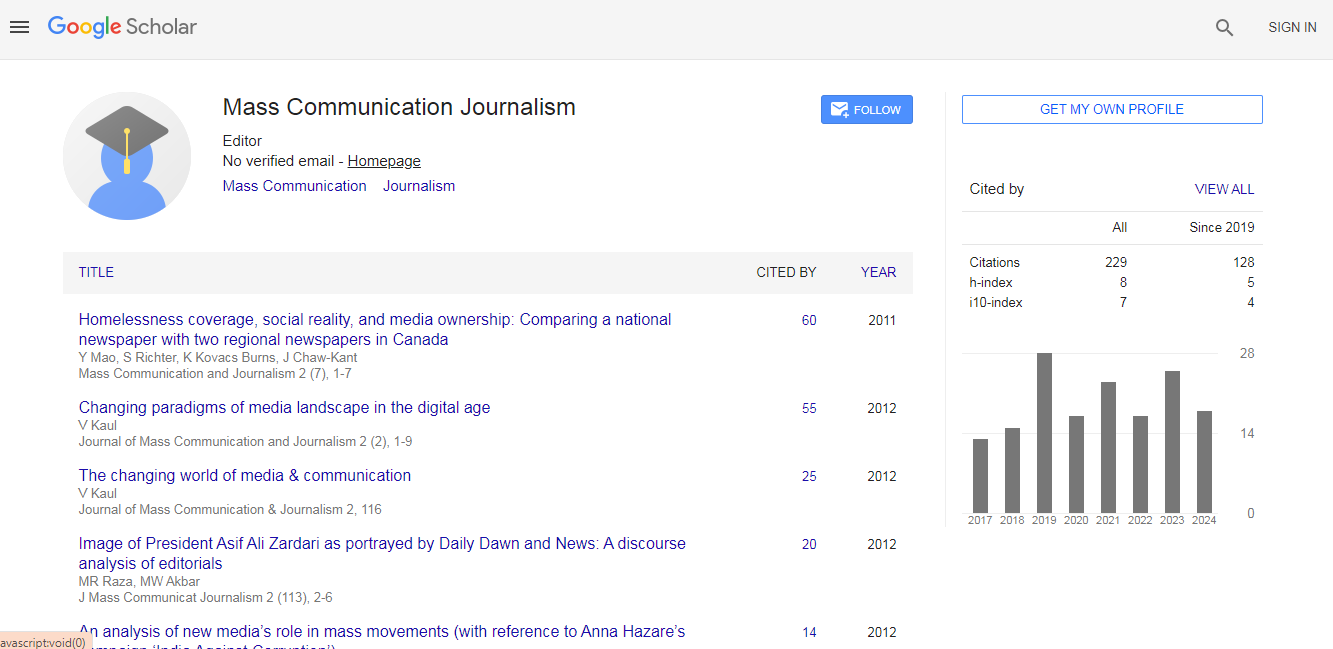
Journal of Mass Communication & Journalism received 205 citations as per Google Scholar report