Commentary - (2025) Volume 15, Issue 6
Received: 27-Nov-2025, Manuscript No. jmcj-25-176933;
Editor assigned: 01-Dec-2025, Pre QC No. P-176933;
Reviewed: 15-Dec-2025, QC No. Q-176933;
Revised: 22-Dec-2025, Manuscript No. R-176933;
Published:
29-Dec-2025
, DOI: 10.37421/2165-7912.2025.15.655
Citation: Nyberg, Ingrid S. Digital Crisis Communication: Strategy, Trust, Reputation. J Mass Communicat Journalism 15(2025):655.
Copyright: © 2025 Nyberg S. Ingrid This is an open-access article distributed under the terms of the Creative Commons Attribution License, which permits unrestricted use,
distribution and reproduction in any medium, provided the original author and source are credited.
Crisis communication in the digital age demands sophisticated and adaptable strategies from organizations. Effective responses to negative publicity online are paramount, as organizational legitimacy and reputation are heavily influenced by how adeptly feedback and crises are managed on digital platforms. What this really means is that a proactive approach to online crisis management is no longer optional but essential for maintaining public trust and stability [1].
Beyond immediate responses, strategic silence itself can be a calculated tool in crisis communication. Research explores the specific conditions under which organizations might deliberately choose silence over an instant reply, analyzing the subsequent impact on public perception. Here's the thing: silence isn't always detrimental; it can be a highly deliberate strategy, though its effectiveness hinges significantly on the unique context of the crisis and existing public expectations [2].
The landscape of crisis communication has expanded to include social media influencers, who navigate their own distinct set of challenges. Studies examine how these influencers manage and communicate during critical periods, detailing various strategies they adopt, ranging from apologies to denials or justifications. Analysis reveals how these approaches profoundly affect audience reactions, with the core insight being that successful influencer crisis communication often relies heavily on authenticity and perceived credibility, directly impacting brand partnerships and broader public trust [3].
Parallel to this, the traditional news media retains a pivotal role in shaping public understanding, particularly evident in comprehensive content analyses of events like the COVID-19 crisis. This research underscores that media coverage during a widespread health crisis significantly influences risk perception and compliance with public health measures, making accurate, consistent, and responsible reporting indispensable for effective crisis management [4].
Furthermore, the visual dimension of crisis communication, especially on social media, has emerged as a crucial area of study. Investigations into how organizations strategically employ images and videos in their crisis responses demonstrate that these visual elements can dramatically impact audience engagement, emotional resonance, and the overall effectiveness of the message. This emphatically highlights the necessity for incorporating strategic visual content into contemporary digital crisis management frameworks [5].
To fully grasp the effectiveness of communication during a crisis on social media, a dual processing model offers valuable insights. This model explores how both central, rational information processing and peripheral, emotional appeals influence public perception and subsequent behavioral intentions. A key finding from this approach is that genuinely successful online crisis communication skillfully balances factual information with emotionally resonant appeals to achieve desired outcomes [6].
Journalists, too, have seen their roles evolve significantly, moving beyond traditional reporting to actively engaging with the public through social media during crises. This shift underlines their dual function as not only information disseminators but also as facilitators of public discourse. Social media platforms enable real-time updates and direct interaction, fundamentally transforming long-established crisis reporting practices and fostering a more dynamic communication environment [7].
In an era rampant with the rapid spread of misinformation, developing robust frameworks for organizational crisis communication is more critical than ever. This area of research emphasizes the urgent need for proactive strategies designed to actively counter false narratives, rebuild or establish trust, and rigorously maintain credibility. Let's break it down: effective crisis responses must now proactively address and debunk misinformation head-on to be truly effective in complex digital environments [8].
The profound impact of crisis communication on a brand's reputation and consumer trust cannot be overstated, particularly within the digital age. Studies consistently find that transparent, empathetic, and timely crisis responses are absolutely crucial for mitigating reputational damage and cultivating enduring consumer loyalty. Conversely, a failure in clear and compassionate communication can severely erode trust and fundamentally jeopardize a brand's long-term viability [9].
Finally, ethical considerations form the bedrock of responsible crisis communication. A comprehensive review in this domain outlines key dilemmas and proposes vital directions for future research. It stresses that foundational ethical principles such as transparency, accountability, and fairness must rigorously guide all crisis responses to sustain public trust and prevent any further harm. This paper powerfully advocates for a more principled and morally conscious approach to crisis management across the board [10].
The digital landscape has fundamentally reshaped the field of crisis communication, making swift and transparent strategies indispensable for organizations facing negative publicity. Organizations must proactively manage feedback and crises online, as their legitimacy and reputation are profoundly influenced by these interactions [1]. In this complex environment, the decision to communicate or remain silent becomes a strategic choice. Research explores when and how organizations might strategically use silence, identifying specific conditions where it could be a deliberate and effective response, rather than simply a detrimental one. The impact of such silence on public perception is heavily context-dependent, reflecting a nuanced approach to crisis management [2]. This evolving communication ecosystem also encompasses the significant role of social media influencers. Studies detail the various strategies influencers employ during crises, including apologies, denials, or justifications, and analyze how these choices shape audience reactions. Authenticity and perceived credibility are critical for influencers, with direct implications for brand partnerships and public trust in their sphere [3].
Beyond individual entities, news media plays a vital role in public discourse during critical events. A content analysis of COVID-19 reporting, for instance, highlights how media framing shapes public understanding and response. During a health crisis, accurate and consistent reporting by the media significantly influences public risk perception and compliance with health measures, underscoring its essential role in effective crisis management [4]. Parallel to textual communication, the visual dimension on social media is increasingly crucial. Organizations now leverage images and videos in their crisis responses, and research demonstrates that these visual elements have a substantial impact on audience engagement, emotional responses, and the overall effectiveness of the message. This necessitates a strategic integration of visual content into digital crisis management plans [5].
Understanding the mechanisms behind effective social media crisis communication often involves a dual processing model. This model examines how both rational, central processing and emotional, peripheral appeals influence public perception and behavioral intentions during a crisis. A key insight is that successful online crisis communication skillfully balances factual information with emotionally resonant appeals to connect with audiences [6]. Journalists themselves are adapting to these digital shifts, leveraging social media not just for reporting but also for direct engagement with the public during crises. This transforms their traditional role, establishing them as both vital information disseminators and facilitators of public discourse. Social media platforms enable real-time updates and direct interaction, fundamentally altering crisis reporting practices and fostering a more dynamic communication environment [7].
However, this openness also introduces challenges, notably the rapid spread of misinformation. A framework for organizational crisis communication in this era emphasizes the necessity for proactive strategies to counter false narratives, build trust, and maintain credibility. Effective crisis responses must actively address and debunk misinformation to ensure their efficacy in digital settings [8]. The ultimate goal of much crisis communication is to protect and restore a brand's reputation and consumer trust. Research consistently shows that transparent, empathetic, and timely crisis responses are paramount for mitigating reputational damage and fostering consumer loyalty in the digital age. Conversely, poor communication can severely erode trust and significantly harm a brand's long-term viability, highlighting the high stakes involved [9]. Guiding all these strategies are fundamental ethical considerations. A comprehensive review outlines key dilemmas and future research directions, stressing that principles like transparency, accountability, and fairness must underpin all crisis responses. Adhering to these ethical guidelines is essential for maintaining public trust and preventing further harm, advocating for a more principled approach to crisis management overall [10].
The collective body of research underscores the evolving and critical nature of crisis communication in the digital age. Organizations must adopt proactive, transparent, and swift communication strategies to safeguard their legitimacy and reputation online, particularly given the rapid spread of information and misinformation. While immediate responses are often preferred, strategic silence can be a deliberate and effective tactic, contingent on the specific crisis context and public expectations. The communication landscape extends to social media influencers, whose crisis responses, whether apologies or denials, heavily rely on authenticity and credibility to maintain public trust and brand partnerships. News media plays an indispensable role in shaping public perception during crises, with its framing significantly influencing public understanding and compliance. The visual dimension of communication on social media is also crucial, with images and videos profoundly impacting audience engagement and message effectiveness. Effective online crisis communication often involves balancing rational information with emotionally resonant appeals, reflecting a dual processing model. Journalists are leveraging social media for real-time reporting and direct public engagement, transforming traditional practices. Crucially, addressing and debunking misinformation has become a core component of organizational crisis responses to maintain trust. Ultimately, transparent, empathetic, and timely communication is vital for preserving brand reputation and consumer loyalty, guided by ethical principles of accountability and fairness to prevent further harm and uphold public trust.
None
None
Mengqi L, Jinna W, Yi-Hui CH. "Crisis Communication in the Digital Age: Analyzing Organizations' Responses to Online Negative Publicity".J Public Relat Res 32 (2020):217-236.
Indexed at, Google Scholar, Crossref
Hyejoon R, Seoyeon K, Hyuk-Jin C. "Strategic Silence in Crisis Communication: When and How Organizations Use Silence as a Crisis Response Strategy".Public Relat Rev 47 (2021):106981.
Indexed at, Google Scholar, Crossref
Hyun JK, Hyo JK, Sora K. "How Social Media Influencers Communicate During Crisis: A Study of Influencer Strategies and Public Reactions".Int J Strateg Commun 16 (2022):440-459.
Indexed at, Google Scholar, Crossref
Jörg M, Jakob-Moritz E, Tobias R. "The Role of News Media in Crisis Communication: A Content Analysis of COVID-19 Reporting".Media Commun 8 (2020):1-12.
Indexed at, Google Scholar, Crossref
Hongmei L, Yan J, Sungsu K. "Visual Crisis Communication on Social Media: A Content Analysis of Organizational Crisis Responses".J Broadcast Electron Media 65 (2021):266-285.
Indexed at, Google Scholar, Crossref
Seoyeon K, Soojung K, Hyejoon R. "Examining Crisis Communication Effectiveness on Social Media: A Dual Processing Model Approach".Comput Hum Behav 126 (2022):106990.
Indexed at, Google Scholar, Crossref
Regina GL, Matt C, Jessica FS. "Beyond the Newsroom: How Journalists Use Social Media for Crisis Reporting and Public Engagement".J Mass Commun Q 96 (2019):928-949.
Indexed at, Google Scholar, Crossref
Florian K, Dennis FGS, Christian F. "Organizational Crisis Communication in the Era of Misinformation: A Framework for Strategic Response".J Commun Manage 27 (2023):167-184.
Indexed at, Google Scholar, Crossref
Jun WK, Eunice K, Joonghwa L. "The Impact of Crisis Communication on Brand Reputation and Consumer Trust in the Digital Age".Int J Advert 39 (2020):1155-1175.
Indexed at, Google Scholar, Crossref
W. TC, Sherry JH, Sun-A P. "Ethical Considerations in Crisis Communication: A Review and Future Directions".Public Relat Rev 47 (2021):102070.
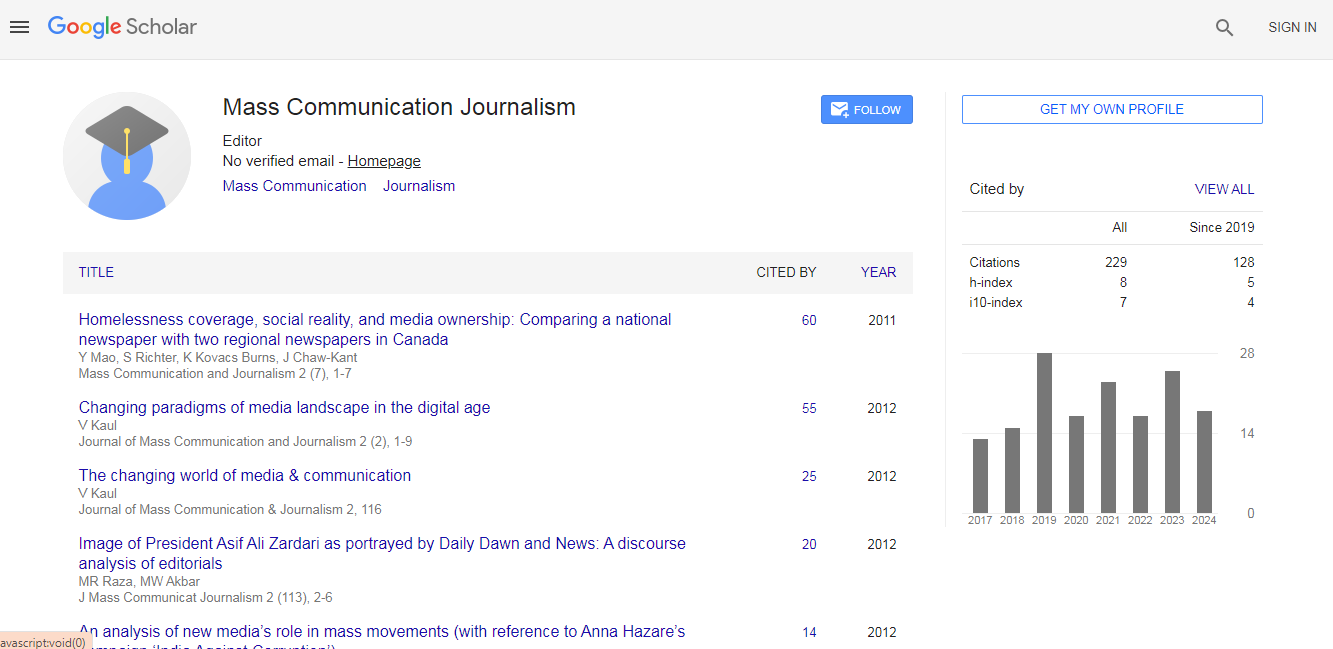
Journal of Mass Communication & Journalism received 205 citations as per Google Scholar report