Perspective - (2025) Volume 16, Issue 3
Received: 01-May-2025, Manuscript No. jpm-26-179411;
Editor assigned: 05-May-2025, Pre QC No. P-179411;
Reviewed: 19-May-2025, QC No. Q-179411;
Revised: 22-May-2025, Manuscript No. R-179411;
Published:
29-May-2025
, DOI: 10.37421/2090-0902.2025.16.536
Citation: Okoye, Daniel. ”Differential Geometry: Gravity’s Geometric Language.” J Phys Math 16 (2025):536.
Copyright: © 2025 Okoye D. This is an open-access article distributed under the terms of the Creative Commons Attribution License, which permits unrestricted use, distribution and reproduction in any medium, provided the original author and source are credited.
Differential geometry serves as the foundational language for comprehending the intricate structure of spacetime as articulated by Einstein's groundbreaking theory of General Relativity. This sophisticated mathematical framework, far from being a mere abstract tool, provides the essential concepts such as curvature, geodesics, and tensors through which gravitational phenomena are not only described but also accurately predicted. The paradigm shift it facilitates moves away from Newtonian force-based conceptions of gravity towards a model where matter and energy actively dictate the very geometry of a curved manifold, which, in turn, governs the motion of all entities within it. Key to this understanding are the geometric origins of the Einstein field equations, which hold profound implications for our models of the cosmos and the enigmatic nature of black holes. The application of differential geometric techniques offers a powerful means to analyze gravitational waves, treating their propagation as inherent geometric phenomena within spacetime. This research delves into the mathematical underpinnings used for the detection and interpretation of these cosmic ripples, specifically highlighting the crucial role of metric tensors and their perturbations. It elucidates how deviations from a flat spacetime metric, caused by passing gravitational waves, are precisely what sensitive detectors register, thereby bridging abstract geometric concepts with observable cosmic events and underscoring the geometric essence of wave dynamics in curved spacetime. The geometric interpretation of black hole thermodynamics presents a fascinating intersection of differential geometry and thermodynamics. This area connects fundamental geometric concepts, including curvature invariants and topological properties of spacetime manifolds, with thermodynamic quantities such as entropy and temperature. The research details how the geometric characteristics of a black hole's event horizon directly correspond to its thermodynamic properties, offering a deeper geometric perspective on these enigmatic cosmic objects and emphasizing the intrinsic link between black hole thermodynamics and the geometry of their surrounding spacetime. Cosmological models, when viewed through the lens of differential geometry, reveal their underlying geometric structure and evolution. This perspective examines how the large-scale geometry of the universe, characterized by metrics and curvature tensors, dynamically changes over cosmic time, profoundly influencing its expansion. The research underscores the utility of differential geometry in deriving and interpreting the complex equations that govern cosmology, providing invaluable insights into the universe's past, present, and future, and grounding cosmic evolution and dynamics in fundamental geometric principles. The geometric properties of vacuum solutions within General Relativity offer significant insights into spacetime structures even in the absence of matter and energy. This research employs differential geometric tools to classify and understand these vacuum spacetimes, such as the well-known Schwarzschild and Kerr solutions. The core principle illustrated is that spacetime geometry, even when devoid of matter, carries profound implications for the fundamental nature of gravity itself, demonstrating that geometry alone can dictate significant physical properties. Geodesic deviation, a concept deeply rooted in differential geometry, provides a geometric perspective on tidal forces. The relative acceleration of nearby free-falling particles, a direct consequence of spacetime curvature, is precisely described using geometric quantities. This geometric explanation elucidates why objects experience 'stretching' and 'squeezing' in the vicinity of massive bodies, establishing a direct link between the curvature of spacetime and observable gravitational effects, thereby solidifying the geometric interpretation of these phenomena. The geometric approach to conserved quantities in General Relativity offers a more nuanced understanding of concepts like energy and momentum. While often derived through Noether's theorem in flat spacetimes, these quantities acquire a complex geometric meaning in curved environments. The research explores the inherent challenges and subtleties involved in defining and comprehending conserved charges within the framework of differential geometry, acknowledging both the limitations and necessary extensions of standard definitions. The geometric characterization of singularities within General Relativity is a critical area of study. Singularities, points where spacetime curvature becomes infinite, can be geometrically defined and understood. This research explores the different classifications of singularities and their profound implications for the boundaries of our current physical understanding, emphasizing how a geometric approach is essential for identifying and analyzing these extreme cosmic conditions. Differential geometry plays a pivotal role in exploring alternative theories of gravity. These theories, which propose deviations from Einstein's General Relativity, manifest their differences through alterations in the fundamental differential geometric structure of spacetime. The research investigates how various geometric formalisms are employed to describe these alternative theories and predict their observable consequences, underscoring the indispensable role of differential geometry in both established and novel gravitational frameworks. The stress-energy tensor, representing the distribution of energy and momentum in spacetime, is intrinsically linked to the curvature of the spacetime manifold. This research uses differential geometric tools to elucidate this fundamental connection, demonstrating that the very source of gravity is geometrical in nature. The key insight is that the presence of matter and energy actively sculpts the geometry of spacetime, providing a geometric interpretation of how gravity operates at its core.
Differential geometry provides the essential mathematical language for understanding the fabric of spacetime as described by Einstein's General Relativity. Concepts such as curvature, geodesics, and tensors are not merely abstract mathematical tools but are the very means through which gravitational phenomena are described and predicted. This geometric interpretation of gravity moves away from the Newtonian force-based model to one where matter and energy dictate the geometry of a curved manifold, which in turn dictates the motion of matter and energy within it. The geometric origin of the Einstein field equations and their implications for cosmological models and black holes are central to this understanding. The application of differential geometric techniques is crucial for analyzing gravitational waves, understanding their propagation as geometric phenomena. This research examines the mathematical framework used to detect and interpret gravitational wave signals, emphasizing the role of metric tensors and their perturbations. It explains how deviations from a flat spacetime metric due to passing gravitational waves are precisely what detectors measure, linking abstract geometry to observable cosmic events and highlighting the significance of a geometric understanding of wave dynamics in curved spacetime. Black hole thermodynamics can be profoundly understood through a geometric interpretation. This approach connects concepts from differential geometry, like curvature invariants and topological properties of the spacetime manifold, to thermodynamic quantities such as entropy and temperature. The research details how the geometric features of the event horizon directly correspond to thermodynamic properties, offering a deeper geometric understanding of these enigmatic cosmic objects and confirming that the thermodynamics of black holes are intrinsically tied to the geometry of the spacetime they inhabit. Cosmological models are inherently geometric in structure when analyzed through the framework of differential geometry. This research examines how the large-scale geometry of the universe, described by metrics and curvature tensors, evolves over time and influences its expansion. It highlights the use of differential geometry to derive and interpret cosmological equations, providing crucial insights into the universe's past, present, and future, and underlining the geometric underpinnings of cosmic evolution and dynamics. The geometric properties of vacuum solutions in General Relativity are explored, focusing on how the absence of matter and energy still imposes significant geometric constraints on spacetime, leading to specific spacetime structures. The article uses differential geometric tools to classify and understand these vacuum spacetimes, such as the Schwarzschild and Kerr solutions. The core idea is that geometry itself, even without matter, carries profound implications for the nature of gravity. Geodesic deviation and its relation to tidal forces are examined from a geometric perspective. This research shows how the relative acceleration of nearby free-falling particles, a direct consequence of spacetime curvature, can be precisely described using geometric quantities. This provides a geometric explanation for why objects experience 'stretching' and 'squeezing' near massive bodies, directly linking the curvature of spacetime to observable gravitational effects and reinforcing the geometric interpretation of these phenomena. Conserved quantities, such as energy and momentum, in General Relativity are approached geometrically. The paper explains how these quantities, often derived from Noether's theorem in flat spacetimes, acquire a more complex geometric meaning in curved spacetimes. The research explores the challenges and nuances of defining and understanding conserved charges in the context of differential geometry, highlighting both the limitations and extensions of standard definitions. The geometric characterization of singularities in General Relativity is discussed. Singularities, points where the curvature of spacetime becomes infinite, can be geometrically identified and understood. The research explores different types of singularities and their implications for the limits of our current understanding of physics, emphasizing the role of differential geometry in analyzing these extreme conditions. Differential geometry is essential for understanding alternative theories of gravity. This paper investigates how deviations from Einstein's General Relativity in these theories manifest as changes in the underlying differential geometric structure of spacetime. It explores how different geometric formalisms are used to describe these theories and their observable consequences, highlighting the crucial role of differential geometry in both established and novel gravitational frameworks. The stress-energy tensor serves as a sculptor of spacetime geometry in General Relativity. This research elucidates how this tensor, representing the distribution of energy and momentum, directly dictates the curvature of the spacetime manifold. The article uses differential geometric tools to demonstrate this fundamental link, showing that the source of gravity is fundamentally geometric and that matter and energy shape the geometry of spacetime.
This collection of articles explores the profound application of differential geometry in understanding gravity and spacetime within the framework of General Relativity. Key areas of investigation include the fundamental connection between differential geometry and Einstein's theory, the geometric interpretation of gravitational waves, and the thermodynamics of black holes. The research also delves into the geometric structure of cosmological models, vacuum spacetimes, geodesic deviation, conserved quantities, and singularities. Furthermore, it examines the role of differential geometry in alternative theories of gravity and highlights how the stress-energy tensor sculpts spacetime geometry. These studies collectively emphasize that gravity is fundamentally a geometric phenomenon, where the distribution of matter and energy dictates the curvature of spacetime, which in turn governs motion.
None
None
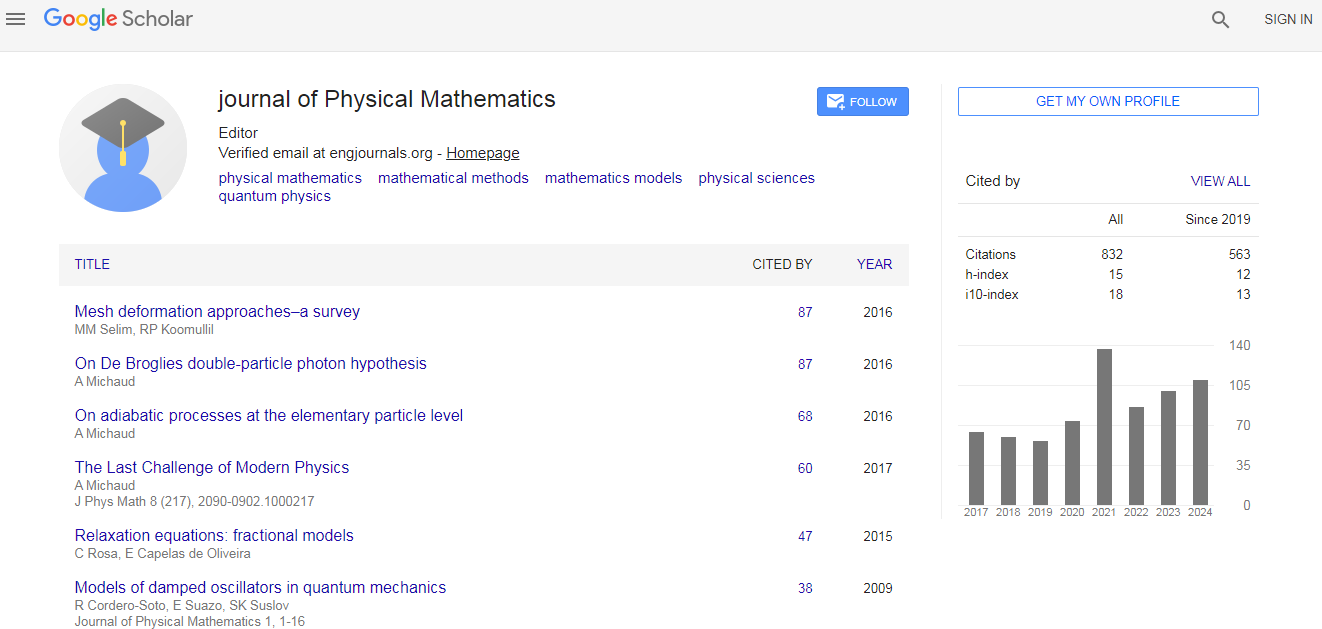
Physical Mathematics received 686 citations as per Google Scholar report