Perspective - (2025) Volume 11, Issue 4
Received: 01-Aug-2025, Manuscript No. jpnp-25-175510;
Editor assigned: 04-Aug-2025, Pre QC No. P-175510;
Reviewed: 18-Aug-2025, QC No. Q-175510;
Revised: 22-Aug-2025, Manuscript No. R-175510;
Published:
29-Aug-2025
, DOI: 10.37421/2472-0992.2025.11.378
Citation: Jensen, Nora. ”Dietary Choices: Shaping Health and Well-being.” J Pharmacogn Nat Prod 11 (2025):378.
Copyright: © 2025 Jensen N. This is an open-access article distributed under the terms of the Creative Commons Attribution License, which permits unrestricted use, distribution and reproduction in any medium, provided the original author and source are credited.
Research consistently shows a strong link between adequate dietary fiber intake and a diverse, healthy gut microbiota. This diversity is crucial for metabolic function, immune health, and nutrient absorption. Increasing fiber through whole grains, fruits, and vegetables supports a thriving gut ecosystem, which in turn contributes to overall well-being [1].
Adopting a plant-based diet offers significant health advantages, including reduced risks of cardiovascular disease, type 2 diabetes, and certain cancers. The emphasis on whole foods, fruits, vegetables, legumes, and nuts provides a rich array of nutrients and beneficial compounds that support long-term health and disease prevention [2].
The Mediterranean diet stands out for its protective effects against chronic diseases, particularly cardiovascular conditions and metabolic syndrome. This eating pattern, rich in olive oil, whole grains, fruits, vegetables, and lean protein, promotes anti-inflammatory processes and improves lipid profiles, offering a robust strategy for disease prevention [3].
Consistent evidence points to a strong association between high consumption of ultra-processed foods and an increased risk of all-cause mortality. These foods, often high in unhealthy fats, sugars, and salt, contribute to poor dietary quality and elevate the risk for various non-communicable diseases. Limiting their intake is crucial for better public health [4].
Personalized nutrition, leveraging individual genetic, metabolic, and lifestyle data, is emerging as a powerful approach to optimize metabolic health. This precision strategy moves beyond one-size-fits-all dietary advice, tailoring recommendations to prevent or manage conditions like type 2 diabetes and obesity more effectively [5].
Vitamin D plays a critical, multifaceted role in modulating immune function. Beyond its well-known role in bone health, adequate vitamin D levels are essential for a robust immune response, potentially reducing susceptibility to infections and modulating autoimmune processes. This highlights its importance for overall immune resilience [6].
Omega-3 fatty acids, particularly EPA and DHA, are vital for numerous physiological processes, influencing everything from cardiovascular health to brain function and inflammation. Consuming sufficient amounts through diet or supplements helps maintain cellular integrity and supports the body's natural anti-inflammatory mechanisms [7].
Early childhood nutrition is a cornerstone for optimal cognitive development. Inadequate nutrition during this critical period can have long-lasting negative impacts on brain structure and function, affecting learning abilities and overall academic performance. Prioritizing nutrient-dense diets for young children is essential for their future potential [8].
Adopting sustainable dietary patterns offers dual benefits for human health and environmental preservation. These diets, often characterized by lower consumption of animal products and higher intake of plant-based foods, reduce ecological footprints while simultaneously promoting better health outcomes and preventing chronic diseases [9].
Intermittent fasting strategies, such as time-restricted eating, are gaining traction for their potential metabolic benefits, including improved insulin sensitivity, weight management, and reduced inflammation. While more research is ongoing, these approaches offer a promising dietary intervention for metabolic health, often showing positive impacts on various health markers [10].
Research consistently shows a strong link between adequate dietary fiber intake and a diverse, healthy gut microbiota [1]. This diversity is crucial for metabolic function, immune health, and nutrient absorption. Increasing fiber through whole grains, fruits, and vegetables supports a thriving gut ecosystem, which in turn contributes to overall well-being. Adopting a plant-based diet offers significant health advantages, including reduced risks of cardiovascular disease, type 2 diabetes, and certain cancers [2]. The emphasis on whole foods, fruits, vegetables, legumes, and nuts provides a rich array of nutrients and beneficial compounds that support long-term health and disease prevention.
The Mediterranean diet stands out for its protective effects against chronic diseases, particularly cardiovascular conditions and metabolic syndrome [3]. This eating pattern, rich in olive oil, whole grains, fruits, vegetables, and lean protein, promotes anti-inflammatory processes and improves lipid profiles, offering a robust strategy for disease prevention. Consistent evidence points to a strong association between high consumption of ultra-processed foods and an increased risk of all-cause mortality [4]. These foods, often high in unhealthy fats, sugars, and salt, contribute to poor dietary quality and elevate the risk for various non-communicable diseases. Limiting their intake is crucial for better public health.
Personalized nutrition, leveraging individual genetic, metabolic, and lifestyle data, is emerging as a powerful approach to optimize metabolic health [5]. This precision strategy moves beyond one-size-fits-all dietary advice, tailoring recommendations to prevent or manage conditions like type 2 diabetes and obesity more effectively. Vitamin D plays a critical, multifaceted role in modulating immune function [6]. Beyond its well-known role in bone health, adequate vitamin D levels are essential for a robust immune response, potentially reducing susceptibility to infections and modulating autoimmune processes. This highlights its importance for overall immune resilience. Omega-3 fatty acids, particularly EPA and DHA, are vital for numerous physiological processes, influencing everything from cardiovascular health to brain function and inflammation [7]. Consuming sufficient amounts through diet or supplements helps maintain cellular integrity and supports the body's natural anti-inflammatory mechanisms.
Early childhood nutrition is a cornerstone for optimal cognitive development [8]. Inadequate nutrition during this critical period can have long-lasting negative impacts on brain structure and function, affecting learning abilities and overall academic performance. Prioritizing nutrient-dense diets for young children is essential for their future potential. Adopting sustainable dietary patterns offers dual benefits for human health and environmental preservation [9]. These diets, often characterized by lower consumption of animal products and higher intake of plant-based foods, reduce ecological footprints while simultaneously promoting better health outcomes and preventing chronic diseases.
Intermittent fasting strategies, such as time-restricted eating, are gaining traction for their potential metabolic benefits [10]. This includes improved insulin sensitivity, weight management, and reduced inflammation. While more research is ongoing, these approaches offer a promising dietary intervention for metabolic health, often showing positive impacts on various health markers.
Research underscores that dietary choices significantly impact overall health, from gut microbiota diversity to chronic disease prevention. Adequate fiber intake, found in whole grains, fruits, and vegetables, fosters a healthy gut ecosystem, crucial for metabolic and immune functions. Similarly, plant-based and Mediterranean diets offer protective benefits against cardiovascular disease, type 2 diabetes, and certain cancers through their nutrient-rich profiles and anti-inflammatory properties. In contrast, high consumption of ultra-processed foods, laden with unhealthy fats, sugars, and salt, is strongly linked to increased mortality and various non-communicable diseases. Beyond general dietary guidelines, personalized nutrition approaches, tailored to individual genetic and lifestyle data, show promise in optimizing metabolic health. Specific micronutrients like Vitamin D are vital for immune modulation, while Omega-3 fatty acids support cardiovascular, brain, and anti-inflammatory functions. The importance of nutrition extends across the lifespan, with early childhood diets being fundamental for cognitive development. What this really means is embracing sustainable dietary patterns not only improves human health but also reduces environmental impact. Emerging strategies like intermittent fasting are being explored for their metabolic benefits, including improved insulin sensitivity and weight management, adding to a growing understanding of how diet shapes well-being.
None
None
Shu C, Qiong Y, Rui L. "Dietary Fiber Intake and Its Association with Gut Microbiota Diversity and Function in Healthy Adults: A Systematic Review".Nutrients 15 (2023):3205.
Indexed at, Google Scholar, Crossref
Ka CT, Man LW, Cheuk-Him T. "Health benefits of plant-based diets: a review of the evidence".World J Gastroenterol 29 (2023):3232-3248.
Indexed at, Google Scholar, Crossref
Penelope M, Theodora P, Kalliopi D. "Mediterranean diet and prevention of chronic diseases: a narrative review".Hellenic J Cardiol 69 (2023):377-386.
Indexed at, Google Scholar, Crossref
Zhen C, Hua Y, Jie H. "Ultra-processed food consumption and risk of all-cause mortality: a systematic review and meta-analysis".Nutrients 15 (2023):2503.
Indexed at, Google Scholar, Crossref
Jose MO, Adela O, Dolores C. "Personalized nutrition for metabolic health: current evidence and future directions".Trends Endocrinol Metab 34 (2023):367-377.
Indexed at, Google Scholar, Crossref
Nattapong C, Ali S, Michael FH. "Vitamin D and immune function: an updated overview".Eur J Clin Nutr 77 (2023):279-287.
Indexed at, Google Scholar, Crossref
Artemis PS, Richard PB, Philip CC. "Omega-3 fatty acids: a review of their role in health and disease".Lipids Health Dis 21 (2022):85.
Indexed at, Google Scholar, Crossref
Maureen MB, Shobha V, Sunil A. "Early childhood nutrition and cognitive development: a systematic review".Dev Med Child Neurol 64 (2022):5-16.
Indexed at, Google Scholar, Crossref
Ujué F, Eva G, Amaia B. "Sustainable diets: a systematic review of the health and environmental impacts of dietary patterns".Nutrients 14 (2022):2055.
Indexed at, Google Scholar, Crossref
Stephen DA, Christiaan L, Gordon W. "Intermittent Fasting and Metabolic Health: A Review".Am J Lifestyle Med 15 (2021):171-182.
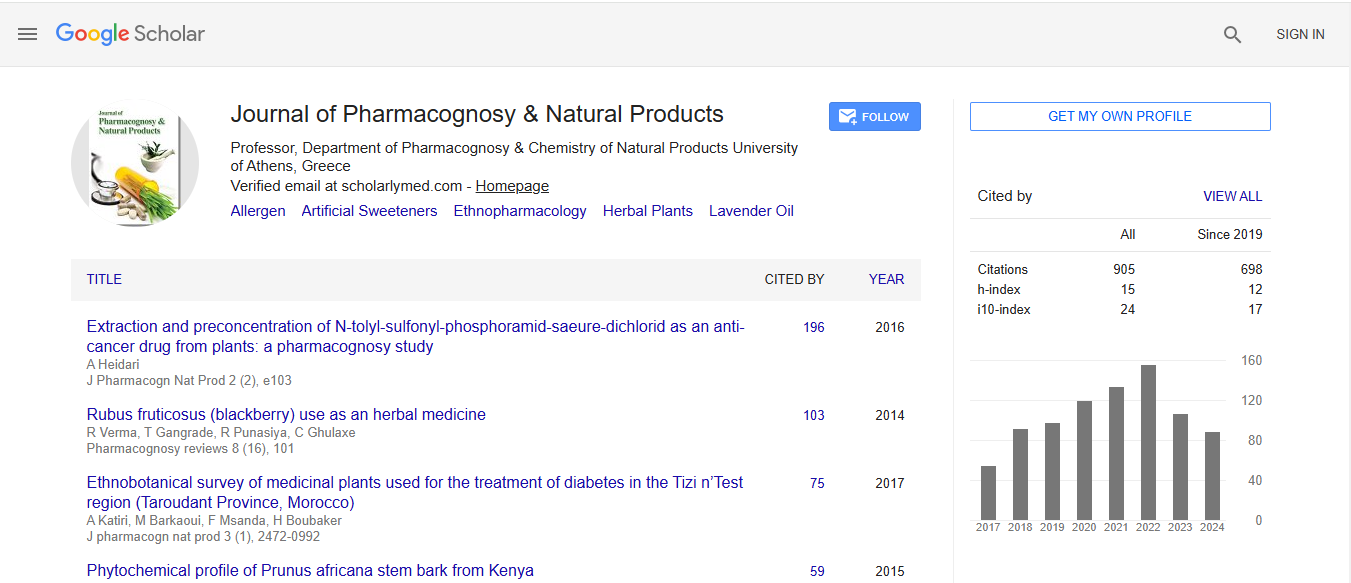
Journal of Pharmacognosy & Natural Products received 606 citations as per Google Scholar report