Opinion - (2025) Volume 10, Issue 2
Received: 01-Apr-2025, Manuscript No. jdcm-26-182184;
Editor assigned: 03-Apr-2025, Pre QC No. P-182184;
Reviewed: 17-Apr-2025, QC No. Q-182184;
Revised: 22-Apr-2025, Manuscript No. R-182184;
Published:
29-Apr-2025
, DOI: 10.37421/2475-3211.2025.10.303
Citation: Deshpande, Priyanka. ”Diabetic Retinopathy: Pathways, Damage, and Therapies.” J Diabetic Complications Med 10 (2025):303.
Copyright: © 2025 Deshpande P. This is an open-access article distributed under the terms of the Creative Commons Attribution License, which permits unrestricted use, distribution and reproduction in any medium, provided the original author and source are credited.
Diabetic retinopathy (DR) is a serious microvascular complication of diabetes mellitus, affecting millions worldwide and leading to significant vision impairment and blindness. The intricate pathogenesis of DR is initiated by chronic hyperglycemia, which triggers a cascade of molecular events within the retinal vasculature. These events ultimately lead to structural and functional damage, culminating in vision loss. Understanding these underlying mechanisms is paramount for developing effective therapeutic strategies to prevent or manage this debilitating condition. At the core of DR pathogenesis lies the persistent state of hyperglycemia. This metabolic derangement initiates a complex interplay of biochemical pathways that directly impact the delicate retinal microvasculature. Key among these are the exacerbation of oxidative stress, the promotion of chronic inflammation, and the accumulation of advanced glycation end products (AGEs). These interconnected processes collectively contribute to the progressive deterioration of retinal health. Oxidative stress plays a pivotal role in DR. It is primarily generated through mitochondrial dysfunction and the activation of the polyol pathway. The excessive production of reactive oxygen species (ROS) damages cellular components, including lipids, proteins, and DNA, thereby impairing retinal cell function and survival. This oxidative burden further fuels the inflammatory response, creating a vicious cycle of damage. Inflammation is another critical driver of DR progression. Elevated levels of pro-inflammatory cytokines, such as tumor necrosis factor-alpha (TNF-α), interleukin-1 beta (IL-1β), and interleukin-6 (IL-6), are consistently observed in the diabetic retina. These mediators contribute to endothelial cell apoptosis, increased vascular permeability, and the recruitment of inflammatory cells, all of which compromise the integrity of the blood-retinal barrier. The renin-angiotensin-aldosterone system (RAAS) is implicated in the development of DR. Angiotensin II, a key effector peptide within the RAAS, has been shown to promote inflammation, oxidative stress, and vascular remodeling in the retina. Consequently, inhibition of RAAS components has emerged as a potential therapeutic avenue for mitigating DR complications. Vascular endothelial growth factor (VEGF) is a potent pro-angiogenic factor that plays a central role in the neovascularization characteristic of advanced DR. Hyperglycemia-induced upregulation of VEGF promotes the formation of new, abnormal blood vessels that are leaky and fragile, leading to hemorrhage and exudation. Anti-VEGF therapies have significantly impacted DR management. Protein kinase C (PKC) pathways, particularly the PKC-beta isoform, are activated by hyperglycemia and contribute to microvascular damage. PKC activation influences various cellular processes, including increased vascular permeability, leukocyte adhesion, and altered gene expression related to angiogenesis and inflammation, thereby exacerbating DR pathology. Advanced glycation end products (AGEs) accumulate in the diabetic retina due to prolonged exposure to high glucose levels. AGEs interact with their receptor (RAGE), triggering signaling cascades that amplify inflammation, oxidative stress, and endothelial dysfunction. Targeting AGE formation or RAGE signaling is a promising strategy for therapeutic intervention. The blood-retinal barrier (BRB) is essential for maintaining retinal homeostasis, and its breakdown is a hallmark of DR, leading to macular edema. This compromise is driven by a confluence of factors including VEGF, inflammation, and oxidative stress, which disrupt the integrity of the endothelial cells and their tight junctions. Restoring BRB integrity is a key therapeutic goal. Emerging research also highlights the role of epigenetic modifications, such as DNA methylation and histone modifications, in DR pathogenesis. These alterations can influence gene expression patterns involved in key pathological processes like inflammation and angiogenesis, underscoring the complex regulatory mechanisms underlying DR progression.
Diabetic retinopathy (DR) is a complex microvascular complication arising from chronic hyperglycemia, initiating a series of detrimental molecular events within the retina. The initial insult of hyperglycemia triggers multifaceted pathways, including the generation of oxidative stress, the propagation of inflammation, and the formation of advanced glycation end products (AGEs) [1].
These factors collectively contribute to vascular damage, characterized by endothelial dysfunction, thickening of the basement membrane, and the development of microaneurysms, setting the stage for vision-threatening complications [1].
The role of inflammation in DR pathogenesis is profound. Elevated levels of pro-inflammatory cytokines such as TNF-α, IL-1β, and IL-6 are consistently observed. These mediators instigate endothelial cell apoptosis and promote vascular leakage, thereby compromising the integrity of the retinal vasculature. Concurrently, oxidative stress, fueled by mitochondrial dysfunction and the polyol pathway, exacerbates this inflammatory cascade and inflicts damage on retinal cells [2].
Oxidative stress, a significant contributor to DR, arises from an imbalance between reactive oxygen species (ROS) production and the body's antioxidant defenses. Mitochondrial dysfunction is a primary source of excess ROS in the diabetic retina. This cellular damage, in turn, activates inflammatory pathways, creating a vicious cycle that promotes disease progression [5].
Advanced glycation end products (AGEs) accumulate in the diabetic retina due to prolonged exposure to hyperglycemia. These molecules can bind to their receptor (RAGE), initiating intracellular signaling pathways that perpetuate inflammation, oxidative stress, and endothelial dysfunction. Interventions aimed at inhibiting AGE formation or blocking RAGE signaling offer potential therapeutic avenues for DR management [4].
The renin-angiotensin-aldosterone system (RAAS) plays a crucial role in the pathophysiology of DR. Activation of RAAS, particularly through angiotensin II, promotes inflammatory responses, oxidative stress, and vascular remodeling within the retina. Therapies targeting RAAS components, such as ACE inhibitors and ARBs, have demonstrated beneficial effects in reducing DR complications [6].
Vascular endothelial growth factor (VEGF) is a key mediator responsible for neovascularization and increased vascular permeability in DR. Hyperglycemia leads to increased VEGF expression, fostering the growth of abnormal, leaky blood vessels that are prone to bleeding. Anti-VEGF therapies have revolutionized DR treatment, highlighting the critical role of this signaling pathway [3].
Protein kinase C (PKC) pathways, especially PKC-beta, are activated by hyperglycemia and contribute significantly to microvascular complications. This activation leads to increased vascular permeability, leukocyte adhesion, and altered gene expression patterns involved in angiogenesis and inflammation, further driving DR progression. The development of novel PKC inhibitors is an area of active research [7].
The breakdown of the blood-retinal barrier (BRB) is a pivotal event in DR, manifesting as macular edema. This disruption is a consequence of combined insults from VEGF, inflammation, and oxidative stress, which collectively compromise the integrity of the endothelial cells and the tight junctions that form the BRB. Therapies focused on restoring BRB integrity are crucial for managing DR [8].
Epigenetic modifications, including DNA methylation and histone modifications, are increasingly recognized for their role in the development and progression of DR. These alterations can influence gene expression related to inflammation, angiogenesis, and oxidative stress, thereby contributing to the long-term microvascular complications of diabetes [9].
The gut microbiota has emerged as a potential modulator of systemic inflammation and metabolic health, which can indirectly influence DR. Dysbiosis in the gut microbiome can lead to increased intestinal permeability, systemic inflammation, and metabolic derangements, all of which are implicated in the pathogenesis of DR [10].
Diabetic retinopathy (DR) is a serious complication of diabetes driven by hyperglycemia. Key molecular pathways involved include oxidative stress, inflammation, advanced glycation end product (AGE) formation, and activation of signaling pathways like RAAS, VEGF, and PKC. These processes lead to vascular damage, breakdown of the blood-retinal barrier, and neovascularization. Mitochondrial dysfunction and ROS production further exacerbate damage. Emerging factors such as epigenetic modifications and gut microbiota dysbiosis also contribute to DR pathogenesis. Therapeutic strategies often target these pathways, including anti-VEGF therapies and agents that mitigate inflammation and oxidative stress.
None
None
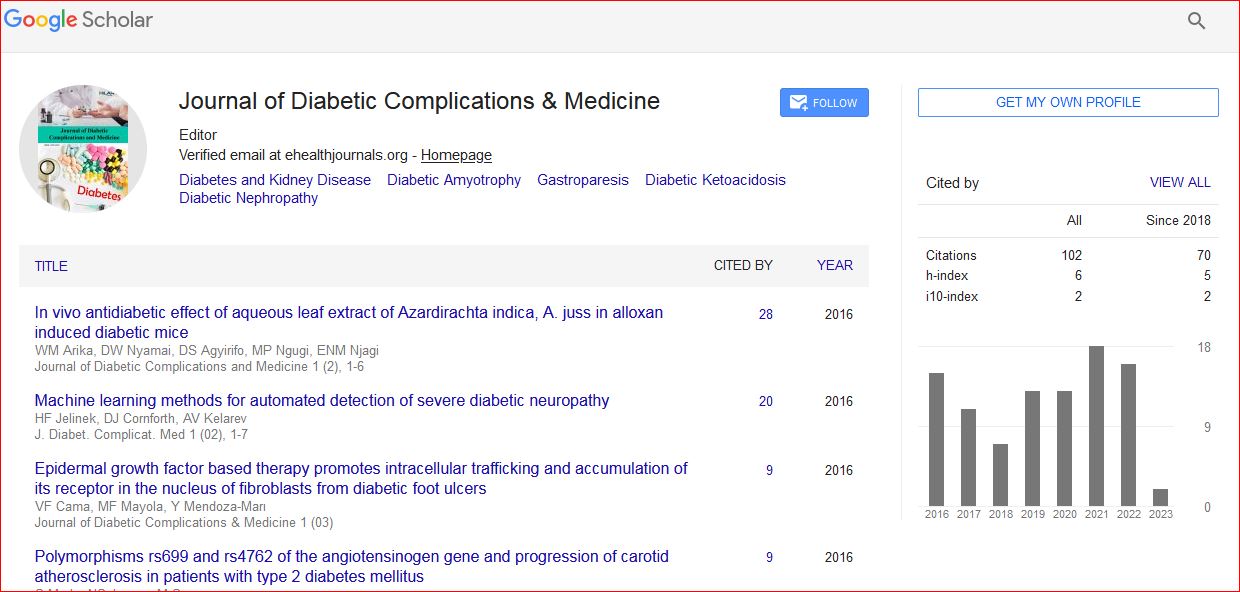
Journal of Diabetic Complications & Medicine received 102 citations as per Google Scholar report