Short Communication - (2025) Volume 11, Issue 2
Received: 31-Mar-2025, Manuscript No. cdp-25-165844;
Editor assigned: 02-Apr-2025, Pre QC No. P-165844;
Reviewed: 16-Apr-2025, QC No. Q-165844;
Revised: 24-Apr-2025, Manuscript No. R-165844;
Published:
30-Apr-2025
, DOI: 10.37421/2572-0791.2025.11.173
Citation: Targla, Simone. “Designing Ethical and Scalable Digital Phenotyping Systems for Psychiatry.” Clin Depress 11 (2025): 173.
Copyright: © 2025 Targla S. This is an open-access article distributed under the terms of the Creative Commons Attribution License, which permits unrestricted use, distribution and reproduction in any medium, provided the original author and source are credited.
Mental health disorders are among the most pressing public health issues of the 21st century, with depression, anxiety, bipolar disorder, and schizophrenia affecting hundreds of millions globally. Yet, the methods used to diagnose, monitor, and manage these conditions have remained largely unchanged for decades, relying on infrequent clinical visits, subjective interviews, and patient self-reports that often fail to capture the complexity and variability of psychiatric symptoms. The rise of ubiquitous personal technologiesâ??particularly smartphones and wearable devicesâ??offers a profound opportunity to rethink psychiatric care. Through digital phenotyping, which involves the moment-by-moment quantification of individual behavior and physiology using data from digital devices, researchers and clinicians now have the means to passively and continuously observe real-world indicators of mental health. However, the transformative promise of this approach is accompanied by equally significant challenges in design, scalability, and ethics. As digital phenotyping systems evolve from experimental prototypes to clinical tools, ensuring their ethical integrity and broad applicability must be central to their development [1].
Digital phenotyping draws on passive data streams such as GPS location, screen interactions, call and text logs, accelerometer data, app usage, and speech patterns to infer behavioral, cognitive, and emotional states. These streams can yield insights into sleep patterns, mobility routines, social connectivity, cognitive effort, and mood fluctuationsâ??elements that are central to psychiatric functioning [2]. For instance, reduced mobility and increased phone screen time may serve as proxies for anhedonia or social withdrawal in depressive disorders, while irregular circadian activity and impulsive digital behavior could indicate manic episodes in bipolar disorder. These behavioral markers, derived without explicit user input, can be tracked continuously and in naturalistic settings, allowing for a nuanced understanding of how psychiatric symptoms manifest over time [3].
Despite its immense potential, designing digital phenotyping systems that are both scalable and ethically sound presents a unique intersection of technical, clinical, and moral complexity. A primary concern is the issue of informed consent. Unlike traditional clinical studies where participants engage with researchers in controlled environments, digital phenotyping often collects data silently in the background [4]. This raises questions about whether participants truly understand the extent, granularity, and implications of the data being gathered. Furthermore, the persistent nature of this data collectionâ??often 24/7â??demands a rethinking of traditional consent paradigms. Dynamic consent models, where participants can modify their preferences over time, may provide a more respectful and transparent approach, but implementing such systems at scale introduces logistical and technical hurdles [5].
Another core challenge lies in ensuring the privacy and security of the highly sensitive data involved. Behavioral traces, even when stripped of personally identifiable information, can reveal intimate details about a person's life, including their routines, relationships, and mental state. The potential for misuseâ??whether by commercial entities, insurers, employers, or even governmentsâ??makes robust data governance frameworks essential. End-to-end encryption, decentralized data storage, and transparent data-sharing policies must be foundational elements of any ethically designed system. Moreover, data minimization principles should be enforced to ensure that only the necessary data is collected and retained for the shortest time required to meet clinical or research objectives.
In conclusion, digital phenotyping holds transformative potential for psychiatry by enabling continuous, real-world monitoring of behavioral and psychological states. However, realizing this potential at scale demands more than technical ingenuityâ??it requires an unwavering commitment to ethical design. Systems must be transparent, privacy-preserving, inclusive, and clinically meaningful. As we stand at the intersection of mental health care and digital innovation, the choices we make today will shape the future of psychiatric diagnosis and treatment. Ethical and scalable digital phenotyping is not simply a technological challenge; it is a profound societal endeavor that must center human dignity, agency, and equity at its core.
None.
None.
Google Scholar Cross Ref Indexed at
Google Scholar Cross Ref Indexed at
Google Scholar Cross Ref Indexed at
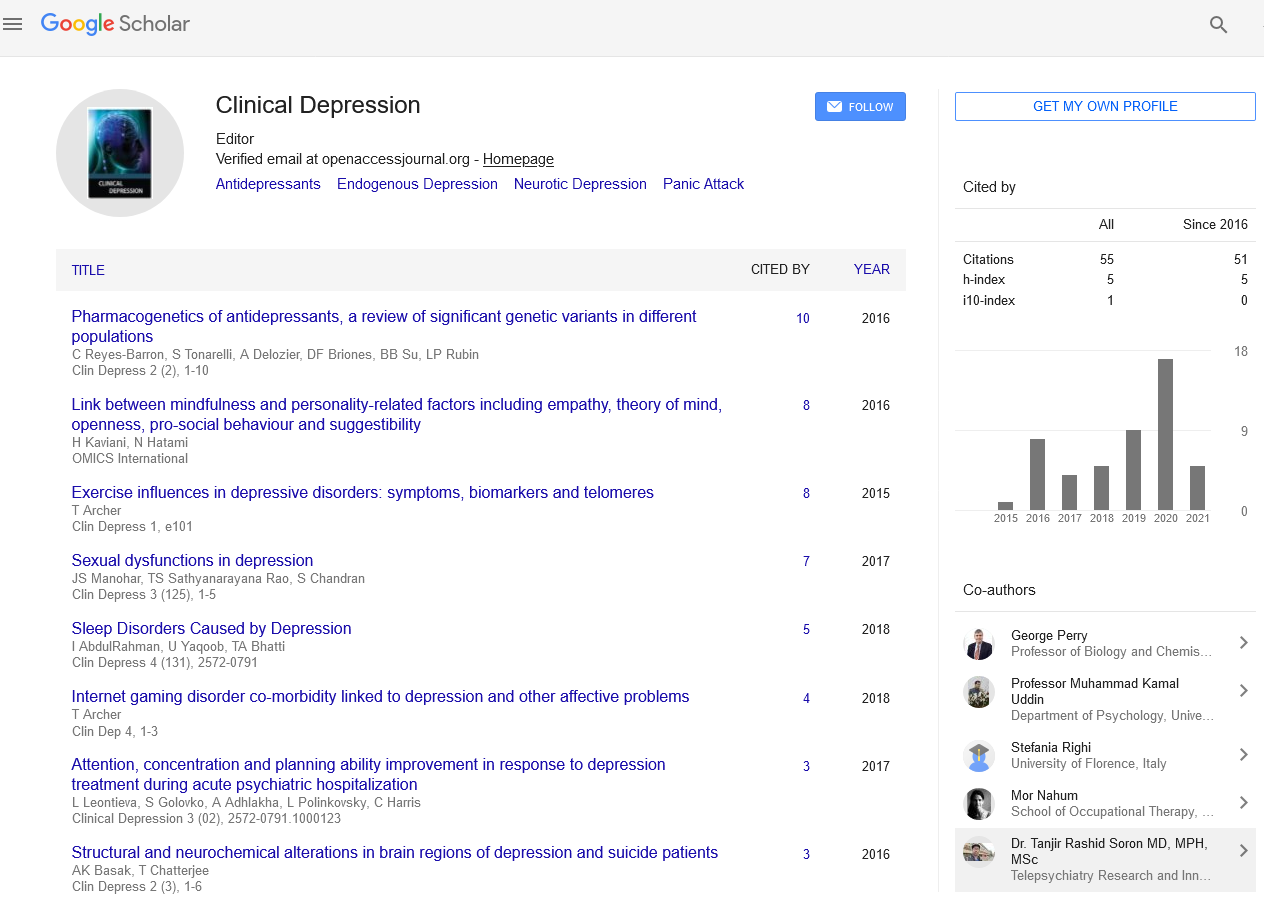
Clinical Depression received 89 citations as per Google Scholar report