Opinion - (2025) Volume 17, Issue 5
Received: 01-Sep-2025, Manuscript No. jcst-25-176301;
Editor assigned: 03-Sep-2025, Pre QC No. P-176301;
Reviewed: 17-Sep-2025, QC No. Q-176301;
Revised: 22-Sep-2025, Manuscript No. R-176301;
Published:
29-Sep-2025
, DOI: 10.37421/1948-5956.2025.17.726
Citation: Hassan Omar. ”Dendritic Cell Vaccines: Broad Utility,
Cancer Potential.” J Cancer Sci Ther 17 (2025):726.
Copyright: © 2025 O. Hassan This is an open-access article distributed under the terms of the Creative Commons Attribution License, which permits unrestricted use,
distribution and reproduction in any medium, provided the original author and source are credited
This Phase I clinical trial explored the safety and preliminary efficacy of combining a dendritic cell vaccine with programmed death protein-1 (PD-1) blockade for patients with recurrent glioblastoma. The study indicates that this combination therapy is tolerable and suggests potential clinical benefits, providing a foundation for further research in a challenging cancer type[1].
This review delves into the significant role of dendritic cells in the development of vaccines for various infectious diseases. It highlights how understanding DC biology can be leveraged to design more effective vaccines against pathogens, discussing current strategies and future directions in this critical area[2].
This article examines the recent progress in dendritic cell vaccine therapies specifically for ovarian cancer, a challenging malignancy. It outlines how these vaccines are being developed and optimized to elicit robust anti-tumor immune responses, offering hope for improved patient outcomes[3].
This review provides an overview of the significant advancements and persistent challenges in the field of dendritic cell-based vaccines. It discusses the evolving strategies for vaccine design, highlighting both successes in clinical trials and the hurdles that need to be overcome to maximize their therapeutic potential[4].
This paper explores the exciting frontier of personalized dendritic cell vaccines for cancer immunotherapy, focusing on the strategy of targeting neoantigens. It explains how identifying unique tumor-specific mutations can lead to highly individualized vaccines designed to provoke a precise anti-tumor immune response[5].
This systematic review and meta-analysis specifically investigates the application and efficacy of dendritic cell vaccines in pediatric brain tumors. It synthesizes existing data to assess the potential of this immunotherapeutic approach in a vulnerable patient population, summarizing current evidence and identifying gaps for future research[6].
This article discusses the recent advancements in dendritic cell-based vaccines designed to treat solid tumors. It covers improvements in vaccine design, antigen presentation strategies, and combination therapies aimed at enhancing anti-tumor immunity and overcoming the immunosuppressive tumor microenvironment[7].
This review explores the significant opportunities and concurrent challenges associated with using dendritic cell vaccines as part of combination therapy for cancer. It emphasizes how combining DCs with other immunotherapies or conventional treatments can potentially amplify anti-tumor responses and improve clinical outcomes, while also addressing complexities in synergistic strategies[8].
This paper focuses on elucidating the underlying mechanism of action of dendritic cell vaccines in the context of cancer immunotherapy. It details how DCs uptake and process tumor antigens, mature, and subsequently activate T cells to mount an effective anti-tumor immune response, shedding light on the biological principles driving their therapeutic effects[9].
This article discusses the critical aspects of manufacturing dendritic cell vaccines for cancer immunotherapy. It covers the intricate processes involved, from sourcing patient cells to ex vivo manipulation, maturation, and quality control, emphasizing the complexities and standardization efforts required for clinical-grade vaccine production[10].
The field of dendritic cell (DC)-based vaccines has seen significant advancements, yet persistent challenges remain in optimizing vaccine design to maximize therapeutic potential in various contexts[4]. A key area is their role in developing vaccines for diverse infectious diseases, where understanding DC biology is leveraged to design more effective vaccines against pathogens, discussing current strategies and future directions[2].
In oncology, a Phase I clinical trial explored the safety and preliminary efficacy of combining a dendritic cell vaccine with programmed death protein-1 (PD-1) blockade for patients with recurrent glioblastoma. This study indicated the combination therapy is tolerable and suggested clinical benefits, providing a foundation for further research in this challenging cancer type[1]. Similar progress is evident in dendritic cell vaccine therapies for ovarian cancer, a particularly challenging malignancy, where vaccines are being developed and optimized to elicit robust anti-tumor immune responses, offering hope for improved patient outcomes[3].
A promising frontier lies in personalized dendritic cell vaccines for cancer immunotherapy, specifically targeting neoantigens. This approach involves identifying unique tumor-specific mutations to create highly individualized vaccines designed to provoke a precise anti-tumor immune response[5]. Beyond personalized medicine, a systematic review and meta-analysis investigated the application and efficacy of dendritic cell vaccines in pediatric brain tumors, synthesizing existing data to assess this immunotherapeutic approach in a vulnerable patient population[6]. Recent advancements also extend to dendritic cell-based vaccines for solid tumors, covering improvements in vaccine design, antigen presentation strategies, and combination therapies aimed at enhancing anti-tumor immunity and overcoming the immunosuppressive tumor microenvironment[7].
Dendritic cell vaccines offer significant opportunities in combination therapy for cancer, despite concurrent challenges. Combining DCs with other immunotherapies or conventional treatments can potentially amplify anti-tumor responses and improve clinical outcomes, though complexities in synergistic strategies must be addressed[8]. Understanding the underlying mechanism of action is crucial; these vaccines function by detailing how DCs uptake and process tumor antigens, mature, and subsequently activate T cells to mount an effective anti-tumor immune response, shedding light on their therapeutic effects[9]. Furthermore, the manufacturing of these clinical-grade vaccines involves intricate processes, from sourcing patient cells to ex vivo manipulation, maturation, and quality control, emphasizing the complexities and standardization efforts required for production[10].
Research into dendritic cell (DC) vaccines highlights their broad utility across both infectious diseases and cancer immunotherapy. Studies demonstrate their significant potential in challenging malignancies, including recurrent glioblastoma, where combining DC vaccines with Programmed Death Protein-1 (PD-1) blockade shows promising clinical benefits. Progress is also evident in developing robust anti-tumor responses for ovarian cancer, and their application is being rigorously investigated in specific populations like pediatric brain tumor patients through systematic reviews. The field is rapidly evolving with substantial advancements in personalized approaches, such as targeting neoantigens for highly individualized cancer treatments. Furthermore, considerable attention is directed towards optimizing vaccine design for solid tumors, improving antigen presentation strategies, and exploring diverse combination therapies to enhance anti-tumor immunity effectively. Fundamental studies are crucial for elucidating the precise mechanism of action, detailing how DCs process tumor antigens, mature, and subsequently activate T cells to mount an effective immune response. The intricate manufacturing processes, from sourcing patient cells to ex vivo manipulation and stringent quality control, remain critical considerations for producing clinical-grade vaccines, underscoring ongoing efforts to overcome current challenges and maximize their overall therapeutic efficacy and broader impact.
Indexed at, Google Scholar, Crossref
Indexed at, Google Scholar, Crossref
Indexed at, Google Scholar, Crossref
Indexed at, Google Scholar, Crossref
Indexed at, Google Scholar, Crossref
Indexed at, Google Scholar, Crossref
Indexed at, Google Scholar, Crossref
Indexed at, Google Scholar, Crossref
Indexed at, Google Scholar, Crossref
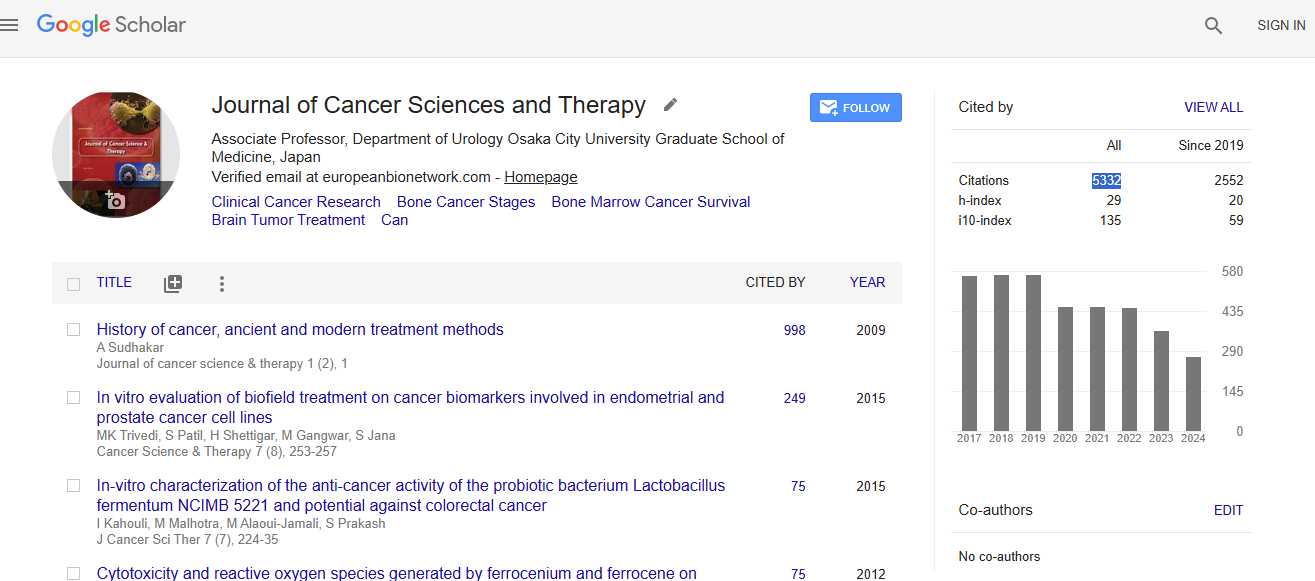
Cancer Science & Therapy received 5332 citations as per Google Scholar report