Brief Report - (2025) Volume 15, Issue 6
Received: 27-Nov-2025, Manuscript No. jmcj-25-176929;
Editor assigned: 01-Dec-2025, Pre QC No. P-176929;
Reviewed: 15-Dec-2025, QC No. Q-176929;
Revised: 22-Dec-2025, Manuscript No. R-176929;
Published:
29-Dec-2025
, DOI: 10.37421/2165-7912.2025.15.652
Citation: Vogel, Matthias R. Deeper News Engagement: Beyond Simple Metrics. J Mass Communicat Journalism 15(2025):652.
Copyright: © 2025 Vogel R. Matthias This is an open-access article distributed under the terms of the Creative Commons Attribution License, which permits unrestricted use, distribution and reproduction in any medium, provided the original author and source are credited.
This study explores how reader comments can serve as a deeper indicator of news engagement beyond simple click metrics. This approach recognizes that simplistic click counts merely scratch the surface of true user involvement. Instead, examining the nuances within reader comments offers profound insights into how audiences truly process, react to, and value news narratives. This reveals a critical qualitative layer often missed by purely quantitative measures [1].
This research delves into the neurophysiological aspects of emotional engagement with news, demonstrating that metrics derived from physiological responses like skin conductance or heart rate can reveal deeper levels of audience connection than self-reported measures or basic behavioral data. The findings underscore that while self-reported measures offer some indication, direct physiological data provides a more objective and unfiltered view of a persons connection to the news. Integrating these emotional metrics is crucial for a genuinely comprehensive understanding of how news affects its audience [2].
This study proposes a multi-dimensional framework for measuring news engagement on social media, moving beyond likes and shares to include qualitative aspects of user interaction. This expanded view moves past superficial interactions, recognizing that true engagement manifests in more substantive interactions like thoughtful comments, detailed discussions, and the organic sharing of content, all of which signify deeper audience involvement and understanding [3].
This research compares various metrics and strategies used by news organizations to foster audience engagement in the digital sphere. It highlights a tension between quantitative metrics like page views and qualitative engagement like community building. The study observes a natural tension between easy-to-track numbers, such as page views, and the more nuanced, community-focused aspects of engagement. It advocates for strategies that skillfully blend these quantitative and qualitative measures, providing a richer, more holistic understanding of how audiences interact with digital news platforms [4].
This paper proposes a comprehensive model for news engagement that moves beyond simple behavioral metrics to include cognitive attention, comprehension and affective emotional response dimensions. This model posits that real engagement goes beyond mere consumption; it involves active cognitive processing, deep attention, full comprehension, and a significant emotional connection. Relying solely on basic behavioral data means missing these crucial, deeper levels of audience interaction and impact [5].
This study investigates how users engage with news content specifically on mobile applications, identifying unique patterns and metrics relevant to the mobile environment. This research shows that the mobile environment requires a tailored approach, where intuitive design, personalized content delivery, and timely push notifications are essential for fostering sustained user engagement, differentiating it significantly from engagement models on traditional web platforms [6].
This research explores the drivers of news engagement in todays fragmented media landscape, focusing on the critical roles of trust in news sources and the perceived value of information. The findings suggest that simply making news accessible is not enough; a deeper level of engagement hinges on establishing strong credibility for news sources and clearly communicating the practical or civic value that the news content offers to its audience [7].
This article proposes a framework for measuring deep engagement with news, distinguishing it from mere attention. Instead of focusing on superficial metrics, this framework calls for measurements that truly reflect cognitive processing, thoughtful reflection, and tangible subsequent actions, such as sharing, engaging in discussions, or actively seeking further information, as traditional measures frequently fail to capture this true user immersion [8].
This study investigates the relationship between journalistic transparency e.g. disclosing sources, methods and its effects on news credibility and audience engagement. The study reveals a direct correlation: when journalists are open about their sources and methods, it markedly improves audience trust and leads to more active engagement. This highlights that transparent practices are fundamental to cultivating a readership that is both loyal and genuinely interactive with news content [9].
This research explores how algorithmic personalization influences news engagement, discussing the double-edged sword of filter bubbles and echo chambers. While algorithms can effectively enhance engagement by customizing content, they simultaneously risk creating filter bubbles and echo chambers, limiting diverse information exposure. Therefore, there is a critical need for engagement metrics that not only quantify individual user interaction but also evaluate the broader health and diversity of the information ecosystem [10].
The current landscape of news consumption necessitates a shift from rudimentary engagement metrics, such as simple click-through rates, towards a more nuanced understanding of audience interaction [1]. A comprehensive model of news engagement must integrate behavioral patterns with cognitive dimensions, encompassing attention and comprehension, as well as affective or emotional responses [5]. Traditional analytics often fall short by missing these deeper levels of processing and emotional connection. The aim is to define and measure deep engagement, which distinguishes itself from mere passive attention by capturing active cognitive processing, thoughtful reflection, and subsequent actions like sharing, discussing, or seeking further information [8]. This broader perspective acknowledges that genuine user immersion goes well beyond superficial interactions.
Qualitative aspects of engagement are crucial for a complete picture. Analyzing the content and sentiment of reader comments, for example, serves as a more profound indicator than simple clicks, providing valuable insights into audience understanding, emotional responses, and the perceived relevance of news stories [1]. Furthermore, research delves into the neurophysiological aspects of emotional engagement, demonstrating that metrics derived from physiological responses, such as skin conductance or heart rate, can uncover deeper levels of audience connection than self-reported measures or basic behavioral data. Incorporating these emotional metrics is advocated for a truly comprehensive understanding of news impact [2]. On social media, measuring news engagement requires a multi-dimensional approach that extends beyond likes and shares to include qualitative user interactions like comments, discussions, and content sharing patterns, which genuinely gauge audience involvement and understanding [3].
Engagement strategies must also adapt to diverse digital environments. News organizations frequently compare various metrics and strategies to foster audience engagement, recognizing a tension between easily quantifiable metrics like page views and the more qualitative aspects, such as community building. Effective strategies are those that integrate both for a holistic understanding of audience interaction in the digital sphere [4]. Specifically for social media, the multi-dimensional framework is essential to capture the nuances of user interactions beyond simple viral metrics [3]. Additionally, user engagement with news content on mobile applications presents unique patterns. This domain highlights the critical importance of design, personalization, and push notifications in driving sustained engagement, which often differs significantly from web-based news consumption [6].
Understanding the drivers behind news engagement is equally vital. In todays fragmented media environment, two critical factors are trust in news sources and the perceived value of the information provided [7]. Beyond simple accessibility, fostering genuine engagement necessitates cultivating credibility and clearly demonstrating the practical or civic utility of the news content. Relatedly, journalistic transparency, which involves disclosing sources and methods, has a significant impact on both news credibility and audience engagement [9]. Studies show that greater transparency can notably enhance trust and actively encourage a more engaged readership, suggesting that open practices are fundamental to building a loyal and interactive audience.
Finally, the influence of algorithmic personalization on news engagement presents both opportunities and challenges. While algorithms can effectively boost engagement by tailoring content to individual preferences, they also carry the inherent risk of creating filter bubbles and echo chambers, thereby limiting exposure to diverse information. This underscores a critical need for metrics that not only assess individual engagement levels but also evaluate the broader health and diversity of the informational landscape [10].
Research on news engagement increasingly moves beyond simple click metrics, seeking deeper insights into audience interaction. Analyzing reader comments and their sentiment provides a qualitative dimension to understanding audience comprehension, emotional responses, and perceived relevance of news stories. Neurophysiological approaches, such as measuring skin conductance or heart rate, reveal more profound levels of audience connection than traditional self-reported data. A multi-dimensional framework for social media engagement considers qualitative aspects like comments, discussions, and sharing patterns, going beyond just likes and shares. News organizations face a challenge balancing quantitative metrics, like page views, with qualitative engagement, such as community building, advocating for integrated strategies. A comprehensive model of news engagement should encompass behavioral, cognitive dimensions like attention and comprehension, and affective dimensions, recognizing that deeper processing and emotional connection are often overlooked by current analytics. Engagement with news on mobile applications presents unique patterns, with design, personalization, and push notifications playing crucial roles distinct from web-based consumption. In todays fragmented media environment, trust in news sources and the perceived value of information are key drivers of engagement, requiring cultivation of credibility and demonstrated utility. Deep engagement with news is distinct from mere attention, demanding metrics that capture cognitive processing, reflection, and subsequent actions like sharing or discussing, as traditional metrics often fall short. Journalistic transparency, through disclosing sources and methods, significantly enhances trust and encourages active engagement, fostering loyal and interactive readership. Finally, algorithmic personalization profoundly influences news engagement, creating both opportunities for tailored content and risks of filter bubbles, necessitating metrics that evaluate both individual engagement and broader informational diversity.
None
None
Badrul H, Waseem A, Irfan N. "Beyond the click: Investigating news engagement metrics through reader comments".Journal of Information Science 49 (2023):1374-1393.
Indexed at, Google Scholar, Crossref
Sara GGdA, Joana GRSdO, Miguel CPBF. "The role of emotional engagement in news consumption: A neurophysiological approach".Journalism & Mass Communication Quarterly 99 (2022):695-716.
Indexed at, Google Scholar, Crossref
Christoph K, Sabrina E, Benjamin K. "Measuring News Engagement on Social Media: A Multi-Dimensional Approach to User Interactions".Communication Research 48 (2021):1157-1180.
Indexed at, Google Scholar, Crossref
Mark D, Nikki U, Seth CL. "Audience engagement in digital news: A comparative study of metrics and strategies".Digital Journalism 8 (2020):350-369.
Indexed at, Google Scholar, Crossref
Homero GdZ, Thomas H, Sebastian S. "Towards a Comprehensive Model of News Engagement: Integrating Behavioral, Cognitive, and Affective Dimensions".Journalism Studies 20 (2019):2339-2358.
Indexed at, Google Scholar, Crossref
Jieun S, Sunyoung L, Jihye P. "Understanding user engagement with news articles on mobile applications".New Media & Society 25 (2023):1989-2008.
Indexed at, Google Scholar, Crossref
Benjamin KJ, Eun HK, Joon KK. "News engagement in a fragmented media environment: The role of trust and perceived value".Mass Communication and Society 25 (2022):357-377.
Indexed at, Google Scholar, Crossref
S. EB, Jeremy DB, Kevin GC. "From attention to action: A framework for measuring deep engagement with news".Journal of Computer-Mediated Communication 26 (2021):1-17.
Indexed at, Google Scholar, Crossref
Jessica LC, Melissa RG, Kevin KK. "The impact of journalistic transparency on news credibility and audience engagement".Journalism & Mass Communication Educator 75 (2020):322-337.
Indexed at, Google Scholar, Crossref
Christian B, Claes HdV, Hajo GB. "News engagement in the age of algorithms: Personalization, filter bubbles, and echo chambers".Annals of the International Communication Association 43 (2019):305-321.
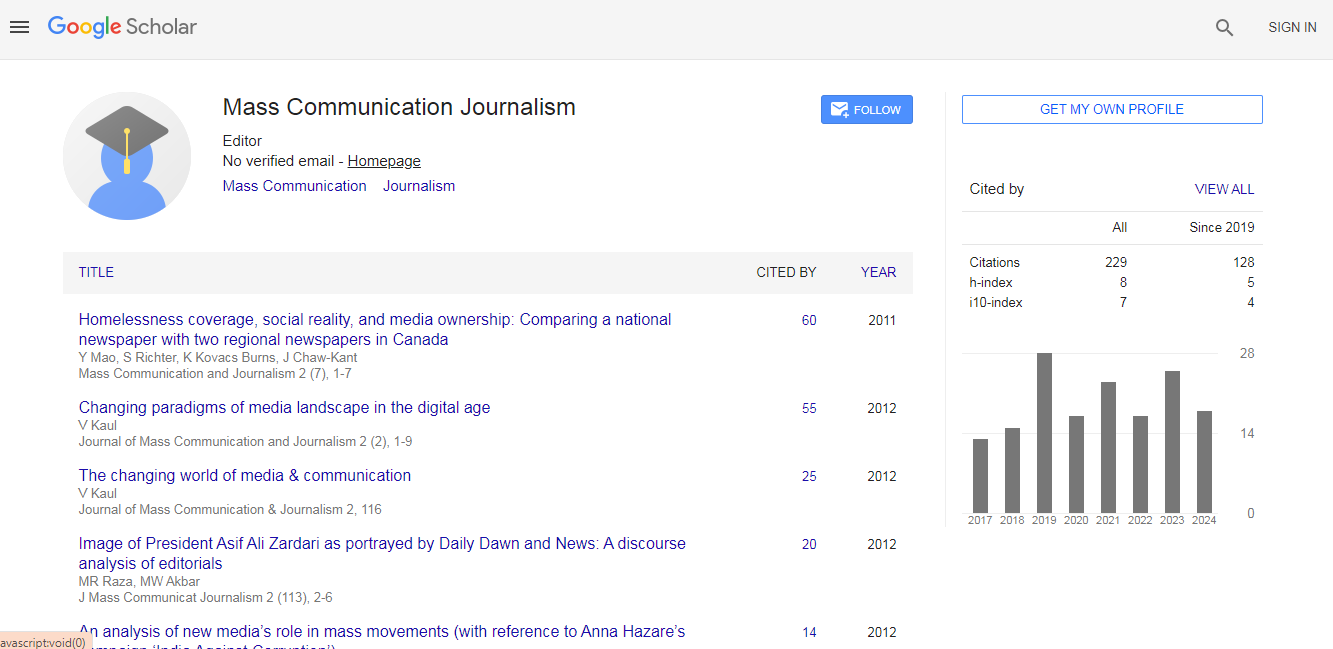
Journal of Mass Communication & Journalism received 205 citations as per Google Scholar report