Brief Report - (2025) Volume 16, Issue 3
Received: 02-May-2025, Manuscript No. jhmi-26-178832;
Editor assigned: 05-May-2025, Pre QC No. P-178832;
Reviewed: 19-May-2025, QC No. Q-178832;
Revised: 23-May-2025, Manuscript No. R-178832;
Published:
31-May-2025
, DOI: 10.37421/2157-7420.2025.16.589
Citation: Reed, Jonathan P.. ”Deep Learning Enhances Medical Imaging: Diagnosis and Beyond.” J Health Med Informat 16 (2025):589.
Copyright: © 2025 Reed P. Jonathan This is an open-access article distributed under the terms of the Creative Commons Attribution License, which permits unrestricted use, distribution and reproduction in any medium, provided the original author and source are credited.
Deep learning is profoundly transforming the landscape of medical image analysis, leading to substantial improvements in diagnostic accuracy and efficiency across diverse medical specialties such as radiology, pathology, and ophthalmology. These advanced models are adept at performing critical tasks including the detection of lesions, segmentation of anatomical structures, and classification of medical conditions, often achieving performance levels that are comparable to or even exceed those of human experts. Significant progress has been driven by the development of sophisticated neural network architectures, notably convolutional neural networks (CNNs) and transformers, which are capable of extracting complex patterns from intricate imaging data. This integration holds the promise of earlier disease detection, the personalization of treatment strategies, and the streamlining of clinical workflows, ultimately contributing to enhanced patient outcomes [1].
The application of deep learning techniques in the diagnosis of diabetic retinopathy from retinal fundus images presents a remarkably promising avenue for early intervention and the prevention of vision loss. Convolutional neural networks have demonstrated a high degree of accuracy in identifying subtle indicators of the disease, thereby facilitating timely treatment. This technological advancement offers a scalable solution for widespread screening programs, particularly in regions where access to specialized ophthalmological care is limited. The automation of detection and grading processes for diabetic retinopathy can significantly alleviate the burden on healthcare systems and improve the overall quality of patient care [2].
Within the field of breast cancer detection, deep learning models are increasingly being employed for the analysis of mammograms and ultrasound images. These sophisticated systems serve as valuable aids to radiologists by precisely highlighting suspicious lesions, thereby augmenting the sensitivity and specificity of cancer diagnoses. The integration of deep learning into clinical practice can lead to the earlier identification of malignant tumors, a critical factor in improving patient survival rates and the efficacy of treatment regimens. Moreover, these advanced tools contribute to reducing the variability often observed in image interpretation among different clinicians [3].
The role of deep learning in pathology is experiencing a rapid and extensive expansion, with notable applications in the automated analysis of digital slides for cancer grading and the identification of biomarkers. The combination of whole-slide imaging and deep learning algorithms enables the precise quantification of tumor characteristics, fostering more objective and reproducible diagnostic assessments. This technology assists pathologists by identifying crucial pathological features, thereby enhancing diagnostic consistency and potentially expediting the analysis of extensive tissue samples [4].
In diagnostic radiology, deep learning is fundamentally reshaping the interpretation of various imaging modalities, including computed tomography (CT), magnetic resonance imaging (MRI), and X-rays. Models are being developed to perform a range of tasks such as lesion detection, organ segmentation, and image reconstruction, all of which contribute to faster and more accurate diagnostic conclusions. The potential for deep learning to alleviate the workload of radiologists and bolster their diagnostic confidence is substantial, paving the way for more efficient and effective patient care pathways [5].
The development and implementation of explainable artificial intelligence (XAI) are recognized as critical factors for the widespread adoption and acceptance of deep learning models in clinical practice. Understanding the underlying reasoning behind a deep learning model's predictions is paramount for cultivating trust among healthcare professionals and ensuring patient safety. Current research in XAI is focused on providing transparent insights into the decision-making processes of these complex algorithms, thereby facilitating their seamless integration into existing diagnostic workflows [6].
Deep learning models are exhibiting significant potential in the early detection and prognosis of neurological disorders, including Alzheimer's disease and Parkinson's disease, through the advanced analysis of neuroimaging data such as MRI and PET scans. These algorithms are capable of identifying subtle patterns and changes within the brain that may not be readily discernible to the human eye, thereby enabling earlier diagnosis and the development of more precisely targeted therapeutic interventions [7].
The integration of deep learning within the domain of cardiovascular imaging is significantly accelerating diagnostic capabilities for a range of conditions, including coronary artery disease and heart failure. By meticulously analyzing echocardiograms, CT angiograms, and cardiac MRIs, these algorithms can accurately quantify cardiac function, detect minute abnormalities, and provide prognoses for cardiovascular events. This capability is vital for improving patient risk stratification and optimizing management strategies [8].
Deep learning is proving to be an instrumental technology in enhancing image reconstruction and denoising across various medical imaging techniques. This leads to an improved quality of medical images while simultaneously reducing radiation exposure or shortening scan times. These advancements are particularly advantageous in imaging applications where image artifacts or noise can impede accurate diagnosis, such as in low-dose CT scans or rapidly acquired MRI sequences [9].
The ethical considerations and regulatory challenges that accompany the deployment of deep learning in medical diagnostics are of utmost importance. Ensuring robust data privacy, algorithmic fairness, and comprehensive validation processes is fundamental to the responsible implementation of these transformative technologies. Proactively addressing these critical issues will foster the necessary trust and facilitate the seamless integration of artificial intelligence into the fabric of clinical practice [10].
Deep learning is revolutionizing medical image analysis, leading to enhanced diagnostic accuracy and efficiency in fields like radiology, pathology, and ophthalmology. These models excel at tasks such as lesion detection, segmentation, and classification, often matching or surpassing human performance. Key advancements include sophisticated convolutional neural networks (CNNs) and transformers, enabling the extraction of intricate patterns from complex imaging data. This integration promises improved early disease detection, personalized treatment strategies, and streamlined clinical workflows, ultimately leading to better patient outcomes [1].
The application of deep learning in diagnosing diabetic retinopathy from retinal fundus images shows remarkable promise. Convolutional neural networks can accurately identify subtle signs of the disease, enabling earlier intervention and potentially preventing vision loss. This technology offers a scalable solution for widespread screening, particularly in regions with limited access to ophthalmologists. The ability to automate detection and grading of diabetic retinopathy can significantly reduce the burden on healthcare systems and improve patient care [2].
In breast cancer detection, deep learning models are being employed to analyze mammograms and ultrasound images. These systems aid radiologists by highlighting suspicious lesions, improving the sensitivity and specificity of cancer diagnosis. The integration of deep learning can lead to earlier detection of malignant tumors, which is crucial for improving patient survival rates and treatment efficacy. Furthermore, these tools help reduce inter-observer variability in image interpretation [3].
The role of deep learning in pathology is rapidly expanding, with applications in automated slide analysis for cancer grading and biomarker identification. Whole-slide imaging combined with deep learning algorithms can quantify tumor characteristics with high precision, supporting more objective and reproducible diagnoses. This technology can assist pathologists in identifying critical features, improving diagnostic consistency, and potentially accelerating the analysis of large tissue samples [4].
In diagnostic radiology, deep learning is transforming the interpretation of various imaging modalities, including CT, MRI, and X-rays. Models are being developed for tasks such as lesion detection, organ segmentation, and image reconstruction, leading to faster and more accurate diagnoses. The potential for deep learning to reduce radiologist workload and improve diagnostic confidence is significant, paving the way for more efficient and effective patient care [5].
The development of explainable AI (XAI) is crucial for the widespread adoption of deep learning in clinical practice. Understanding why a deep learning model makes a particular prediction is essential for building trust among clinicians and ensuring patient safety. Research in XAI aims to provide insights into the decision-making process of these complex models, facilitating their integration into diagnostic workflows [6].
Deep learning models are demonstrating significant potential in the early detection and prognosis of neurological disorders, such as Alzheimer's disease and Parkinson's disease, through the analysis of neuroimaging data like MRI and PET scans. These models can identify subtle patterns and changes that may not be readily apparent to the human eye, enabling earlier diagnosis and the development of more targeted therapeutic interventions [7].
The integration of deep learning in cardiovascular imaging is accelerating diagnostic capabilities for conditions like coronary artery disease and heart failure. By analyzing echocardiograms, CT angiograms, and cardiac MRIs, these algorithms can precisely quantify cardiac function, detect subtle abnormalities, and predict cardiovascular events, thus improving patient risk stratification and management [8].
Deep learning is proving instrumental in enhancing image reconstruction and denoising in various medical imaging techniques, leading to improved image quality with reduced radiation exposure or scan times. This advancement is particularly beneficial in areas where image artifacts or noise can hinder accurate diagnosis, such as in low-dose CT scans or accelerated MRI sequences [9].
The ethical considerations and regulatory challenges associated with deploying deep learning in medical diagnostics are paramount. Ensuring data privacy, algorithmic fairness, and robust validation processes is essential for the responsible implementation of these technologies. Addressing these issues proactively will foster trust and facilitate the seamless integration of AI into clinical practice [10].
Deep learning is significantly advancing medical image analysis across radiology, pathology, and ophthalmology, enhancing diagnostic accuracy and efficiency. Specialized models are improving lesion detection, segmentation, and classification, often matching or exceeding human capabilities. Key areas of application include diabetic retinopathy detection, breast cancer diagnosis, and neurological disorder prognostics, leading to earlier interventions and better patient outcomes. In radiology, deep learning streamlines image interpretation and aids in diagnosis. Furthermore, advancements in image reconstruction and denoising improve image quality while reducing exposure. The development of explainable AI is crucial for clinical trust and safety. However, ethical and regulatory considerations, including data privacy and algorithmic fairness, must be addressed for responsible implementation.
None
None
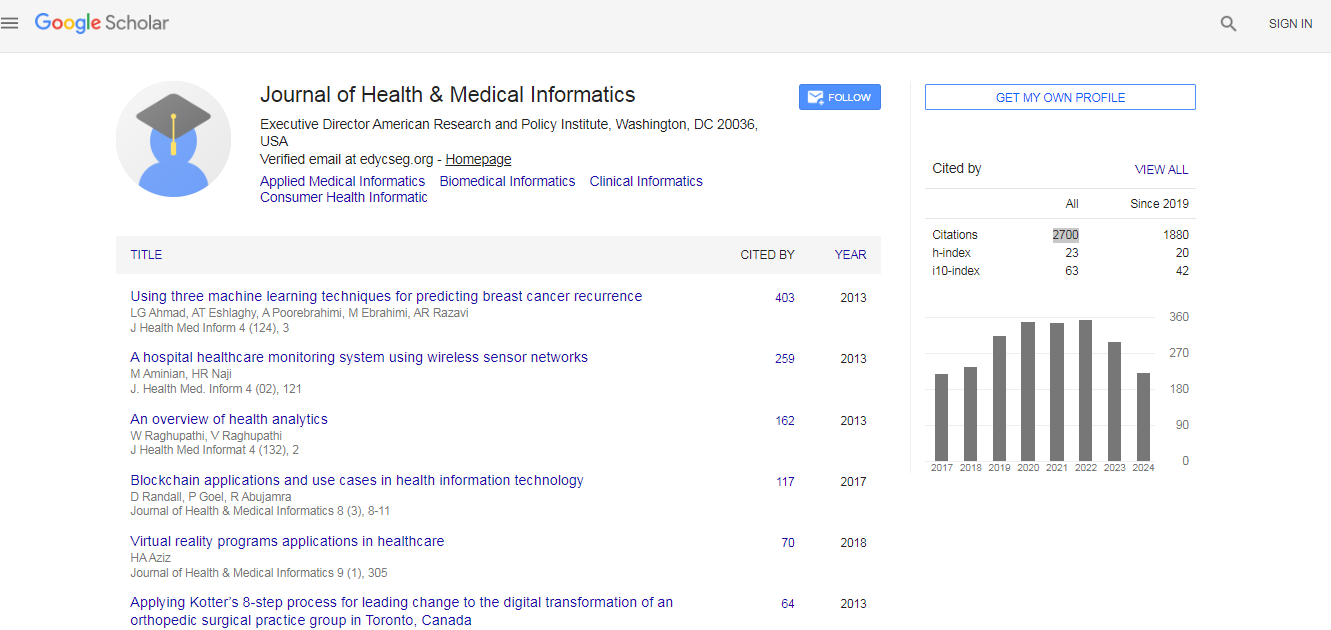
Journal of Health & Medical Informatics received 2700 citations as per Google Scholar report