Brief Report - (2025) Volume 15, Issue 3
Received: 30-May-2025, Manuscript No. jmcj-25-176494;
Editor assigned: 02-Jun-2025, Pre QC No. P-176494;
Reviewed: 13-Jun-2025, QC No. Q-176494;
Revised: 20-Jun-2025, Manuscript No. R-176494;
Published:
27-Jun-2025
, DOI: 10.37421/2165-7912.2025.15.622
Citation: Al-Rashid, Amina. "Data Journalism: Impact, Ethics, Technology, and Trust." J Mass Communicat Journalism 15 (2025): 622.
Copyright: © 2025 Al-Rashid A. This is an open-access article distributed under the terms of the Creative Commons Attribution License, which permits unrestricted use, distribution and reproduction in any medium, provided the original author and source are credited.
Data journalism is fundamentally reshaping the news landscape. This evolution involves its growth and how professionals perceive their roles, highlighting data journalists as integral to newsrooms, blending analytical prowess with traditional storytelling. What this really means is that beyond mere data presentation, emphasis lies on interpretation and narrative creation, expanding journalistic capabilities [1].
While data journalism strives to serve the public interest, this field often grapples with ethical dilemmas, examining the tensions between journalistic ideals and data-driven realities. It points out that concerns such as data privacy, source anonymity, and the potential for misinterpretation are constant, necessitating careful consideration to maintain public trust [2].
Within the European Union, the professional perceptions of data journalism reveal both its value and persistent challenges. These include the need for standardization and better resource allocation. What this really means is that adoption and practice are significantly influenced by diverse national contexts [3].
Journalists navigating data journalism often balance automated processes with interpretive skills, grappling with algorithms in their work. A mixed-method approach shows that while algorithms bring efficiency, human judgment remains essential for data interpretation and narrative construction. The takeaway here is that technology enhances, but does not replace, the journalist's role [4].
A key area of concern is algorithmic accountability, with challenges and opportunities for transparency and public trust. As algorithms become more central to news production, their fairness and explainability become critical for journalistic credibility. What this really means is that journalists must not only use data responsibly but also clarify the algorithms behind their insights [5].
Data journalism also plays a role in fostering citizen engagement within the hybrid media system, exemplified by case studies like The Guardian and Süddeutsche Zeitung. Interactive data visualizations and user-generated content create a more participatory news environment. The main idea is that engaging audiences with data simplifies complex issues and encourages public participation in civic discourse [6].
Specifically, the professional roles and self-conceptions of journalists in the algorithmic age, particularly in data-driven journalism, reveal significant challenges. Journalists grapple with new technical demands and ethical dilemmas, necessitating evolving skillsets and a redefinition of their professional identity. What this really means is that while adapting to data tools is crucial, maintaining core journalistic values is equally important [7].
Data visualization in news emerges as a practice with its own ethical considerations. While powerful for conveying complex information, visualizations carry risks of misrepresentation or bias if not handled carefully. Here's the thing: effective data visualization requires both technical skill and a deep understanding of journalistic integrity to ensure clarity and accuracy [8].
Automation is also reshaping data journalistic practices and newsrooms. Algorithms increasingly manage tasks like data collection and initial analysis, allowing journalists more time for in-depth reporting and storytelling. What this really means is that while automation streamlines processes, the human element of critical analysis and narrative construction remains paramount for impactful journalism [9].
During crises, such as the COVID-19 pandemic in the Netherlands, data journalism proved critical for communicating complex information. It highlighted the essential role of data journalists in making public health data accessible and understandable, even amid uncertainty. The key insight is that timely, clear, and contextually rich data presentations significantly aid public comprehension and decision-making during emergencies [10].
Data journalism is rapidly evolving, changing how professionals understand their roles within newsrooms. Journalists increasingly see themselves as crucial players, combining analytical skills with traditional reporting to unearth compelling stories. This shift emphasizes interpretation and storytelling over mere data presentation, pushing the boundaries of what journalism can achieve [1]. However, the adoption and practice of data journalism vary significantly, particularly within the European Union, where national contexts, standardization efforts, and resource allocation present considerable hurdles [3].
Here's the thing: while data journalism strives to serve the public interest, it often faces complex ethical dilemmas. Issues like data privacy, ensuring source anonymity, and the potential for misinterpretation are constant concerns that demand careful consideration to uphold public trust [2]. Furthermore, journalists grapple with algorithms, balancing automated processes with their own interpretive skills. While algorithms offer efficiency for tasks like data collection, human judgment remains indispensable for making sense of data and constructing narratives. The takeaway here is that technology enhances, but never replaces, the journalist's critical role [4].
A vital aspect of this field is algorithmic accountability. As algorithms become more deeply integrated into news production, ensuring their fairness and explainability is crucial for maintaining journalistic credibility. What this really means is that journalists must not only use data responsibly but also demystify the algorithms that generate their insights for the public [5]. Automation further reshapes practices in newsrooms, with algorithms increasingly handling initial analysis, allowing journalists to focus on more in-depth reporting and storytelling. While automation streamlines processes, the human element of critical analysis and narrative construction remains paramount for impactful journalism [9]. These new technical demands and ethical considerations require journalists to shift their skillsets and redefine their professional identity, emphasizing that adapting to data tools must go hand-in-hand with preserving core journalistic values [7].
Data visualization has emerged as a critical practice in news, bringing with it new ethical considerations. While visualizations can powerfully communicate complex information, they also carry the risk of misrepresentation or bias if not handled with care. Effective data visualization demands both technical skill and a profound understanding of journalistic integrity to ensure clarity and accuracy [8]. This visual approach also links to fostering citizen engagement within the hybrid media system. Interactive data visualizations and user-generated content create a more participatory news environment, making complex issues more accessible and encouraging public participation in civic discourse [6].
Finally, data journalism plays a crucial role in crisis communication. During the COVID-19 pandemic in the Netherlands, for example, data journalists were essential in making complex public health information understandable and accessible amidst widespread uncertainty. The key insight is that timely, clear, and contextually rich data presentations can significantly aid public comprehension and decision-making during emergencies [10].
Data journalism is changing how newsrooms work, with journalists seeing themselves as central figures who combine analytical skills with traditional reporting to tell compelling stories. There's a strong focus on interpreting data and weaving it into narratives, moving beyond just presenting raw numbers. This shift, however, brings its own set of challenges, including ethical dilemmas like data privacy, source anonymity, and the risk of misinterpretation, all of which need careful handling to maintain public trust. The adoption of data journalism varies across different regions, for instance within the European Union, due to differing national contexts, resource allocation, and a need for standardization. Algorithms play a big part in this new landscape. While they make tasks like data collection efficient, human judgment remains crucial for making sense of the data and crafting narratives; technology enhances the journalist's role, but doesn't replace it. Ensuring algorithmic accountability is also a key concern, requiring fairness and explainability to uphold journalistic credibility. Automation helps streamline processes, allowing journalists to focus more on in-depth reporting and storytelling. Data visualization is another important aspect, demanding technical skill and journalistic integrity to avoid misrepresentation and bias, ensuring clarity and accuracy. Journalists face new technical demands and ethical considerations, needing to adapt their skillsets while holding onto core journalistic values. Data journalism has proven vital in crisis communication, as seen during the COVID-19 pandemic, where it helped make complex public health information accessible and understandable. Engaging citizens through interactive data visualizations also fosters a more participatory news environment, making complex issues accessible and encouraging civic discourse.
None
None
Indexed at, Google Scholar, Crossref
Indexed at, Google Scholar, Crossref
Indexed at, Google Scholar, Crossref
Indexed at, Google Scholar, Crossref
Indexed at, Google Scholar, Crossref
Indexed at, Google Scholar, Crossref
Indexed at, Google Scholar, Crossref
Indexed at, Google Scholar, Crossref
Indexed at, Google Scholar, Crossref
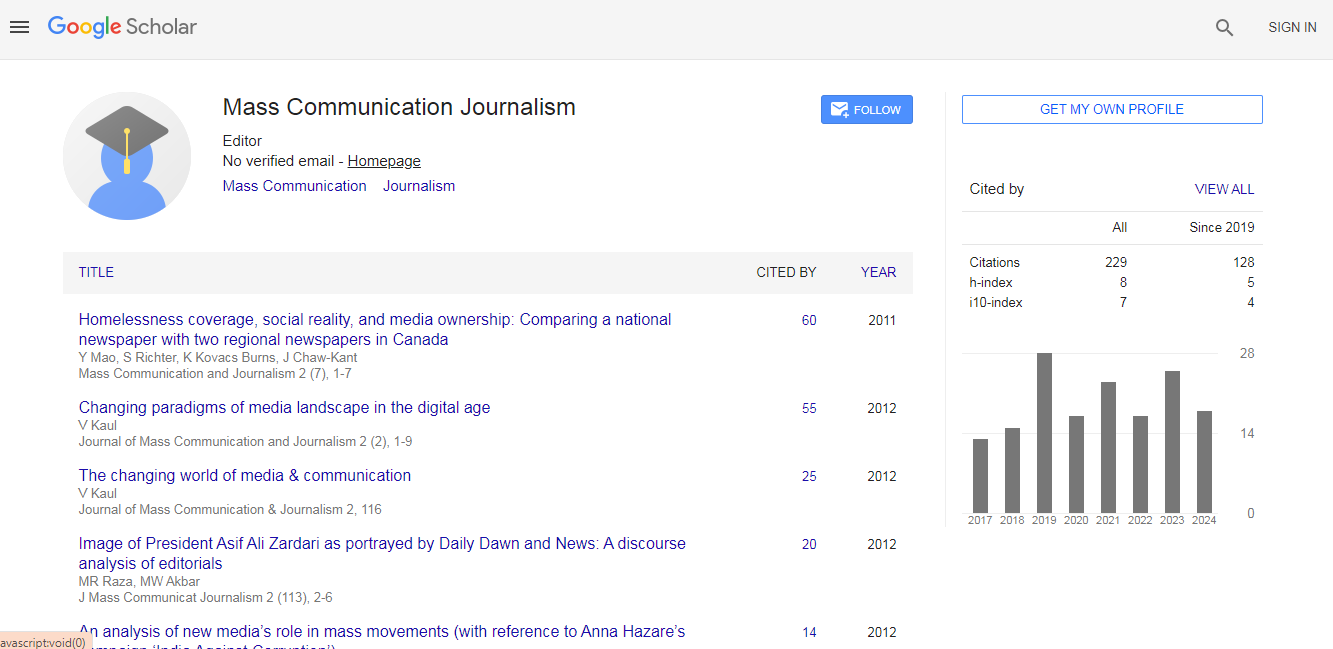
Journal of Mass Communication & Journalism received 205 citations as per Google Scholar report