Perspective - (2025) Volume 16, Issue 2
Received: 03-Mar-2025, Manuscript No. jch-26-178750;
Editor assigned: 05-Mar-2025, Pre QC No. P-178750;
Reviewed: 19-Mar-2025, QC No. Q-178750;
Revised: 24-Mar-2025, Manuscript No. R-178750;
Published:
31-Mar-2025
, DOI: 10.37421/2157-7099.2025.16.788
Citation: Müller, Nadine K.. ”Cytomorphology: A Vital Tool for Infectious Lesion Diagnosis.” J Cytol Histol 16 (2025):788.
Copyright: © 2025 Müller K. Nadine This is an open-access article distributed under the terms of the Creative Commons Attribution License, which permits unrestricted use, distribution and reproduction in any medium, provided the original author and source are credited.
The critical role of cytomorphology in diagnosing inflammatory and infectious lesions is underscored by its ability to identify cellular changes that are fundamental for accurate identification and differentiation of various conditions. Careful microscopic examination of these changes, including specific inflammatory cells, microbial forms, and host cellular responses like reactive atypia, forms the bedrock of initial assessment [1].
The cytological nuances of viral infections are particularly important, with characteristic cellular alterations such as inclusion bodies and cytopathic effects serving as crucial diagnostic markers. Recognizing specific viral patterns on cytology smears can guide further molecular testing and patient management, highlighting the need for adept cytopathologists to differentiate viral etiologies from other inflammatory processes [2].
A comprehensive review of bacterial infections reveals a distinct cytomorphological spectrum, detailing the identification of various bacterial forms and the associated host cellular responses. The presence of neutrophils, macrophages, and reactive epithelial cells, alongside direct visualization of bacteria, aids in establishing a diagnosis, with special stains enhancing bacterial detection and differentiating inflammatory patterns [3].
Fungal infections present unique cytomorphological challenges, necessitating the recognition of fungal elements like yeasts and hyphae, along with characteristic inflammatory infiltrates. Identifying pseudohyphae, spores, and characteristic tissue reactions is vital, and special stains like Gomori methenamine silver and periodic acid-Schiff are crucial for confirmation [4].
Parasitic infections exhibit diverse cytomorphological presentations, requiring the recognition of various parasitic forms, including protozoa and helminths, within cellular samples. Associated inflammatory responses and cellular damage are noted, and meticulous examination combined with familiarity of life cycles and morphological variations ensures accurate diagnosis [5].
Reactive cellular changes in inflammatory conditions can mimic malignancy, posing significant diagnostic challenges. Differentiating benign reactive atypia from true neoplastic changes requires careful attention to features like nuclear enlargement, hyperchromasia, and prominent nucleoli in reactive cells, employing criteria to distinguish them from dysplastic or malignant cells and avoid overdiagnosis [6].
The cytomorphological evaluation of abscesses is crucial for identifying the causative agent and guiding therapy. Examining cellular constituents and microbial findings in fine needle aspirates highlights the importance of recognizing polymorphonuclear leukocytes, macrophages, necrotic debris, and direct visualization of microorganisms in determining abscess etiology and planning treatment [7].
Cytology plays a significant role in diagnosing sexually transmitted infections (STIs), with specific cytomorphological features of common STIs being reviewed. Emphasis is placed on identifying inclusion bodies, inflammatory patterns, and cellular changes associated with these infections, underscoring cytology's utility in rapid screening and diagnosis [8].
The interpretation of inflammatory cytology in effusions necessitates a systematic approach, discussing findings in pleural, peritoneal, and pericardial effusions related to inflammatory and infectious processes. Identifying inflammatory cells, mesothelial cell changes, and any microorganisms or atypical cells is essential to ascertain the effusion's underlying cause [9].
Integration of cytomorphology with ancillary techniques significantly improves the diagnosis of infectious lesions. While morphology offers initial clues, molecular methods and microbial cultures are often essential for definitive identification and susceptibility testing, advocating for a multimodal diagnostic approach where cytology serves as a vital screening tool that guides further investigations [10].
Cytomorphology is instrumental in the diagnosis of inflammatory and infectious lesions by enabling the identification of specific cellular changes. Microscopic examination of cellular alterations, including inflammatory cells, microbial forms, and host responses like reactive atypia, is fundamental for accurate identification and differentiation of various conditions. The correlation of cytological findings with clinical presentations and other diagnostic modalities reinforces cytomorphology's cornerstone role in the initial assessment of these lesions [1].
In the realm of viral infections, cytological nuances are paramount, with characteristic cellular alterations such as inclusion bodies and cytopathic effects being crucial for diagnosis. Specific viral patterns observed on cytology smears can effectively guide further molecular testing and patient management, underscoring the necessity for cytopathologists to be proficient in recognizing these morphological clues to differentiate viral etiologies from other inflammatory processes [2].
The cytomorphological spectrum of bacterial infections involves the identification of diverse bacterial forms and associated host cellular responses. The presence of neutrophils, macrophages, and reactive epithelial cells, in conjunction with the direct visualization of bacteria, contributes significantly to establishing a diagnosis. Furthermore, the utility of special stains in improving bacterial detection and distinguishing between acute and chronic inflammatory patterns is also discussed [3].
Fungal infections present distinct cytomorphological challenges, with the recognition of fungal elements such as yeasts and hyphae, and the characteristic inflammatory infiltrates they induce, being central. The article covers common fungal pathogens and emphasizes the significance of identifying pseudohyphae, spores, and characteristic tissue reactions. Special stains, including Gomori methenamine silver and periodic acid-Schiff, play a vital role in confirming fungal identification [4].
Parasitic infections manifest with varied cytomorphological presentations, and this review details the recognition of various parasitic forms, encompassing protozoa and helminths, within cellular samples. The associated inflammatory responses and cellular damage are highlighted, stressing the importance of meticulous examination and a thorough understanding of the life cycles and morphological variations of different parasites for accurate cytological diagnosis [5].
Reactive cellular changes arising from inflammatory conditions can closely resemble malignancy, thereby posing diagnostic challenges. This article concentrates on differentiating benign reactive atypia from genuine neoplastic changes within inflammatory lesions. It expounds on features such as nuclear enlargement, hyperchromasia, and prominent nucleoli in reactive cells, providing criteria to distinguish them from dysplastic or malignant cells and thus avoid misdiagnosis [6].
The cytomorphological evaluation of abscesses is critical for pinpointing the causative agent and directing appropriate therapy. This study scrutinizes the cellular constituents and microbial findings present in fine needle aspirates from abscesses, emphasizing the importance of recognizing polymorphonuclear leukocytes, macrophages, necrotic debris, and directly visualized bacteria or fungi to ascertain the abscess's etiology and plan effective treatment [7].
Cytology holds considerable importance in the diagnosis of sexually transmitted infections (STIs), and this article offers a review of the cytomorphological features associated with common STIs, including those caused by Chlamydia, Neisseria gonorrhoeae, and Human Papillomavirus. The identification of specific inclusion bodies, characteristic inflammatory patterns, and cellular changes linked to these infections is emphasized, reinforcing the value of cytology in rapid screening and diagnosis [8].
The interpretation of inflammatory cytology in effusions necessitates a structured approach, with this paper delving into the cytological findings observed in pleural, peritoneal, and pericardial effusions associated with diverse inflammatory and infectious processes. It highlights the crucial role of identifying inflammatory cells, mesothelial cell alterations, and any microorganisms or atypical cells in determining the underlying cause of the effusion [9].
This article underscores the synergy between cytomorphology and ancillary techniques for enhancing the diagnosis of infectious lesions. While morphological examination offers vital initial clues, molecular methods and microbial cultures are frequently indispensable for definitive identification and antimicrobial susceptibility testing. The authors advocate for a comprehensive diagnostic strategy where cytology serves as a rapid and essential screening tool, guiding subsequent investigations for a thorough understanding of inflammatory and infectious processes [10].
Cytomorphology is a crucial diagnostic tool for inflammatory and infectious lesions, enabling the identification of cellular changes, microbial forms, and host responses. It plays a key role in diagnosing viral, bacterial, fungal, and parasitic infections by recognizing characteristic morphological patterns and cellular alterations. Differentiating reactive atypia from neoplasia in inflammatory contexts is also a significant application. Cytology aids in the diagnosis of abscesses and sexually transmitted infections by identifying causative agents and associated changes. The interpretation of inflammatory cytology in effusions requires a systematic approach. Integrating cytomorphology with ancillary techniques like molecular methods and cultures enhances diagnostic accuracy and guides treatment decisions, positioning cytology as a vital initial screening tool.
None
None
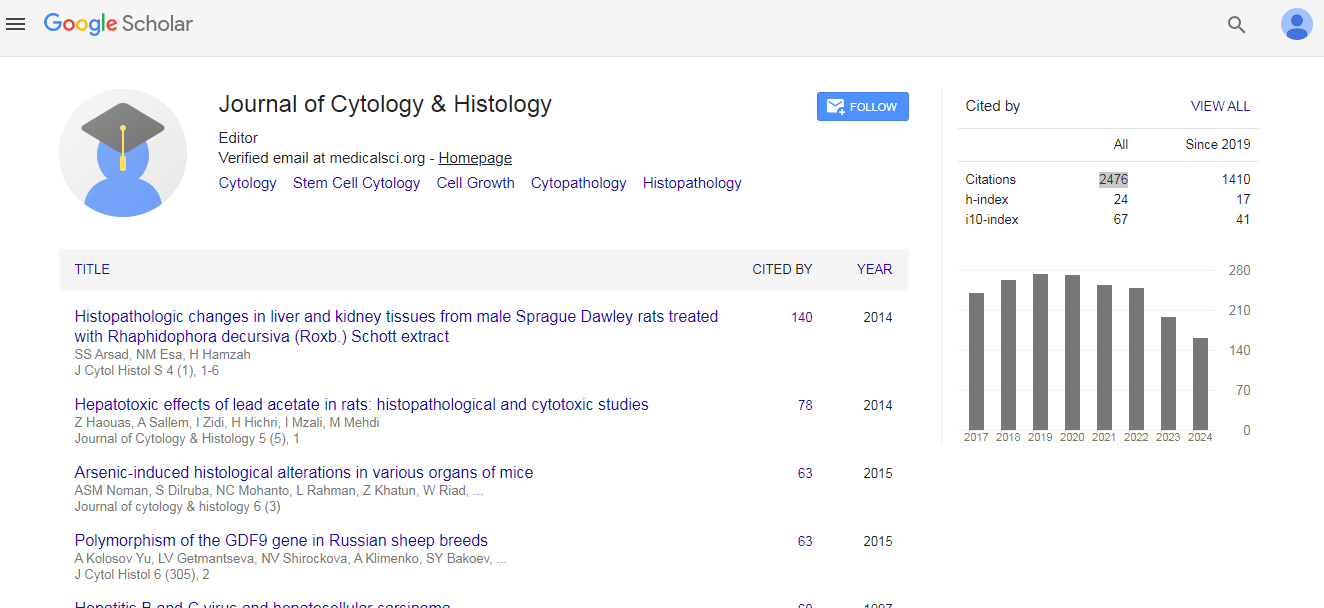
Journal of Cytology & Histology received 2476 citations as per Google Scholar report