Brief Report - (2025) Volume 16, Issue 2
Received: 03-Mar-2025, Manuscript No. jch-26-178747;
Editor assigned: 05-Mar-2025, Pre QC No. P-178747;
Reviewed: 19-Mar-2025, QC No. Q-178747;
Revised: 24-Mar-2025, Manuscript No. R-178747;
Published:
31-Mar-2025
, DOI: 10.37421/2157-7099.2025.16.785
Citation: Khan, Aisha M.. ”Cytology and Histopathology: Synergistic Diagnoses for Cancer.” J Cytol Histol 16 (2025):785.
Copyright: © 2025 Khan M. Aisha This is an open-access article distributed under the terms of the Creative Commons Attribution License, which permits unrestricted use, distribution and reproduction in any medium, provided the original author and source are credited.
The precise correlation between cytological diagnoses and subsequent histopathological confirmations is a cornerstone of accurate oncological practice. Cytology, often serving as the initial diagnostic modality, provides critical insights into cellular morphology and architecture, which are then meticulously validated and refined by histopathology. This interplay is indispensable for establishing definitive diagnoses, guiding therapeutic strategies, and ultimately improving patient outcomes in a wide spectrum of neoplastic lesions. In breast lesions, the nuances of cellular morphology, nuclear characteristics, and architectural patterns observed in cytological preparations are directly mirrored in the definitive histological findings. Understanding these correlations is paramount for accurate diagnosis, appropriate patient management, and effective treatment planning in oncology, bridging the gap between initial assessment and definitive characterization. [1] For lung neoplasms, the examination of the histopathological basis of cytological interpretations is crucial for clarifying diagnostic discrepancies. The correlation of fine-needle aspiration or brushing cytology with biopsy or surgical specimen histology is particularly important for distinguishing benign from malignant conditions and for subtyping lung cancers, which directly impacts therapeutic decisions. [2] The exploration of the histopathological underpinnings of suspicious cytological findings in thyroid nodules reveals how subtle cytological cues are precisely mirrored in follicular architecture and cellular patterns on histology. This correlation is instrumental in distinguishing between benign follicular lesions and malignant conditions like papillary thyroid carcinoma. [3] In the realm of cervical cytology, the histopathological confirmation of squamous intraepithelial lesions (SILs) and atypical squamous cells of undetermined significance (ASC-US) validates the findings from Pap smears and liquid-based cytology. This process reinforces the diagnostic accuracy of cytological screening by correlating observed cellular abnormalities with histological evidence. [4] The investigation into the histopathological spectrum of gastrointestinal stromal tumors (GISTs) that present with cytological findings underscores the complementary roles of both disciplines. While cytology can suggest GISTs based on cell morphology, histopathology remains essential for definitive diagnosis, subtyping, and risk stratification. [5] A correlative analysis of lymphomas highlights how cytological features observed in lymph node aspirates can offer diagnostic clues regarding lymphoma subtypes. However, definitive classification and guiding therapeutic strategies frequently necessitate tissue biopsy for comprehensive architectural assessment and immunophenotyping. [6] The histopathological evaluation of effusions with suspicious cytological findings is a critical step in cancer management. The presence of malignant cells in serous effusions, as detected by cytology, is confirmed and further characterized by histopathological examination of cell blocks, aiding in staging and prognosis. [7] In the context of bone and soft tissue tumors, the histopathological basis of cytological diagnoses is examined. Cellular morphology and arrangement in fine-needle aspiration smears are correlated with histological patterns and immunohistochemical profiles, which is crucial for classification and guiding treatment. [8] Finally, the investigation of salivary gland neoplasms demonstrates that while cytological assessment of aspirates can suggest malignancy or specific tumor types, histopathological examination of surgical resections is indispensable for definitive diagnosis and grading, underscoring the essential link between these diagnostic modalities. [9] Cytological and histopathological correlation is an integral component of diagnosing various neoplastic processes, ensuring accuracy and guiding patient care across diverse organ systems. This synergy between cytological interpretation and histological validation is fundamental to modern diagnostic pathology, enabling precise classification and informing therapeutic decisions. [10]
The robust correlation between cytological observations and histopathological findings serves as a critical diagnostic bridge in the evaluation of neoplastic lesions. Cytology provides an initial assessment based on cellular morphology, nuclear characteristics, and architectural patterns, which are subsequently confirmed and elaborated upon by histopathology. This synergistic relationship is fundamental for accurate diagnosis, effective patient management, and optimal treatment planning in oncology. In the specific context of breast lesions, the study emphasizes how cytological features, such as cellular morphology and nuclear characteristics, are directly correlated with definitive histological findings. This linkage is crucial for achieving accurate diagnoses, enabling appropriate patient management, and formulating effective treatment strategies within the field of oncology. [1] Regarding lung neoplasms, the research clarifies diagnostic discrepancies by examining the histopathological basis of cytological interpretations. It highlights the significance of correlating fine-needle aspiration or brushing cytology with biopsy or surgical specimen histology, particularly for differentiating benign from malignant conditions and for accurately subtyping lung cancers, thereby influencing therapeutic choices. [2] The exploration of thyroid nodules delves into the histopathological underpinnings of suspicious cytological findings. It underscores how subtle cytological cues, like nuclear pleomorphism and intranuclear pseudoinclusions, are precisely mirrored in the follicular architecture and cellular patterns observed on histology, aiding in the crucial distinction between benign follicular lesions and papillary thyroid carcinoma. [3] In the domain of cervical cytology, the study focuses on the histopathological correlates of squamous intraepithelial lesions (SILs). It demonstrates how dysplastic cellular changes detected in Pap smears and liquid-based cytology are validated by the architectural and cytological abnormalities present in cervical biopsies, thereby reinforcing the diagnostic accuracy of cytological screening. [4] The investigation into gastrointestinal stromal tumors (GISTs) reveals that while cytology can raise suspicion based on spindle or epithelioid cell morphology, histopathology is indispensable for definitive diagnosis, subtyping, and risk stratification, often employing immunohistochemistry for comprehensive evaluation. [5] Concerning lymphomas, the review elucidates the correlation between cytological features of lymphomas and their corresponding histopathological diagnoses. It points out that while lymph node aspirates offer diagnostic clues, definitive classification and subsequent therapeutic guidance typically require tissue biopsy for architectural assessment and immunophenotyping. [6] The histopathological evaluation of effusions with suspicious cytological findings is paramount for accurate cancer staging and prognosis. Cytological detection of malignant cells in serous effusions is confirmed and further characterized by histopathological examination of cell blocks, providing essential details for patient management. [7] In the assessment of bone and soft tissue tumors, the study examines the histopathological basis of cytological diagnoses. It highlights the correlation between cellular morphology and arrangement in FNA smears and the histological patterns and immunohistochemical profiles of these tumors, crucial for classification and treatment direction. [8] The investigation into salivary gland neoplasms emphasizes that while cytology can indicate malignancy or suggest specific tumor types, histopathology of surgical resections is vital for definitive diagnosis and grading, underscoring the necessity of this correlative approach. [9] This collective body of work underscores the indispensable role of integrating cytological and histopathological evaluations. This approach ensures diagnostic certainty, facilitates precise classification of neoplasms, and is foundational for formulating evidence-based treatment strategies, ultimately benefiting patient care across various oncological disciplines. [10]
This collection of studies highlights the critical importance of correlating cytological findings with histopathological diagnoses across a range of neoplastic conditions. From breast and lung lesions to thyroid nodules, cervical abnormalities, and gastrointestinal stromal tumors, the research consistently demonstrates that while cytology offers initial diagnostic clues based on cellular morphology, histopathology is essential for definitive diagnosis, subtyping, and accurate grading. This integrated approach is crucial for guiding appropriate patient management, therapeutic decisions, and ultimately improving patient outcomes. The studies emphasize how specific cytological features are validated by histological examination, reinforcing diagnostic accuracy and refining our understanding of various cancers. The synergy between these two diagnostic modalities is presented as fundamental in modern pathology practice.
None
None
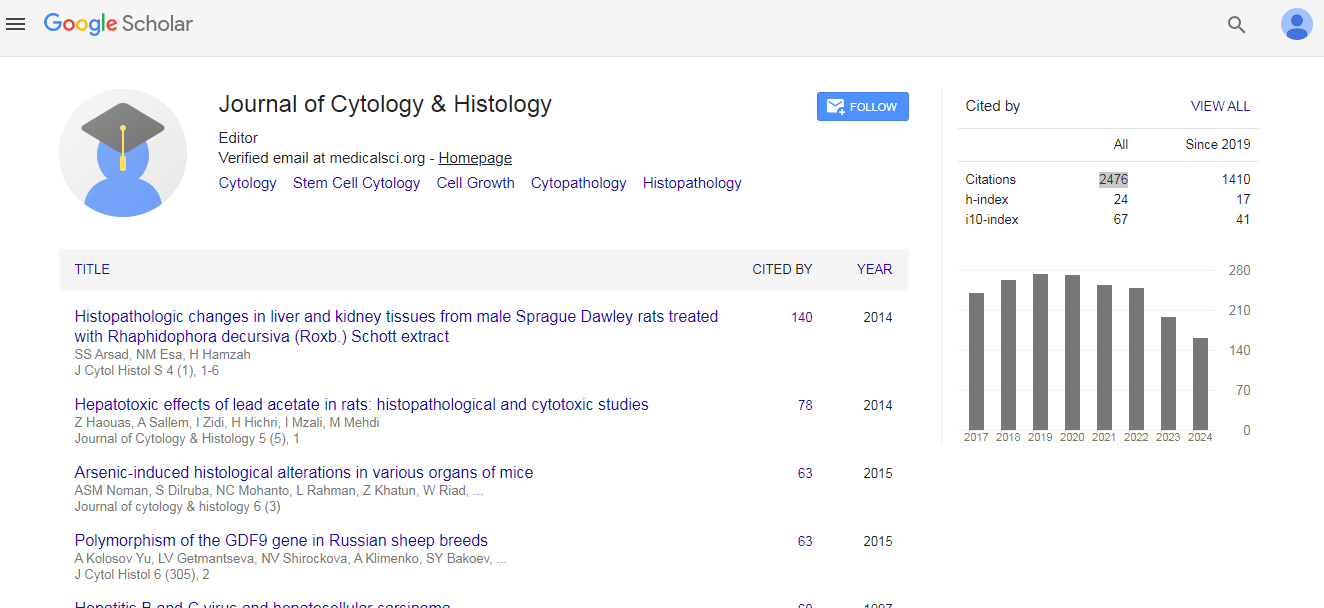
Journal of Cytology & Histology received 2476 citations as per Google Scholar report