Brief Report - (2025) Volume 13, Issue 4
Received: 01-Aug-2025, Manuscript No. jaat-26-183166;
Editor assigned: 04-Aug-2025, Pre QC No. P-183166;
Reviewed: 18-Aug-2025, QC No. Q-183166;
Revised: 22-Aug-2025, Manuscript No. R-183166;
Published:
29-Aug-2025
, DOI: 10.37421/2329-6542.2025.13.365
Citation: Nakamura, Takeshi. ”CubeSats Revolutionize Astrophysics and Space Exploration.” J Astrophys Aerospace Technol 13 (2025):365.
Copyright: © 2025 Nakamura T. This is an open-access article distributed under the terms of the Creative Commons Attribution License, which permits unrestricted use, distribution and reproduction in any medium, provided the original author and source are credited.
CubeSats are emerging as crucial platforms for advancing astrophysical and aerospace research due to their cost-effectiveness and suitability for specialized missions. These small satellites are enabling diverse scientific inquiries, ranging from the detection of exoplanets to fundamental physics investigations, driven by improvements in miniaturized instruments and reliable deployment mechanisms. Their growing capabilities are significantly enhancing our understanding of the universe and the exploration of space [1].
The development of advanced sensor technologies tailored for CubeSat payloads is fundamental to achieving high-precision astrophysical observations. This includes the miniaturization of charge-coupled device (CCD) detectors and associated electronics, demonstrating their potential for wide-field imaging and spectroscopic analysis of celestial objects. Addressing integration challenges and implementing successful calibration strategies are key to enabling more ambitious remote sensing missions with these platforms [2].
Ensuring stable astrophysical pointing relies heavily on sophisticated attitude determination and control systems (ADCS) for CubeSats. Research in this area reviews various sensor and actuator combinations, such as reaction wheels and magnetorquers, evaluating their performance in maintaining precise orientations for extended observational periods. Novel control algorithms are being developed to enhance pointing accuracy and minimize jitter, which is critical for high-resolution imaging applications [3].
The application of CubeSats in solar physics, specifically for observing the Sun's corona and solar flares, is being actively investigated. This involves designing compact coronagraphs and X-ray spectrometers suitable for deployment on 3U CubeSats. Critical design considerations include radiation hardening and thermal management to ensure instrument survival in the harsh space environment near the Sun, with preliminary data demonstrating instrument capabilities [4].
CubeSats are also being utilized to characterize Earth's ionosphere and magnetosphere, with studies focusing on miniaturized plasma probes and magnetometers for 6U CubeSat platforms. Challenges such as power limitations and data transmission rates for in-situ measurements are being addressed, alongside the potential of constellation deployments for improved spatial and temporal resolution [5].
The feasibility of using CubeSats for exoplanet detection through transit photometry is being explored, requiring the design of compact telescopes and photometers capable of achieving the necessary photometric precision. Orbital stability, thermal control, and noise reduction are paramount considerations for these missions, with proposed concepts aiming to significantly enhance the search for potentially habitable exoplanets [6].
Miniaturization of high-energy particle detectors for CubeSat applications in cosmic ray research is a significant area of development. This involves optimizing silicon strip detectors and scintillators for CubeSat platforms, addressing challenges related to power consumption and radiation damage. The potential for these CubeSats to provide global coverage of cosmic ray flux and energy spectra is a key advantage [7].
Testing fundamental physics theories in space is another avenue where CubeSats are proving valuable. Mission concepts are being developed to utilize these platforms for precise measurements related to gravitational physics and tests of general relativity. Miniaturizing sensitive instruments and establishing stable orbits are key challenges, highlighting the cost-effectiveness of CubeSats for space-based fundamental physics experiments [8].
Propulsion systems for CubeSat missions in astrophysical research present unique challenges and opportunities. Research discusses various technologies, including electric propulsion and cold gas thrusters, tailored to the size and power constraints of CubeSats. Precise maneuvering for target acquisition and station-keeping is emphasized for observational platforms requiring stable pointing [9].
Developing radiation-hardened electronics is essential for the success of CubeSat missions operating in energetic space environments for astrophysical research. Studies focus on the radiation tolerance of commercial off-the-shelf microcontrollers and propose mitigation strategies and testing protocols to ensure mission reliability against ionizing radiation, a critical factor for long-duration space missions [10].
CubeSats are increasingly vital for astrophysical and aerospace research, offering cost-effective platforms for specialized missions. This compilation highlights key advancements and future directions in leveraging CubeSats for diverse scientific inquiries, from exoplanet detection to fundamental physics. The growing sophistication of miniaturized instruments and reliable deployment mechanisms enables these small satellites to contribute significantly to our understanding of the universe and space exploration [1].
The development of advanced sensor technologies suitable for CubeSat payloads is critical for enabling high-precision astrophysical observations. This work details the miniaturization of CCD detectors and accompanying electronics, showcasing their potential for wide-field imaging and spectroscopic analysis of celestial objects. The integration challenges and successful calibration strategies are discussed, paving the way for more ambitious remote sensing missions [2].
This paper explores the challenges and solutions for CubeSat attitude determination and control systems (ADCS) essential for stable astrophysical pointing. It reviews various sensor and actuator combinations, including reaction wheels and magnetorquers, and their performance in maintaining precise orientations for long-duration observations. The authors present a novel control algorithm that enhances pointing accuracy and reduces jitter, crucial for high-resolution imaging [3].
The application of CubeSats in observing the Sun's corona and solar flares is investigated. This research focuses on the development of compact coronagraphs and X-ray spectrometers suitable for deployment on a 3U CubeSat. The paper details the design considerations for radiation hardening and thermal management, essential for survival in the harsh space environment near the Sun. Preliminary observational data demonstrating the capability of these instruments are presented [4].
This study examines the use of CubeSats for characterizing the Earth's ionosphere and magnetosphere. The authors present the design of a miniaturized plasma probe and a magnetometer suitable for a 6U CubeSat. The challenges of in-situ measurements with small platforms, including power limitations and data transmission rates, are addressed. The potential for constellation deployments to provide enhanced spatial and temporal resolution is also discussed [5].
The feasibility of using CubeSats for detecting and characterizing exoplanets via transit photometry is explored. This research details the design of a compact telescope and photometer capable of achieving the photometric precision required for exoplanet detection. Considerations for orbital stability, thermal control, and noise reduction are paramount. The paper outlines a mission concept that could significantly enhance the search for potentially habitable exoplanets [6].
This paper focuses on the miniaturization of high-energy particle detectors for CubeSat applications in cosmic ray research. The authors discuss the development of silicon strip detectors and scintillators optimized for CubeSat platforms, addressing challenges related to power consumption and radiation damage. The potential for these CubeSats to provide global coverage of cosmic ray flux and energy spectra is highlighted [7].
The deployment of CubeSats for testing fundamental physics theories in space is examined. This research presents a mission concept utilizing CubeSats to perform precise measurements related to gravitational physics and tests of general relativity. Key challenges include the miniaturization of sensitive scientific instruments and the establishment of stable orbits. The potential for CubeSats to offer a cost-effective avenue for space-based fundamental physics experiments is discussed [8].
This paper reviews the challenges and opportunities in the miniaturization of CubeSat propulsion systems for astrophysical missions. It discusses various technologies, including electric propulsion and cold gas thrusters, suitable for the size and power constraints of CubeSats. The authors emphasize the importance of precise maneuvering for target acquisition and station-keeping, particularly for observational platforms requiring stable pointing [9].
The development of radiation-hardened electronics is crucial for the success of CubeSat missions operating in energetic space environments for astrophysical research. This work presents a study on the radiation tolerance of COTS (Commercial Off-The-Shelf) microcontrollers and their suitability for space applications. The authors propose mitigation strategies and testing protocols to ensure mission reliability in the face of ionizing radiation, a significant challenge for long-duration space missions [10].
CubeSats are revolutionizing astrophysical and aerospace research by providing cost-effective platforms for specialized scientific missions. Recent advancements have focused on miniaturizing instruments for high-precision astronomical imaging, developing sophisticated attitude control systems for stable pointing, and designing specialized payloads for solar physics and Earth observation. The application of CubeSats extends to exoplanet detection, cosmic ray studies, and fundamental physics experiments, necessitating innovations in propulsion and radiation-hardened electronics. These small satellites offer significant potential for enhanced understanding of the universe and space exploration.
None
None
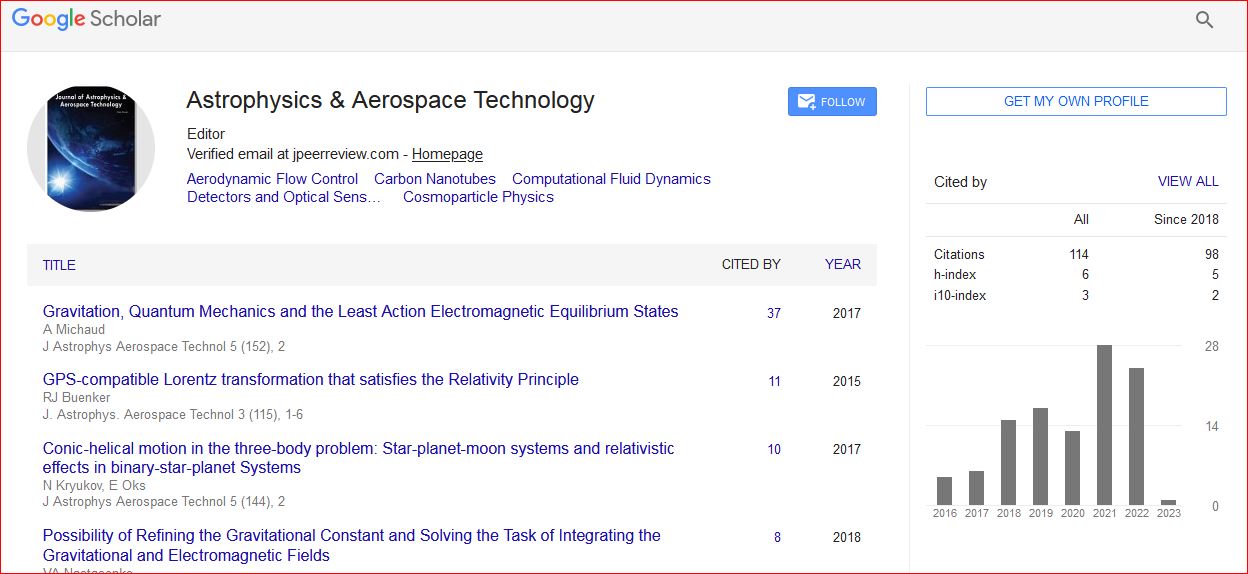
Astrophysics & Aerospace Technology received 114 citations as per Google Scholar report