Opinion - (2025) Volume 14, Issue 3
Received: 01-Jun-2025, Manuscript No. jbfa-25-174145;
Editor assigned: 03-Jun-2025, Pre QC No. P-174145;
Reviewed: 17-Jun-2025, QC No. Q-174145;
Revised: 23-Jun-2025, Manuscript No. R-174145;
Published:
30-Jun-2025
, DOI: 10.37421/2167-0234.2025.14.533
Citation: Castillo, Javier. ”CSR: Comprehensive Strategy for Sustainable Success.” J Bus Fin Aff 14 (2025):533.
Copyright: © 2025 Castillo J. This is an open-access article distributed under the terms of the Creative Commons Attribution License, which permits unrestricted use, distribution and reproduction in any medium, provided the original author and source are credited.
Corporate social responsibility (CSR) initiatives significantly influence a company's financial performance, with empirical evidence from regions like Saudi Arabia indicating a positive correlation between CSR investments and financial outcomes. What this really means is that integrating social responsibility into core business practices can be good for the bottom line, even in contexts where the CSR concept is still developing [1].
Beyond financial returns, CSR implementation deeply involves how companies engage with their stakeholders. A systematic review highlights the critical role of stakeholder involvement in achieving sustainable business practices. Here's the thing: meaningful engagement isn't just about listening; it's about embedding stakeholder perspectives into the very fabric of a company's social and environmental commitments [2].
From a social contract perspective, the connection between corporate social responsibility and corporate financial performance is also shaped by financial flexibility. Research suggests that companies with ample financial slack are better equipped to navigate CSR initiatives, which in turn positively affects their financial health. Let's break it down: robust financial resources allow firms to commit more genuinely to CSR, fostering a stronger social contract and potentially boosting profits [3].
CSR's influence extends to consumer behavior, where it plays a crucial role by mediating factors like corporate reputation and brand loyalty. When consumers perceive a company as socially responsible, it enhances the company's reputation, which then solidifies brand loyalty, ultimately influencing purchase decisions. Simply put, good deeds build a strong brand image that keeps customers coming back [4].
The internal dynamics of an organization are also impacted. Ethical leadership, for instance, fosters a strong CSR environment. Corporate governance mechanisms then act as intermediaries, translating these ethical intentions into tangible social responsibility actions. The takeaway is that ethical leadership isn't just a moral imperative; it's a practical driver for effective CSR when supported by proper oversight [5].
Furthermore, the environmental performance of a company is significantly shaped by its corporate social responsibility. A systematic review and meta-analysis underscore that intentional CSR can drive meaningful ecological improvements. What this tells us is that while the link between CSR and environmental impact can be complex, there's clear evidence it leads to better environmental outcomes [6].
CSR initiatives can also stimulate technological innovation. Evidence from Chinese listed companies suggests that CSR acts as a catalyst, pushing firms to develop new, more sustainable technologies and processes. The point is, CSR isn't just about compliance or philanthropy; it can be a strategic lever for fostering a culture of innovation within an organization, especially in dynamic economies [7].
Employee motivation is another key area influenced by corporate social responsibility. A cross-cultural analysis reveals that CSR genuinely motivates employees, impacting their attitudes and behaviors. When companies prioritize societal good, their employees often feel a stronger sense of purpose and commitment, regardless of their cultural background, making CSR a powerful tool for talent attraction and retention [8].
Moreover, CSR significantly influences brand value through the mediating effects of brand reputation and brand trust. Initiatives in social responsibility build a positive corporate reputation, which fosters trust among consumers, ultimately enhancing the brand's overall market worth. What this really means is that investing in social responsibility is a long-term strategy to strengthen a brand's standing [9].
Lastly, corporate social responsibility contributes to organizational resilience, mediated by supply chain agility. Companies committed to CSR often develop more agile supply chains, significantly boosting their ability to withstand and recover from disruptions. In essence, CSR helps build a more flexible and robust operational framework, making organizations better equipped for crisis management [10].
Corporate social responsibility (CSR) has emerged as a crucial strategic imperative, significantly impacting a company's financial performance across various economic landscapes. Studies show a positive correlation between CSR initiatives and financial outcomes, particularly in emerging markets where the concept is still evolving, suggesting that ethical practices can indeed contribute to the bottom line [1]. This financial connection is further deepened when considering the moderating role of financial slack. Companies possessing greater financial flexibility are better positioned to genuinely commit to CSR efforts, which, in turn, can positively influence their overall financial health and foster a stronger social contract with their operating environment [3]. This perspective emphasizes that adequate resources are not just a benefit but an enabler for deeper CSR integration and its subsequent financial rewards.
A critical aspect of effective CSR lies in stakeholder engagement and internal governance. Meaningful engagement with stakeholders is vital for successful CSR implementation, involving more than just listening; it requires integrating diverse perspectives into a company's social and environmental commitments to achieve sustainable business practices [2]. Complementing this, ethical leadership is identified as a practical driver for a strong CSR environment. When leaders prioritize ethical conduct, it sets a precedent for the entire organization. This ethical intent is then translated into tangible social responsibility actions through robust corporate governance mechanisms, underscoring the importance of proper oversight in realizing CSR goals [5].
CSR also profoundly shapes external perceptions and market interactions, particularly concerning consumer behavior and brand equity. Research reveals that CSR initiatives significantly influence consumer behavior by mediating corporate reputation and brand loyalty. Consumers who perceive a company as socially responsible often enhance its reputation, leading to solidified brand loyalty and ultimately impacting purchase decisions [4]. This positive cycle extends to overall brand value. Investing in social responsibility builds a strong corporate reputation and fosters trust among consumers, directly contributing to the brand's market worth and standing. Here's the thing: consistent good deeds are a long-term strategy for brand strengthening [9].
Beyond its immediate financial and reputational benefits, corporate social responsibility plays a pivotal role in fostering environmental performance and technological advancement. A systematic review and meta-analysis confirm that CSR activities lead to improved environmental outcomes, highlighting that intentional CSR can drive meaningful ecological improvements despite the inherent complexities [6]. Moreover, CSR acts as a catalyst for technological innovation. Empirical evidence, such as from Chinese listed companies, suggests that these initiatives push firms to develop new, more sustainable technologies and processes. The point is, CSR moves beyond mere compliance, becoming a strategic lever for cultivating an innovation culture within organizations, especially in dynamic economies [7].
Finally, the internal and operational resilience of an organization are deeply intertwined with its CSR commitments. CSR genuinely motivates employees across different cultural contexts, influencing their attitudes and behaviors. When companies prioritize societal good, their workforce often experiences a stronger sense of purpose and commitment, making CSR a potent tool for attracting and retaining talent [8]. Furthermore, CSR contributes significantly to organizational resilience through the mediating role of supply chain agility. Companies committed to social responsibility frequently develop more agile supply chains, which bolsters their capacity to withstand and recover from various disruptions. In essence, CSR helps build a more flexible and robust operational framework, making organizations better equipped for crisis management and long-term sustainability [10].
Corporate Social Responsibility (CSR) significantly influences various facets of business operations and outcomes. It positively correlates with a company's financial performance, suggesting that strategic integration of social responsibility can enhance the bottom line, even in emerging markets [1, 3]. This involves meaningful stakeholder engagement, which is crucial for effective CSR implementation and achieving sustainable practices by integrating diverse perspectives [2]. CSR also strongly impacts external market dynamics. It shapes consumer behavior by enhancing corporate reputation and fostering brand loyalty, ultimately influencing purchase decisions [4]. Investing in social responsibility builds brand trust and reputation, directly contributing to increased brand value [9]. Internally, ethical leadership and robust corporate governance mechanisms are vital, as they translate ethical intentions into tangible CSR actions, driving effective social responsibility within the organization [5]. Beyond financial and brand benefits, CSR acts as a catalyst for environmental improvements and technological innovation. Intentional CSR activities lead to better environmental performance [6] and stimulate the development of new, more sustainable technologies and processes [7]. Furthermore, CSR motivates employees across cultures, fostering a stronger sense of purpose and commitment, which aids in talent attraction and retention [8]. Finally, CSR bolsters organizational resilience by promoting agile supply chains, equipping companies to navigate and recover from disruptions effectively [10]. These diverse impacts underscore CSR as a comprehensive strategic framework for sustainable business success.
None
None
Indexed at, Google Scholar, Crossref
Indexed at, Google Scholar, Crossref
Indexed at, Google Scholar, Crossref
Indexed at, Google Scholar, Crossref
Indexed at, Google Scholar, Crossref
Indexed at, Google Scholar, Crossref
Indexed at, Google Scholar, Crossref
Indexed at, Google Scholar, Crossref
Indexed at, Google Scholar, Crossref
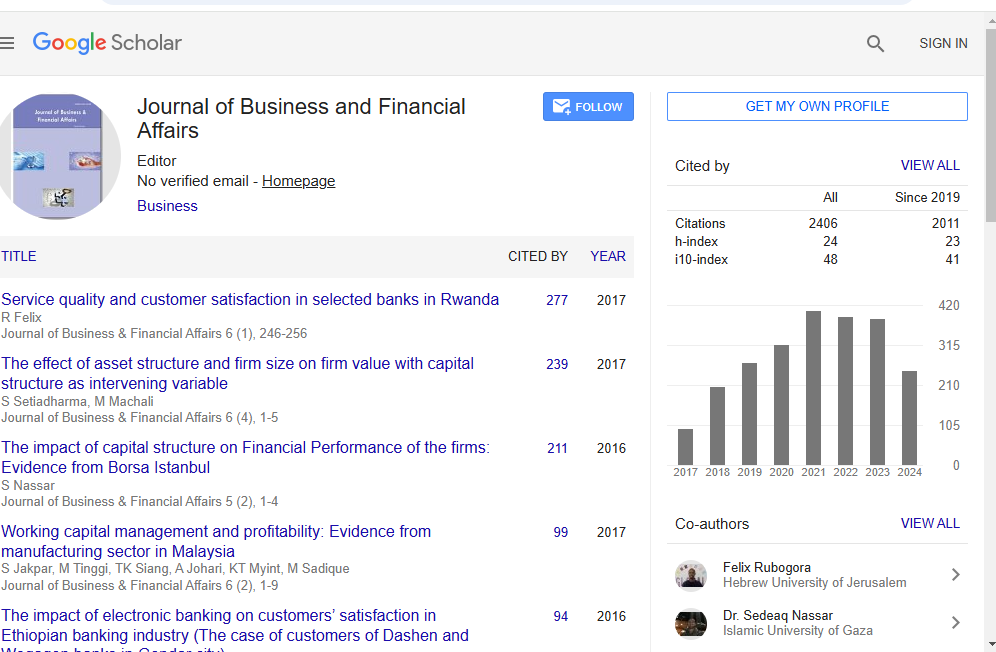
Journal of Business & Financial Affairs received 1726 citations as per Google Scholar report