Short Communication - (2025) Volume 17, Issue 6
Received: 03-Nov-2025, Manuscript No. jcst-25-176315;
Editor assigned: 05-Nov-2025, Pre QC No. P-176315;
Reviewed: 19-Nov-2025, QC No. Q-176315;
Revised: 24-Nov-2025, Manuscript No. R-176315;
Published:
01-Dec-2025
, DOI: 10.37421/1948-5956.2025.17.739
Citation: Benjamin Cohen. ”CRC Management: Evolving
Screening, Treatment, Diagnostics.” J Cancer Sci Ther 17 (2025):739.
Copyright: © 2025 C. Benjamin This is an open-access article distributed under the terms of the Creative Commons Attribution License, which permits unrestricted use,
distribution and reproduction in any medium, provided the original author and source are credited.
The American Cancer Society (ACS) recently updated its guidelines for colorectal cancer screening, now recommending initiation at age 45 for individuals at average risk. These guidelines emphasize the importance of various screening modalities, including stool-based tests and direct visualization tests like colonoscopy, offering options to improve adherence and early detection. What this really means is a push for earlier intervention, recognizing the rising incidence of colorectal cancer in younger populations[1].
Immunotherapy has transformed the treatment landscape for colorectal cancer, particularly for patients with microsatellite instability-high (MSI-H) or mismatch repair-deficient (dMMR) tumors. This article reviews current immunotherapy strategies, like checkpoint inhibitors, and explores future perspectives, including combination therapies and novel targets. The key insight is that patient selection remains crucial, but the expanding repertoire of immunotherapeutic agents offers new hope for improved outcomes[2].
Precision medicine in colorectal cancer leverages molecular profiling to tailor treatments to individual patients. This review discusses the significance of identifying specific genetic alterations, such as RAS and BRAF mutations, which inform the use of targeted therapies. The challenge here is integrating complex genomic data into routine clinical practice, ensuring that patients receive the most effective and least toxic treatments based on their unique tumor biology[3].
The rising incidence of early-onset colorectal cancer, defined as diagnosis before age 50, presents unique challenges for clinicians and patients. This article explores potential contributing factors, including genetic predispositions and lifestyle, while highlighting distinct clinical and molecular characteristics of these tumors. Understanding these differences is crucial for developing targeted screening and treatment strategies for younger individuals, moving beyond traditional age-based guidelines[4].
Artificial Intelligence (AI) and machine learning are rapidly being integrated into various aspects of colorectal cancer management, from enhancing diagnostic accuracy to predicting patient prognosis. This review delves into AI's applications in areas like automated polyp detection during endoscopy, analysis of pathological images, and personalized treatment prediction. The promise here is to improve efficiency and precision, ultimately leading to better patient outcomes by leveraging advanced computational tools[5].
The gut microbiome plays a significant, complex role in the initiation and progression of colorectal cancer. This systematic review synthesizes current evidence on how specific bacterial species and microbial dysbiosis contribute to CRC development. Understanding these microbial interactions offers potential avenues for novel diagnostic biomarkers, risk assessment tools, and even therapeutic interventions aimed at modulating the gut environment. It's clear that the interplay between our diet, our microbes, and cancer risk is something we're only beginning to fully appreciate[6].
Liquid biopsy techniques are emerging as non-invasive tools for managing colorectal cancer, offering advantages over traditional tissue biopsies. This review highlights the utility of circulating tumor DNA (ctDNA) for early detection, monitoring treatment response, detecting minimal residual disease, and predicting recurrence. The potential for liquid biopsy is to provide real-time insights into tumor evolution and guide personalized treatment strategies, making cancer management more dynamic and less invasive for patients[7].
Adjuvant therapy following surgery for stage II and III colon cancer aims to eradicate residual disease and prevent recurrence. This article reviews current standard-of-care chemotherapy regimens and explores emerging therapeutic strategies, including immunotherapy and targeted agents, along with risk stratification tools. The focus is on refining treatment selection to optimize efficacy while minimizing toxicity, ensuring that patients receive tailored post-operative care that matches their individual risk profiles[8].
Health disparities in colorectal cancer screening remain a significant concern, affecting various populations based on socioeconomic status, race, ethnicity, and geographic location. This systematic review identifies and analyzes the factors contributing to these disparities, such as lack of access to care, lower health literacy, and cultural barriers. Understanding these multifaceted issues is critical for designing effective public health interventions that promote equitable screening rates and ultimately reduce preventable deaths[9].
Advances in surgical techniques have profoundly impacted the treatment of colorectal cancer, offering less invasive options and improved patient recovery. This review highlights developments in minimally invasive surgery, including laparoscopic and robotic approaches, as well as organ-preserving strategies and enhanced recovery after surgery (ERAS) protocols. The goal is to maximize tumor removal while minimizing surgical trauma, allowing patients to recover faster and experience better quality of life post-operation[10].
The American Cancer Society recently updated its guidelines for colorectal cancer (CRC) screening, now recommending initiation at age 45 for individuals at average risk [1]. These guidelines highlight the importance of various screening modalities, including stool-based tests and direct visualization methods like colonoscopy, aiming to improve adherence and early detection [1]. What this really means is a push for earlier intervention, recognizing the rising incidence of CRC in younger populations [1]. The rising incidence of early-onset colorectal cancer, defined as diagnosis before age 50, presents unique challenges [4]. Understanding potential contributing factors, like genetic predispositions and lifestyle, along with distinct clinical and molecular characteristics of these tumors, is crucial for developing targeted screening and treatment strategies for younger individuals [4]. Despite these advancements, health disparities in CRC screening remain a significant concern, affecting various populations based on socioeconomic status, race, ethnicity, and geographic location [9]. Identifying factors such as lack of access to care, lower health literacy, and cultural barriers is critical for designing effective public health interventions that promote equitable screening rates and reduce preventable deaths [9].
Immunotherapy has transformed the treatment landscape for CRC, particularly for patients with microsatellite instability-high (MSI-H) or mismatch repair-deficient (dMMR) tumors [2]. Current strategies often involve checkpoint inhibitors, with future perspectives exploring combination therapies and novel targets. The key insight is that patient selection remains crucial, but the expanding repertoire of immunotherapeutic agents offers new hope for improved outcomes [2]. Precision medicine in CRC leverages molecular profiling to tailor treatments to individual patients [3]. Identifying specific genetic alterations, such as RAS and BRAF mutations, informs the use of targeted therapies [3]. The challenge lies in integrating complex genomic data into routine clinical practice, ensuring patients receive the most effective and least toxic treatments based on their unique tumor biology [3]. Adjuvant therapy following surgery for stage II and III colon cancer aims to eradicate residual disease and prevent recurrence [8]. This includes current standard-of-care chemotherapy regimens and emerging therapeutic strategies like immunotherapy and targeted agents, along with risk stratification tools. The focus is on refining treatment selection to optimize efficacy while minimizing toxicity, ensuring tailored post-operative care [8].
Advances in surgical techniques have profoundly impacted CRC treatment, offering less invasive options and improved patient recovery [10]. Developments in minimally invasive surgery, including laparoscopic and robotic approaches, along with organ-preserving strategies and Enhanced Recovery After Surgery (ERAS) protocols, are key [10]. The goal is to maximize tumor removal while minimizing surgical trauma, allowing patients to recover faster and experience better quality of life post-operation [10].
Artificial Intelligence (AI) and machine learning are rapidly integrating into CRC management, enhancing diagnostic accuracy and predicting patient prognosis [5]. AI's applications range from automated polyp detection during endoscopy to analysis of pathological images and personalized treatment prediction. The promise here is to improve efficiency and precision, leading to better patient outcomes by leveraging advanced computational tools [5]. Liquid biopsy techniques are also emerging as non-invasive tools for managing CRC, offering advantages over traditional tissue biopsies [7]. The utility of circulating tumor DNA (ctDNA) for early detection, monitoring treatment response, detecting minimal residual disease, and predicting recurrence is significant [7]. Liquid biopsy has the potential to provide real-time insights into tumor evolution and guide personalized treatment strategies, making cancer management more dynamic and less invasive for patients [7].
The gut microbiome plays a significant, complex role in the initiation and progression of colorectal cancer [6]. Current systematic reviews synthesize evidence on how specific bacterial species and microbial dysbiosis contribute to CRC development. Understanding these microbial interactions offers potential avenues for novel diagnostic biomarkers, risk assessment tools, and even therapeutic interventions aimed at modulating the gut environment [6]. It's clear that the interplay between our diet, our microbes, and cancer risk is something we're only beginning to fully appreciate [6].
The landscape of colorectal cancer (CRC) management is undergoing significant evolution, starting with updated American Cancer Society guidelines that now recommend screening at age 45 for average-risk individuals. This reflects a recognition of rising CRC incidence in younger populations and a push for earlier intervention through diverse screening modalities. Treatment strategies are also advancing, with immunotherapy transforming care for specific tumor types, and precision medicine leveraging molecular profiling to tailor therapies. Surgical techniques have become less invasive, employing laparoscopic and robotic methods alongside enhanced recovery protocols. Adjuvant therapy is increasingly refined, incorporating emerging agents to prevent recurrence effectively. On the diagnostic front, liquid biopsy offers non-invasive insights into tumor evolution and treatment response. Artificial Intelligence and machine learning are rapidly integrating to improve diagnostic accuracy and personalize treatment predictions. Additionally, understanding the gut microbiome's role in CRC development is opening new avenues for biomarkers and therapeutic interventions. Despite these advancements, significant health disparities in screening persist due to socioeconomic factors and access barriers, underscoring the ongoing need for equitable public health efforts.
Indexed at, Google Scholar, Crossref
Indexed at, Google Scholar, Crossref
Indexed at, Google Scholar, Crossref
Indexed at, Google Scholar, Crossref
Indexed at, Google Scholar, Crossref
Indexed at, Google Scholar, Crossref
Indexed at, Google Scholar, Crossref
Indexed at, Google Scholar, Crossref
Indexed at, Google Scholar, Crossref
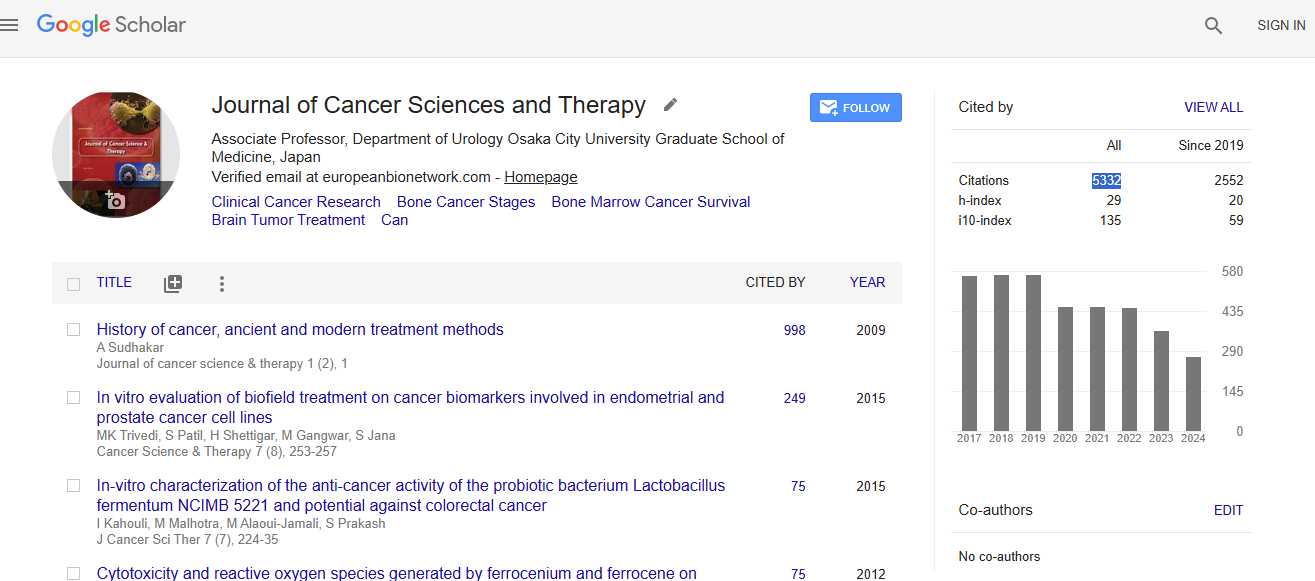
Cancer Science & Therapy received 5332 citations as per Google Scholar report