Short Communication - (2025) Volume 13, Issue 4
Received: 01-Aug-2025, Manuscript No. jaat-26-183172;
Editor assigned: 04-Aug-2025, Pre QC No. P-183172;
Reviewed: 18-Aug-2025, QC No. Q-183172;
Revised: 22-Aug-2025, Manuscript No. R-183172;
Published:
29-Aug-2025
, DOI: 10.37421/2329-6542.2025.13.370
Citation: Bianchi, Giovanni. ”Cosmic Microwave Background: Probing The Early Universe.” J Astrophys Aerospace Technol 13 (2025):370.
Copyright: © 2025 Bianchi G. This is an open-access article distributed under the terms of the Creative Commons Attribution License, which permits unrestricted use, distribution and reproduction in any medium, provided the original author and source are credited.
Cosmic Microwave Background (CMB) studies represent a cornerstone of precision cosmology, offering profound insights into the universe's nascent stages, its evolutionary trajectory, and fundamental cosmological parameters. The analysis of subtle temperature and polarization fluctuations, known as anisotropies, within the CMB has been instrumental in rigorously testing the prevailing Lambda-CDM model. These observations enable stringent constraints on key cosmological quantities, including the density of baryonic matter, the abundance of dark matter, and the Hubble constant, providing a precise picture of the universe's composition. These measurements are not merely descriptive but are crucial for validating theories of cosmic inflation, understanding the mechanisms behind the generation of large-scale structure, and elucidating the enigmatic nature of dark energy, the driving force behind the universe's accelerated expansion [1].
The precise measurement of the temperature and polarization anisotropies in the CMB has revealed subtle imprints suggestive of inflationary cosmology. The statistical characteristics of these primordial fluctuations, such as their near scale-invariance and Gaussianity, align remarkably well with the predictions derived from simplified inflationary models. Such consistency bolsters the theoretical framework of inflation as the leading explanation for the universe's initial conditions. Future CMB experiments are designed with the ambitious goal of detecting primordial gravitational waves, which are considered a key signature predicted by inflation. The definitive detection of these waves would provide direct observational evidence supporting the existence of this extremely early epoch of cosmic expansion [2].
Furthermore, the expansion history of the universe is intrinsically linked to CMB data. The CMB serves as a precise and independent anchor point tracing back to the universe's early moments. By synergistically combining CMB observations with data from other complementary cosmological probes, scientists can achieve significantly refined constraints on the properties of dark energy. This includes a more accurate determination of its equation of state, a parameter critical for understanding the physics governing the accelerated expansion of the cosmos [3].
The CMB anisotropies are also invaluable archives of information pertaining to the reionization epoch. This era marks the period when the first stars and galaxies emerged, emitting ultraviolet radiation that subsequently ionized the neutral hydrogen pervading the universe. Detailed measurements of the polarization patterns imprinted on the CMB, especially the detection of B-modes, hold the potential to illuminate the precise timing and duration of this transformative reionization process [4].
Precise measurements of the CMB's angular power spectrum have yielded exceptionally tight constraints on the masses of neutrinos. The existence of massive neutrinos has a discernible effect on the growth and evolution of cosmic structures, and this influence is subtly imprinted on the CMB. Consequently, these CMB observations enable cosmologists to establish robust upper limits on the total mass of neutrinos, a fundamental parameter in particle physics and cosmology [5].
The study of CMB spectral distortions offers a unique observational window into physical processes that transpired in the early universe after the epoch of recombination. These distortions can arise from various interactions, including those between photons and baryonic matter. Analyzing these distortions can unveil critical information about the nature of dark matter annihilation or decay, as well as shed light on the primordial power spectrum, providing complementary insights beyond standard anisotropy measurements [6].
The phenomenon of gravitational lensing, where massive structures in the universe bend the paths of CMB photons, distorts the observed CMB patterns. Quantifying this lensing effect provides an independent avenue for determining key cosmological parameters. Notably, it allows for a complementary determination of the sum of neutrino masses and offers insights into the growth of cosmic structure, serving as a valuable cross-check against other observational methods [7].
The meticulous search for deviations from Gaussianity, known as non-Gaussianities, in the CMB is a pivotal endeavor for testing the validity of inflationary models and searching for exotic physics that might have operated in the early universe. The detection of significant non-Gaussianities could signal the presence of primordial non-Gaussianities, a phenomenon predicted by certain inflationary scenarios, or could potentially indicate the influence of topological defects formed during phase transitions [8].
The CMB dipole, a consequence of our motion relative to the CMB rest frame, provides crucial information about our local velocity within the cosmic web. Studying the properties of this dipole, in conjunction with other kinematic effects, can significantly enhance our understanding of our peculiar motion and our position within the larger framework of cosmic structure [9].
Future CMB experiments are poised to achieve unprecedented levels of sensitivity in measuring both CMB anisotropies and polarization. These technological advancements will pave the way for significantly tighter constraints on fundamental cosmological parameters, enabling more precise tests of the Lambda-CDM model. Furthermore, these experiments aim to probe fundamental physics that lies beyond the Standard Model of particle physics and could potentially achieve the long-sought detection of the B-mode polarization signal, a direct indicator of primordial gravitational waves from inflation [10].
Cosmic Microwave Background (CMB) studies have emerged as a paramount tool in precision cosmology, offering an unparalleled view into the universe's earliest moments, its subsequent evolution, and the fundamental parameters that govern its structure and dynamics. The analysis of anisotropies, particularly the minute temperature and polarization variations detected from missions like Planck, allows for rigorous validation and refinement of the Lambda-CDM model. This process yields stringent constraints on crucial cosmological parameters such as the baryon density, the density of dark matter, and the Hubble constant, painting a detailed picture of cosmic composition. These observations are indispensable for advancing our understanding of cosmic inflation, the origins of large-scale structure, and the nature of dark energy [1].
The precise characterization of temperature and polarization anisotropies in the CMB has provided compelling evidence supporting inflationary cosmology. The statistical properties observed in these primordial fluctuations, specifically their near scale-invariance and Gaussian distribution, align favorably with the theoretical predictions of simplified inflationary models. This observational concordance lends strong support to the inflationary paradigm as the leading explanation for the initial conditions of the universe. Future generations of CMB experiments are specifically designed to detect primordial gravitational waves, which are a direct and anticipated consequence of inflation, and their detection would offer definitive proof of this early epoch [2].
The expansion history of the universe is profoundly illuminated by CMB data. The CMB acts as a precise chronological marker from the early universe. When CMB observations are combined with data from other cosmological probes, such as supernovae and galaxy clustering, cosmologists can significantly improve the precision with which they constrain the properties of dark energy. This includes a more accurate determination of its equation of state, a parameter crucial for understanding the phenomenon of accelerated cosmic expansion [3].
The CMB anisotropies also encode invaluable information about the epoch of reionization. This critical period signifies when the first luminous sources, stars and galaxies, emerged and began to ionize the vast, neutral hydrogen gas that filled the universe. By studying the polarization patterns within the CMB, particularly the sought-after B-modes, scientists can gain crucial insights into the timing and duration of this fundamental cosmic transition [4].
Precise measurements of the CMB angular power spectrum have been instrumental in establishing tight constraints on the masses of neutrinos. The presence of neutrinos with non-zero mass influences the evolution of cosmic structures and leaves a distinct imprint on the CMB. This imprint allows for the determination of upper limits on the total mass of neutrinos, a value of significant importance in both particle physics and cosmology [5].
The investigation of CMB spectral distortions provides a unique avenue for probing physical processes that occurred in the early universe after recombination. These distortions can arise from various interactions, including those involving photons and baryonic matter. Studying these spectral distortions can reveal information about the nature of dark matter annihilation or decay, as well as provide insights into the primordial power spectrum, offering a complementary perspective to traditional CMB analyses [6].
The phenomenon of gravitational lensing of the CMB by large-scale structures subtly distorts the observed CMB patterns. The measurement of this lensing effect offers an independent method for determining cosmological parameters. It is particularly effective for constraining the sum of neutrino masses and the growth of structure, providing a valuable cross-check with other cosmological observations [7].
The systematic search for non-Gaussianities in the CMB is a critical component in testing inflationary models and searching for signatures of exotic physics in the early universe. The detection of deviations from Gaussianity could indicate the presence of primordial non-Gaussianities, which are predicted by certain inflationary scenarios, or could potentially be a signal of topological defects formed during early universe phase transitions [8].
The CMB dipole, arising from our motion relative to the CMB rest frame, provides direct information about our local velocity. Analyzing the properties of this dipole, along with other kinematic effects, helps us to better understand our motion within the cosmic structure and our place in the universe [9].
Future CMB experiments are being developed with the goal of achieving unprecedented sensitivity in measuring CMB anisotropies and polarization. These advancements will enable significantly tighter constraints on cosmological parameters, facilitate probes of fundamental physics beyond the Standard Model, and potentially lead to the detection of the B-mode polarization signal originating from primordial gravitational waves, a direct signature of inflation [10].
Cosmic Microwave Background (CMB) studies are fundamental to precision cosmology, providing insights into the early universe, its evolution, and key cosmological parameters. Analysis of CMB anisotropies, particularly from missions like Planck, rigorously tests the Lambda-CDM model, constraining parameters such as baryon density, dark matter density, and the Hubble constant. These observations are vital for understanding inflation, structure formation, and dark energy. CMB anisotropies also carry information about reionization, and precise measurements constrain neutrino masses and test inflationary models by searching for non-Gaussianities. Gravitational lensing of the CMB offers an independent method for parameter determination. Future CMB experiments promise enhanced sensitivity, leading to tighter constraints and potential detection of primordial gravitational waves. The CMB dipole provides information about our local velocity.
None
None
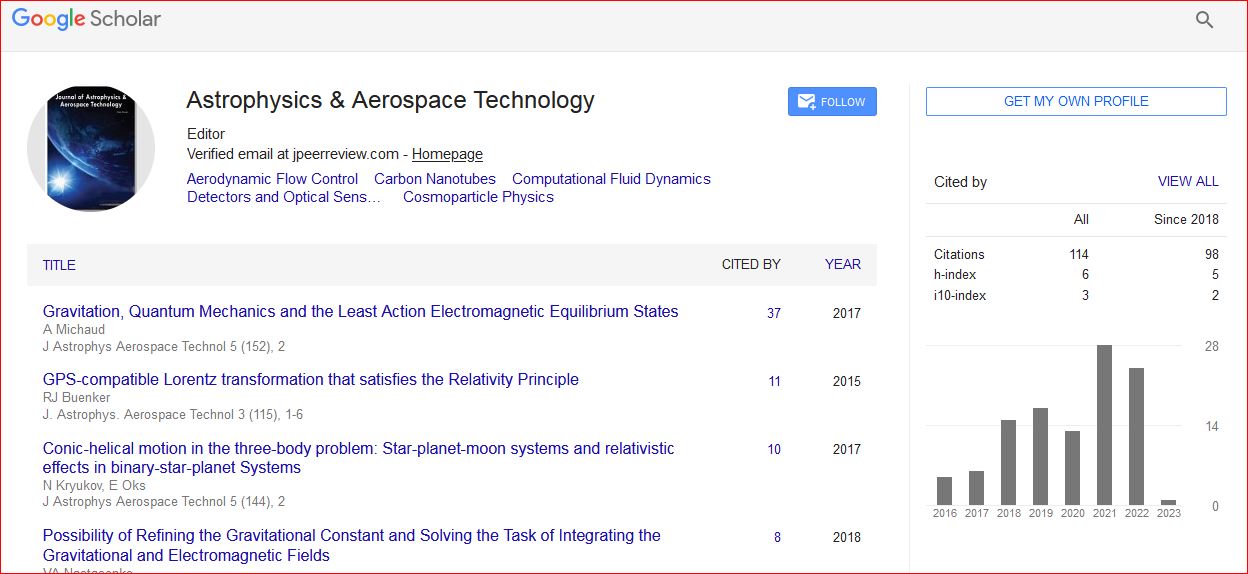
Astrophysics & Aerospace Technology received 114 citations as per Google Scholar report