Commentary - (2025) Volume 9, Issue 3
Received: 01-May-2025, Manuscript No. jchd-26-185686;
Editor assigned: 04-May-2025, Pre QC No. P-185686;
Reviewed: 18-May-2025, QC No. Q-185686;
Revised: 22-May-2025, Manuscript No. R-185686;
Published:
29-May-2025
, DOI: 10.37421/2684-6020.2024.9.242
Citation: Nguyen, David. ”Coronary Heart Disease: Early Detection,
Prevention, and Personalized Care.” J Coron Heart Dis 09 (2026):242.
Copyright: © 2026 Nguyen D. This is an open-access article distributed under the terms of the Creative Commons Attribution License, which permits unrestricted use,
distribution and reproduction in any medium, provided the original author and source are credited.
Coronary heart disease (CHD) represents a profound and persistent global health crisis in the 21st century, often characterized as a silent epidemic due to its insidious progression and extensive societal impact. This article delves into the multifaceted nature of CHD, encompassing its enduring prevalence, the dynamic shifts in risk factors influenced by lifestyle changes and environmental exposures, and the continuous evolution of diagnostic and therapeutic methodologies. The paramount importance of early detection, proactive preventative strategies, and the implementation of personalized treatment plans are highlighted as crucial for mitigating the substantial burden imposed by this disease [1].
Furthermore, a comprehensive review synthesizes the current understanding of novel biomarkers that hold significant promise for the early identification and risk stratification of individuals with CHD. This exploration encompasses proteomic, genomic, and metabolomic approaches, with a particular emphasis on their potential to accurately identify those at elevated risk even before the manifestation of overt clinical symptoms. The seamless integration of these advanced biomarkers into routine clinical practice is posited to be revolutionary in enhancing CHD prevention and management efforts [2].
In parallel, the critical impact of lifestyle interventions on the prevention of CHD is meticulously examined. This investigation focuses on key modifiable behaviors, including dietary habits, regular physical exercise, and smoking cessation. The existing body of evidence strongly supports the considerable efficacy of comprehensive lifestyle modification programs in not only reducing the incidence of cardiovascular events but also in substantially improving the overall quality of life for affected individuals. Consequently, there is an urgent need for a more pronounced public health emphasis on addressing these highly modifiable risk factors [3].
This discourse also delves into the dynamic and evolving landscape of pharmacological therapies specifically designed for the management of CHD. It provides a detailed review of recent breakthroughs and advancements, including novel statins, PCSK9 inhibitors, and emerging anti-inflammatory agents. The discussion elaborates on their distinct mechanisms of action, the outcomes derived from pivotal clinical trials, and their tailored application across diverse patient demographics. The indispensable role of guideline-directed medical therapy is strongly underscored as a cornerstone of effective CHD treatment [4].
The crucial role of interventional cardiology in addressing complex cases of CHD is critically examined. This section centers on the sophisticated percutaneous coronary intervention (PCI) techniques and the utilization of advanced imaging modalities. The paper meticulously discusses the outcomes observed in large-scale clinical trials that have evaluated novel stent designs and supplementary therapeutic approaches for managing complex coronary lesions and high-risk patient cohorts [5].
Moreover, this article addresses the significant, though frequently underestimated, influence of social determinants of health on both the prevalence and the clinical outcomes associated with CHD. It meticulously highlights how socioeconomic status, the accessibility of healthcare services, and environmental exposures collectively contribute to the exacerbation of health disparities observed in cardiovascular diseases. This analysis underscores the imperative for integrated public health initiatives and clinical strategies to address these critical social factors [6].
The nascent yet rapidly advancing field of precision medicine within the context of CHD is explored. This approach emphasizes the crucial integration of genetic information, environmental data, and lifestyle factors to enable the development of highly tailored prevention and treatment strategies. The potential benefits of pharmacogenomics and personalized risk assessment in significantly improving patient outcomes are thoroughly discussed [7].
This paper is dedicated to the long-term management and effective secondary prevention of established CHD. It meticulously reviews the extant evidence supporting the optimal medical therapies, rigorous risk factor control, and comprehensive cardiac rehabilitation programs. The primary objective of these strategies is to substantially reduce the incidence of recurrent cardiovascular events and enhance long-term survival rates in patients diagnosed with CHD [8].
The article critically addresses the alarming increase in the prevalence of CHD among younger populations. It highlights the unique and complex challenges associated with preventing and managing this disease in this specific demographic. Emphasis is placed on the significant role of genetic predispositions, early-onset lifestyle factors, and the growing influence of emerging risk factors such as obesity and diabetes mellitus [9].
Finally, this review meticulously focuses on the often-intertwined psychological and behavioral aspects of CHD. It explores the profound impact that stress, depression, and anxiety can have on disease progression and overall patient outcomes. The critical importance of integrating comprehensive mental health support services within standard cardiac care pathways is strongly emphasized [10].
Coronary heart disease (CHD) remains a formidable global health challenge in the 21st century, frequently described as a silent epidemic due to its asymptomatic progression and widespread impact. This article provides a comprehensive examination of CHD's multifaceted nature, including its persistent prevalence, evolving risk factors such as lifestyle shifts and environmental influences, and advancements in diagnostic and therapeutic strategies. It underscores the critical importance of early detection, preventative measures, and personalized treatment approaches to effectively mitigate the disease's substantial burden [1].
This review synthesizes the current understanding of novel biomarkers essential for the early detection and precise risk stratification of CHD. It elaborates on proteomic, genomic, and metabolomic methodologies, highlighting their significant potential to identify individuals at high risk prior to the onset of clinical symptoms. The successful integration of these biomarkers into routine clinical practice is anticipated to revolutionize the approaches to CHD prevention and management [2].
The profound impact of lifestyle interventions on CHD prevention is thoroughly investigated, with a specific focus on diet, exercise, and smoking cessation. This paper presents compelling evidence supporting the efficacy of comprehensive lifestyle modification programs in reducing cardiovascular events and improving patient quality of life. It strongly advocates for increased public health attention to these modifiable risk factors [3].
This article delves into the rapidly evolving landscape of pharmacological therapies for CHD. It reviews recent advancements in statins, PCSK9 inhibitors, and novel anti-inflammatory agents, discussing their respective mechanisms of action, clinical trial outcomes, and their application in varied patient populations. The paramount importance of adhering to guideline-directed medical therapy is consistently emphasized [4].
The critical role of interventional cardiology in managing complex CHD is explored, with a particular emphasis on percutaneous coronary intervention (PCI) techniques and advanced imaging modalities. The paper discusses outcomes from extensive trials that have evaluated novel stent designs and adjunctive therapies for intricate lesions and high-risk patient groups [5].
This article addresses the substantial, yet often overlooked, impact of social determinants of health on CHD prevalence and outcomes. It elucidates how socioeconomic factors, access to healthcare, and environmental exposures contribute significantly to health disparities in cardiovascular disease, calling for integrated public health and clinical strategies [6].
The article examines the burgeoning field of precision medicine within CHD, focusing on the integration of genetic, environmental, and lifestyle data to personalize prevention and treatment strategies. It highlights the potential of pharmacogenomics and personalized risk assessment to significantly improve patient outcomes [7].
This paper concentrates on the long-term management and secondary prevention of established CHD. It reviews the evidence base for optimal medical therapy, rigorous risk factor control, and cardiac rehabilitation programs aimed at reducing recurrent events and enhancing survival in patients with diagnosed CHD [8].
The article discusses the rising prevalence of CHD in younger populations and the unique challenges associated with its prevention and management in this demographic. It emphasizes the role of genetic predispositions, early lifestyle influences, and emerging risk factors such as obesity and diabetes [9].
Finally, this review directs its focus toward the psychological and behavioral aspects of CHD, investigating the influence of stress, depression, and anxiety on disease progression and patient outcomes. It strongly advocates for the integration of mental health support within comprehensive cardiac care [10].
Coronary heart disease (CHD) is a significant global health concern characterized by its silent progression and widespread impact. Advances in diagnosis and treatment are crucial, with a focus on early detection, preventative measures, and personalized care. Emerging biomarkers, including proteomic, genomic, and metabolomic approaches, are showing promise for early identification and risk stratification. Lifestyle modifications such as diet, exercise, and smoking cessation are vital for prevention and management, supported by robust evidence. Pharmacological therapies are continuously evolving, with advancements in statins, PCSK9 inhibitors, and anti-inflammatory agents offering new treatment avenues. Interventional cardiology plays a key role in managing complex cases through techniques like percutaneous coronary intervention. Social determinants of health significantly influence CHD outcomes, necessitating integrated public health and clinical strategies. Precision medicine, utilizing genetic, environmental, and lifestyle data, aims to personalize care. Long-term management and secondary prevention are critical for reducing recurrent events and improving survival, with a growing concern for CHD in younger populations due to genetic factors and lifestyle influences. Psychological factors like stress, depression, and anxiety are also important considerations, highlighting the need for integrated mental health support.
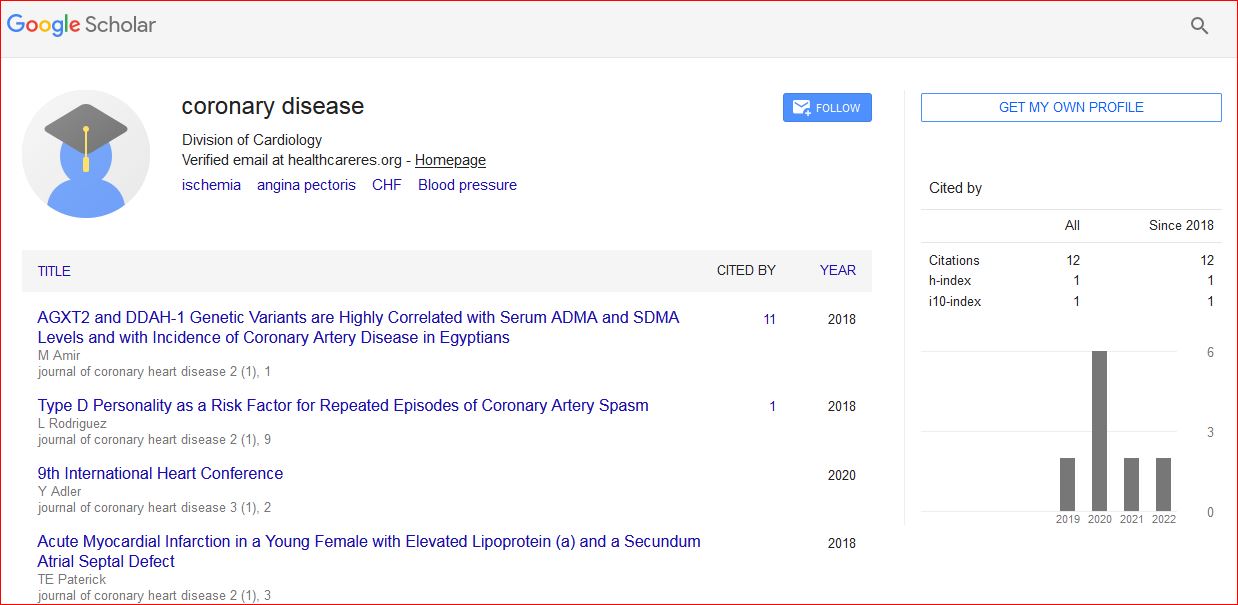
Journal of Coronary Heart Diseases received 15 citations as per Google Scholar report